





















LACE: A New Framework for Advanced Cellular Automata and Artificial Life
By
airesearcher

Front-window bakery material. Catches the eye, delivers the goods.
Summary
The article introduces LACE (Link Automata Computing Engine), a new class of cellular automata that represents an evolution beyond traditional systems like Conway's Game of Life. LACE rules operate on a grid where cells can form links with neighbors, enabling more complex emergent behaviors and artificial life simulations. The author shares their personal journey of fascination with cellular automata and digital physics, inspired by thinkers like Ed Fredkin and Stephen Wolfram, leading to the development of this new computational framework that demonstrates sophisticated emergent patterns from simple local rules.
Key quotes
· 5 pulledI have been thinking about cellular automata ever since I read a fascinating and important book, Three Scientists and Their Gods, during the summer of my sophomore year of college.
This book changed my life. After reading this book ferociously on the drive home from Oberlin college to Boston, for summer vacation, I became obsessed with the idea of digital physics.
I actually had what I can only describe as a kind of epiphany about the nature of reality as computation.
LACE rules running on LACE, the Link Automata Computing Engine platform, which when applied locally on a grid of cells, demonstrates fascinating emergent 'artificial life' behavior.
For readers familiar with the Game of Life (GOL), this is a next-level class of cellular automata.
You might also wanna read

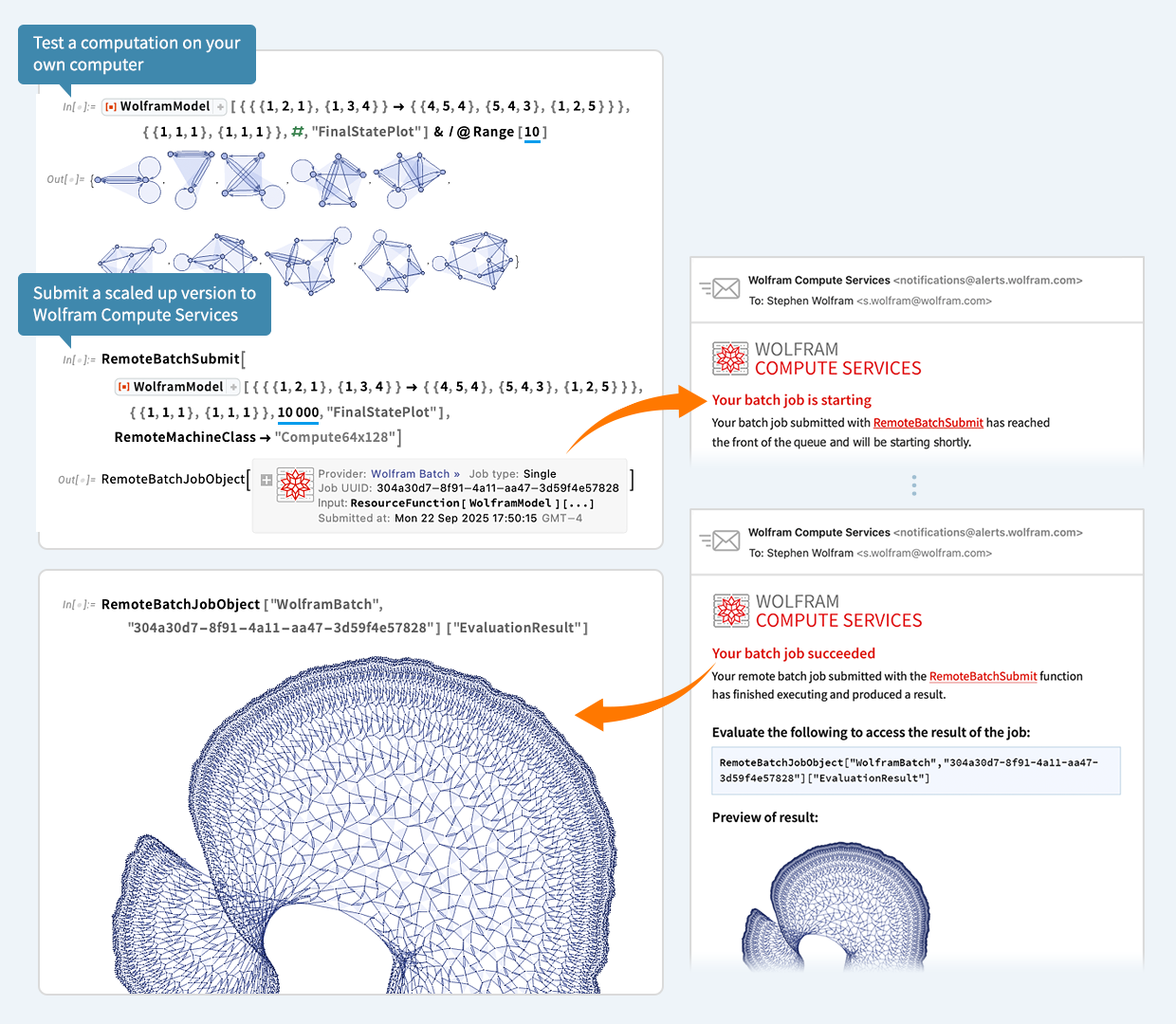
Wolfram Launches Compute Services for Scaling Wolfram Language Computations
Wolfram Research has launched Wolfram Compute Services, a new system that enables users to easily scale up Wolfram Language computations by
 writings.stephenwolfram.com·5mo ago
Running Gemma 4 on a 2016 Xeon Server with No GPU: A Technical Walkthrough
The article describes running Gemma 4 (a 25B-parameter Mixture-of-Experts model) on a severely outdated server with a 2016 Intel Xeon E5-262
 point.free·2h ago
NVIDIA Announces "Hack for Impact" London Event for Autonomous AI Agent Development
NVIDIA is hosting a "Hack for Impact" event in London, challenging participants to build autonomous agentic applications using open-source m
 luma.com·4h ago
Four practical steps to control Azure Foundry token costs for agentic AI workloads
This article provides practical guidance on controlling token costs in Microsoft Azure Foundry, particularly for agentic AI workloads where
 purplefrogsystems.com·5h ago
MerLean-Prover: A Recursive Agent Harness for Lean 4 Theorem Proving Outperforms Baselines
MerLean-Prover is an end-to-end Lean4 theorem prover that replaces 'sorry' declarations with kernel-checkable proofs using three agent types
 arxiv.org·5h ago
Why small pull request policies can backfire on software quality
The article critiques a common software engineering policy that limits pull requests (PRs) to small sizes (e.g., 500 lines, few files). Whil
 apenwarr.ca·7h ago