
























Key PostgreSQL Queries to Detect Silent Database Degradation Early
A technical guide published on DEV Community outlines how PostgreSQL databases can degrade silently without triggering standard monitoring alerts. Common culprits include table bloat from unvacuumed…
Read the full articleYou might also wanna read


Understanding PostgreSQL VACUUM at the Page Level: Dead Tuple Lifecycle and Space Reclamation
Watch a VACUUM cycle with pageinspect, pg_freespace, and pg_visibility: how a dead tuple loses its storage, then its index entry, then its s
 boringsql.com·4d ago
PostgreSQL VACUUM Limitations: Why Indexes Become Bloated and How to Fix Them
PostgreSQL VACUUM cleans tables but leaves indexes bloated. Learn why B-trees fragment and how to fix them properly.
boringsql.com·6mo ago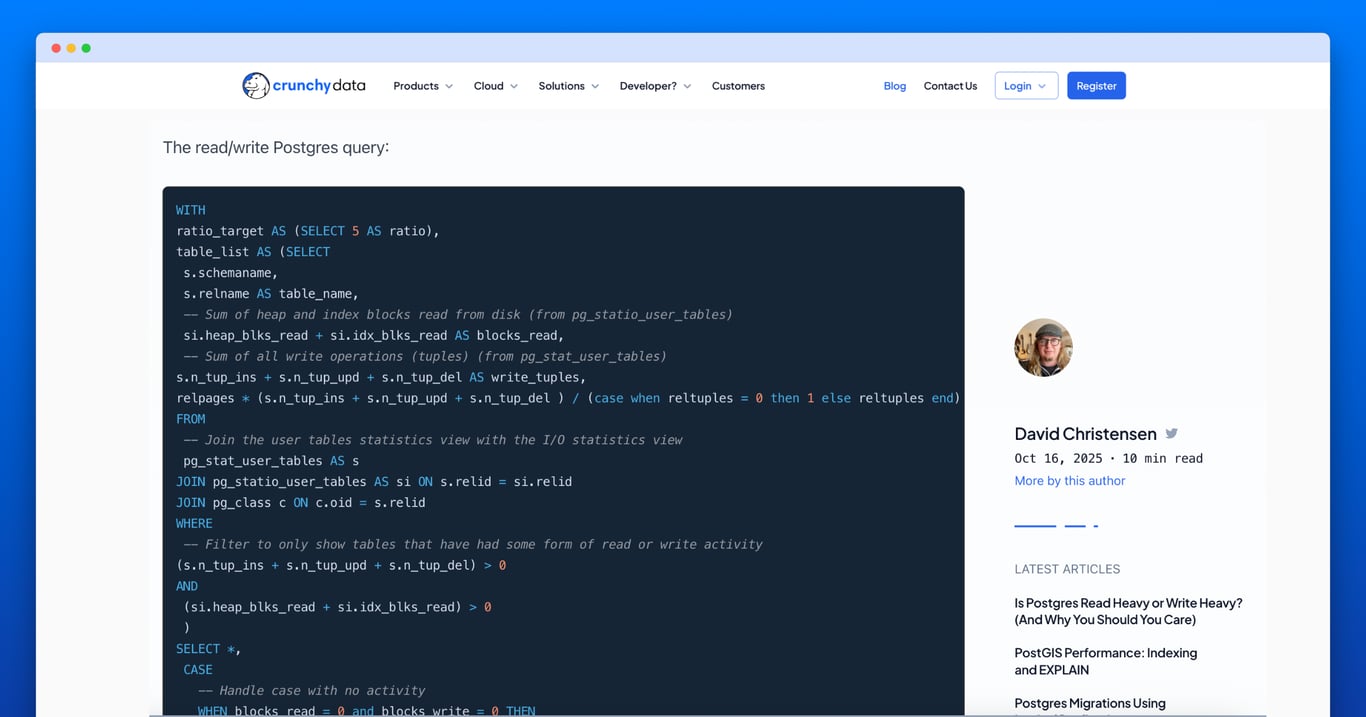
Analyzing PostgreSQL Database Workloads: Read-Heavy vs Write-Heavy Patterns and Optimization Strategies
A query to find out if Postgres is read heavy or write heavy and tips for optimizing Postgres for both read and write workloads.

PostgreSQL work_mem Configuration Pitfalls: How Low Memory Settings Can Cause Catastrophic Outages
My friend Henrietta Dombrovskaya pinged me on Telegram. Her production cluster had just been killed by the OOM killer after eating 2 TB of R
mydbanotebook.org·3mo ago
PostgreSQL Locks: Deadlocks, Object-Level Locks, and Predicate Locks
We've already discussed some object-level locks (specifically, relation-level locks), as well as row-level locks with their connection to ob
 habr.com·7mo ago
PostgreSQL Transaction ID Wraparound Incident: A Production Database Outage Case Study
Learn about transaction ID wraparound in PostgreSQL, which caused a problem for the author.
 sqlservercentral.com·2mo ago
Comments
Sign in to join the conversation.
No comments yet. Be the first.