
























First reported by bsky
Iran holds massive funeral for Supreme Leader Ali Khamenei after Israeli-US bombing
Inferring messages from the Supreme Leader’s funeral
From the article
Inferring messages from the Supreme Leader’s funeral newspress_en Thu, 07/09/2026 - 06:00 Opinion The funeral arrangements in Iran for the late Supreme Leader, Ali Khamenei, were more than religious rites or official ceremonies marking the passing of a political-religious figure; they formed part of a broader effort by the Islamic Republic to restore its authority and prestige after the existential challenges of recent months. The event in the capital, Tehran, served as a big test for the regime in the post-Khamenei era. A close reading of the official tableau—from those in the front rows to those conspicuously absent despite their political weight—suggests that the choreography went far beyond protocol. It revealed shifts in influence and power among the ruling elite and gave early indications as to who may steer the next phase. In this sense, the regime used the funeral to stage a tightly managed political scene. On one level, it sought to demonstrate that it had weathered its most complex and perilous moment since the assassination of the Supreme Leader on 28 February 2026. On another, it tried to signal that a new political chapter was taking shape from the remnants of the old order. Preventing collapse Across 36 years of leadership, Ali Khamenei became the point at which the religious establishment, the security services, the army, the bazaar, and political decision-making converged. The regime’s stability came to depend heavily on his presence, and the continuity of the state became closely tied to his person. For that reason, the gravest challenge after his killing was not merely the choice of a successor, but the need to prevent institutional fracture or collapse. In this context, the funeral ceremonies appeared first as a message directed inward, towards the ruling elite. The regime’s religious, security, economic, and political institutions required reassurance that the reassertion of authority after the Supreme Leader’s death would bring no major surprises—only swift settlements. The system, it implied, would remain intact in essence, with limited adjustments in the centres of command, elevating one faction while sidelining another. Badia Fahs The event was a carefully choreographed projection, but of what and for whom? Amidst the uncertainty, most agree that change is coming Iran Supreme Leader of Iran funeral Ali Khamenei 09 July , 2026 Region Gulf The funeral ceremonies were a message to the ruling elite. The regime's religious, security, economic, and political institutions required reassurance The second message travelled beyond Iran's borders. The procession of the coffin through Shiite cities in Iraq on Wednesday carried political and security implications that exceeded the funerary ritual. Through it, the Iranian regime signalled to its allies in the region that the elder Khamenei's death would not alter strategy or policy. The network of alliances he had built would remain in place. The transfer of leadership to his son appeared to confirm as much. A noticeable absence The 'million-strong' funeral can also be read as a message of allegiance. The vast crowds were intended to demonstrate a deep bond between the nation and the imam, between the public and the state built around the Velayat-e Faqih (Guardianship of the Jurist) system of governance, and to counter the notion of a rupture between state and society. Yet for all these messages and their layered meanings, the absence of the new Supreme Leader, Mojtaba Khamenei, from his father's funeral—and from his wife's the previous day—casts doubt on the reassurance the regime sought to project, and on the stability of his image both inside Iran and beyond. Had the new Supreme Leader appeared in public or addressed the nation through a video or audio message (as Hezbollah's leaders do), it would have ended speculation by conveying that the regime had regained its footing with an image of authority similar to that enjoyed before 28 February. Instead, his continued absence from public view, and the reliance on written messages, suggests that the regime is not being fully candid about his condition. It is already known that he was badly injured in the bombing that killed his father and wife, and his invisibility hints at a hidden, unsettling truth. Masking anxiety Seen this way, the regime appears to have relied on the million-strong crowd because it is the only spectacle currently capable of compensating for the absence of political certainty. When personalist regimes turn to mass displays and costly ceremonies, they are often seeking less to project strength than to mask anxiety about their political future. The funeral marked the end of one political phase in Iran and the beginning of another. The new phase may not be stable, but filled with surprises and changes, both at home and abroad. Despite the momentum the funeral gave the regime, it did not erase the deeper truth: if the Islamic Republic wishes to stabilise itself, or even endure, it must first confront its governing mentality, rather than sending messages in every direction. 09 July , 2026 story cover Off Label No label Promotion Article Off Show on issuepdf page Off
Continue reading on مجلة المجلة | مجلة العرب الدوليةYou might also wanna read

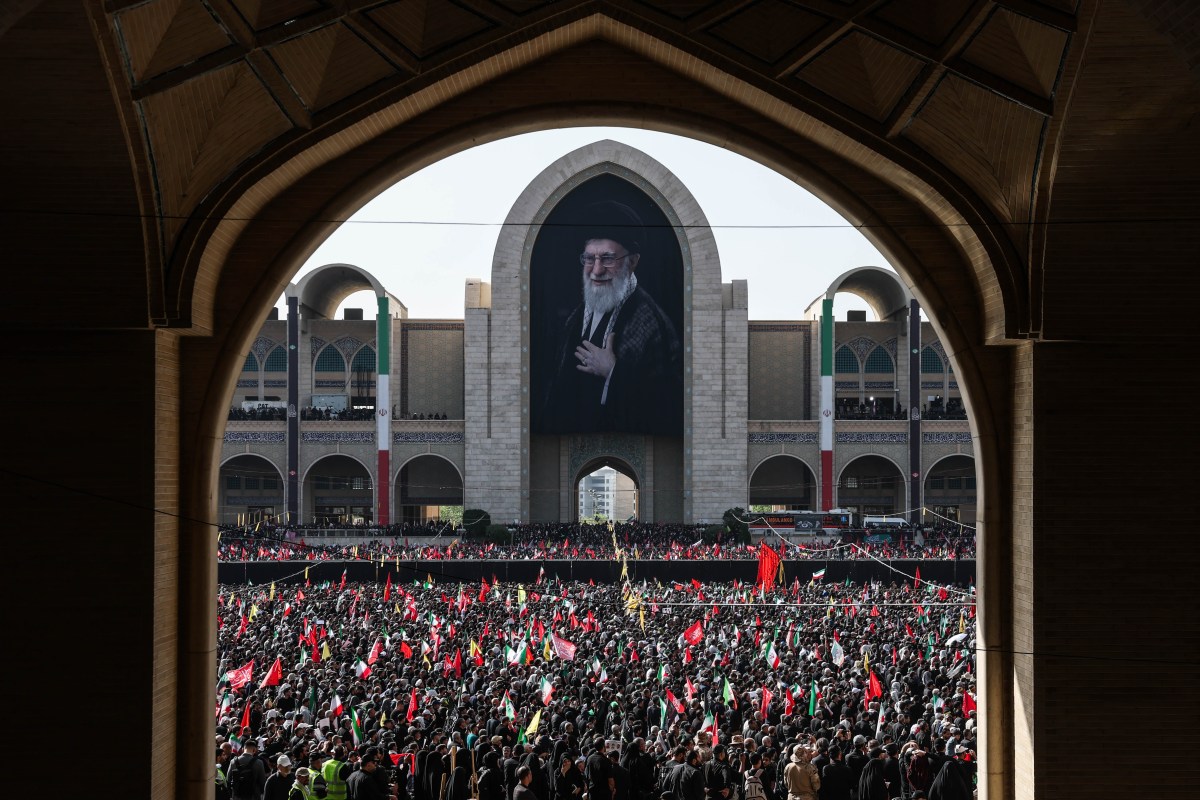
Funeral for Iran's Supreme Leader Khamenei Becomes Diplomatic Flashpoint as U.S.-Iran Talks Loom
Iran has begun dayslong funeral ceremonies for Supreme Leader Ayatollah Ali Khamenei, drawing massive gatherings and heightened security. Pr
 newsweek.com·4d ago
Iran begins a procession through Tehran for Supreme Leader Ayatollah Ali Khamenei's funeral
The Independent·3d ago
How Iran Is Trying To Turn A Funeral Into A Vote Of Confidence
GlobalSecurity·2d ago

Iran prepares state funeral of Khamenei as a declaration of victory
Ara·6d ago

Crowds gather as six-day funeral for former Iranian supreme leader begins
The Guardian·5d ago

Iran says millions expected at funeral for former supreme leader
NBC News·5d ago
Comments
Sign in to join the conversation.
No comments yet. Be the first.