
























camdl: A Domain-Specific Language for Compartmental Infectious Disease Modeling
Summary
camdl is a domain-specific language (DSL), simulation runtime, and statistical inference stack designed for compartmental infectious disease models. It allows researchers to express compartmental models intuitively, similar to writing math on a whiteboard. Inspired by Stan, camdl supports multiple runtime backends (ODE, chain-binomial, Gillespie) and various inference methods (iterated filtering, Particle Marginal Metropolis–Hastings, Particle Gibbs with Ancestral Sampling). Models are written in terms of compartments, transitions, and rates.
Source

 Twitter / Xcamdl: A Domain-Specific Language for Compartmental Infectious Disease Modelinggithub.com
Key quotes
· 3 pulledThe goal of camdl is to make writing compartmental models easy
the mechanics of a model are expressed in the camdl DSL just as you'd write the math on a whiteboard
Inspired by Stan, camdl supports multiple runtime backends (ODE, chain-binomial, Gillespie) and inference methods
You might also wanna read

Vera: A programming language designed for LLMs with compile-time verification and no variable names
Vera is a novel programming language specifically designed for large language models (LLMs) to write. It eliminates variable names in favor
GitHub·2mo ago
MARRVEL-MCP: A natural-language interface enabling LLMs to use 44 genomic tools for rare disease variant interpretation
Everton et al. introduce MARRVEL-MCP, a natural-language interface that allows large language models (LLMs) to access 44 genomic tools for r
CRML: A Declarative Language for Cyber Risk Modeling as Code
CRML (Cyber Risk Modeling Language) is an open, declarative language for writing cyber risk as code. It provides a YAML/JSON format for desc
 Product Hunt·4mo ago
Marko: A Declarative HTML-Based Language for Building Web Applications
Marko is a declarative, HTML-based programming language designed for building web applications with a focus on performance and developer exp
 markojs.com·7mo ago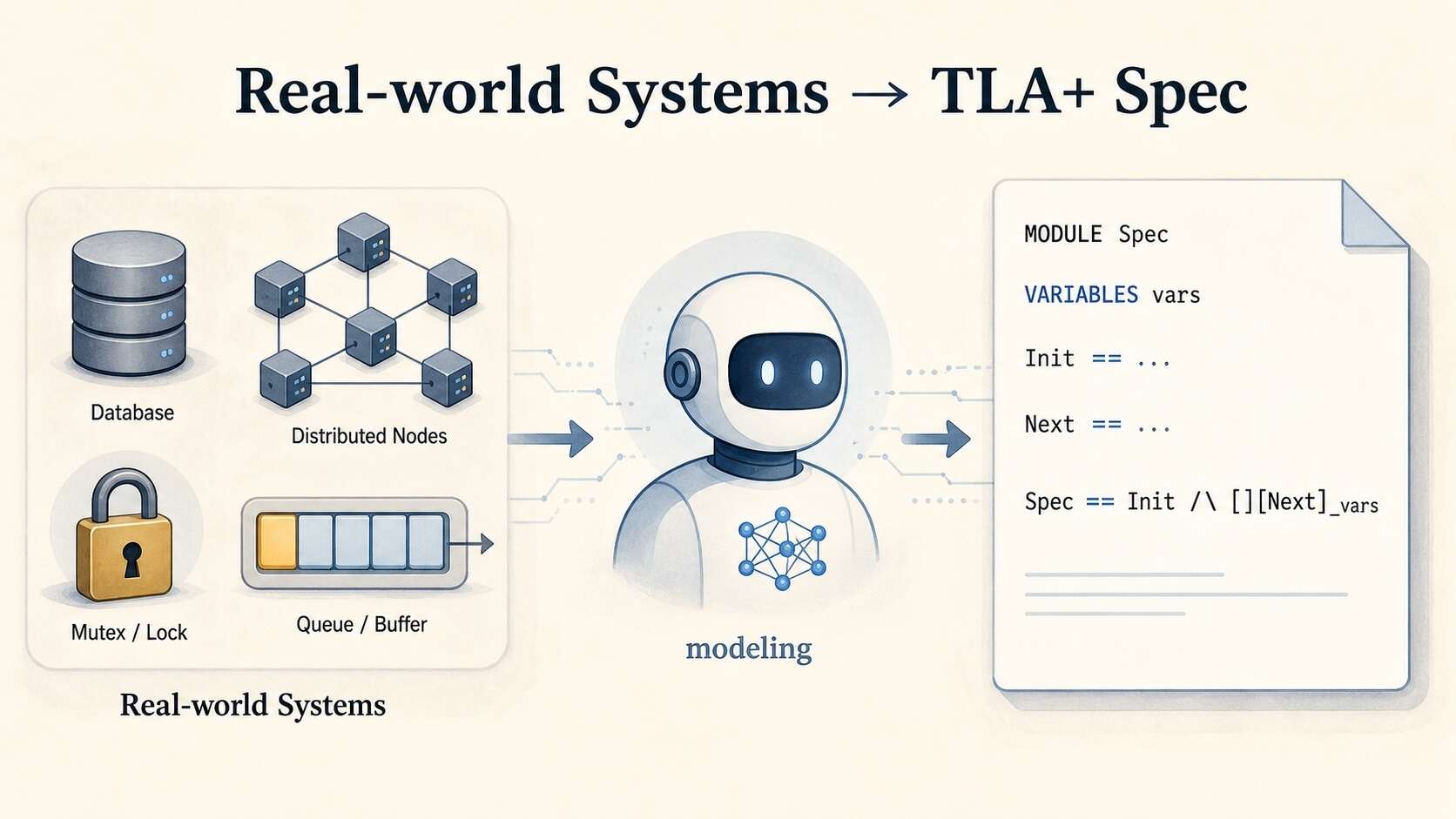
Evaluating LLMs for TLA+ System Modeling: The Specula Team's Experience with Claude and Raft
The Specula team evaluates LLMs (specifically Claude) on their ability to model real-world systems using TLA+, a formal specification langua
 ACM SIGOPS·1mo ago
D Programming Language: Combining Multiple Paradigms for Fast, Scalable Code
The article presents D as a programming language that combines multiple programming paradigms harmoniously, offering classic polymorphism, v
 dlang.org·4mo ago
Comments
Sign in to join the conversation.
No comments yet. Be the first.