
























English Grammar Guide: Present Progressive vs. Simple Present Tense
By
Lindsey Lange-Abramowitz, M.A.
Summary
A detailed grammar guide explaining the English present progressive (present continuous) tense — how to form it (am/is/are + verb-ing), when to use it (ongoing actions, temporary situations, future plans, repeated actions with 'always'), and how it differs from the simple present tense (habits, permanent states, general truths). The article covers structure, usage rules, stative verbs that don't take progressive forms, and provides numerous examples and practice exercises.
Source

 DuolingoEnglish Grammar Guide: Present Progressive vs. Simple Present Tenseduolingo.com
Key quotes
· 3 pulledThe present progressive is a frequently used tense in English.
Sentences in the present progressive, also called the present continuous, are formed with am, is, or are (depending on the subject) followed by the present participle, which is created by adding -ing to the base form of the verb.
If you *are learning* English, then this guide to the present progressive is for you!
You might also wanna read

Exploring Grammatical Diversity: The Usage of 'Try' in North American English
The article discusses the grammatical diversity in North American English, focusing on the usage of 'try' followed by different phrases (nou
ygdp.yale.edu·11mo ago
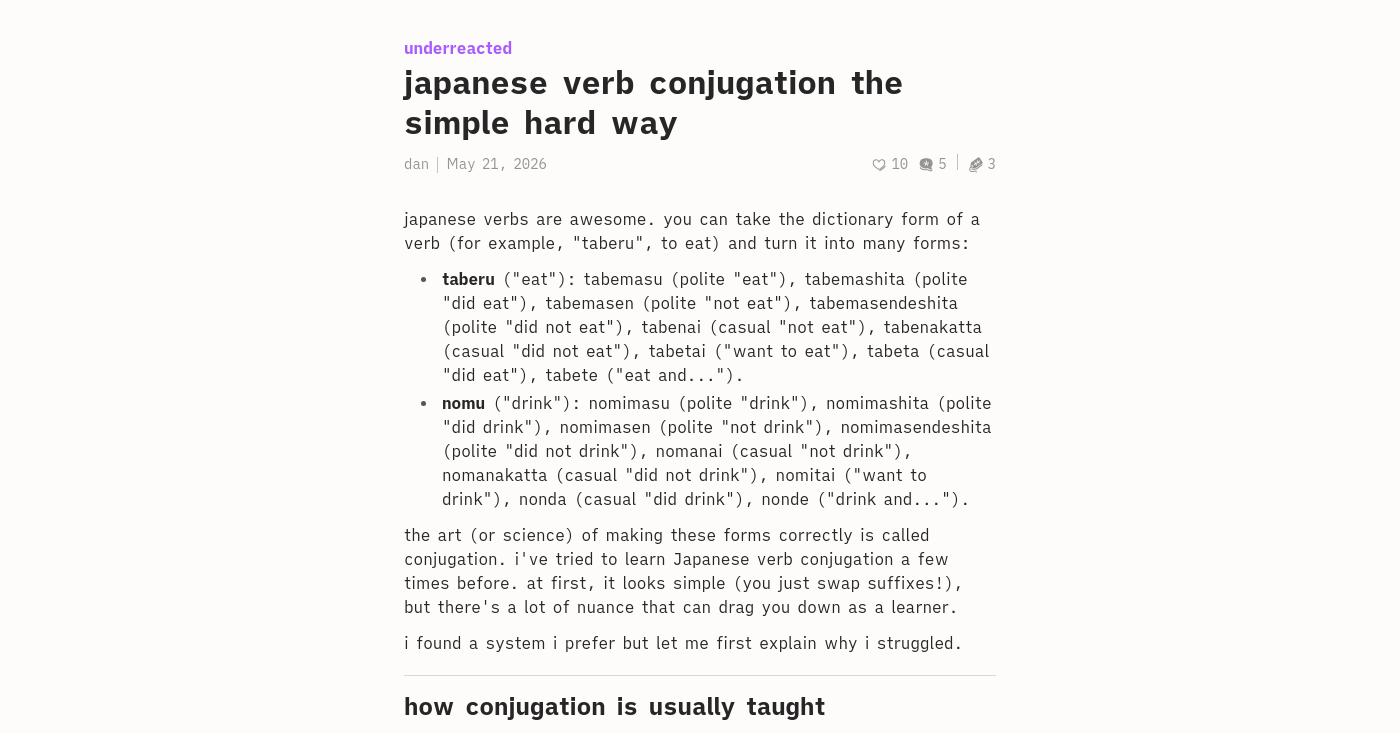
Japanese Verb Conjugation: A Comprehensive Guide to Transforming Dictionary Forms
A detailed guide to Japanese verb conjugation, explaining the patterns and rules for transforming dictionary-form verbs into various forms i
 underreacted.leaflet.pub·16d ago
Four Daily Practices That Transform Work and Life
The article explores a personal daily rhythm built around four verbs—learn, reflect, apply, and prepare—as a quieter, more sustainable alter
 opuslabs.substack.com·11mo ago
Comments
Sign in to join the conversation.
No comments yet. Be the first.