
























GrapheneOS criticizes Apple and Google's expansion of hardware-based attestation and Privacy Pass
Apple and Google are gradually expanding their use of hardware-based attestation. They're convincing a growing number of services to adopt it. Google's Play Integrity API and Apple's App Attest API…
Read the full articleYou might also wanna read


GrapheneOS: A privacy-focused, open-source mobile OS with Android app compatibility
GrapheneOS is a security and privacy focused mobile OS with Android app compatibility.
 grapheneos.org·1mo ago
GrapheneOS Frequently Asked Questions: Comprehensive Reference Guide
Answers to frequently asked questions about GrapheneOS.
grapheneos.org·21d ago
GrapheneOS release notes and installation guide
Official releases of GrapheneOS, a security and privacy focused mobile OS with Android app compatibility.
grapheneos.org·17d agoBest Android Alternatives in 2026: LineageOS vs /e/OS vs GrapheneOS
Looking for an Android alternative? Compare LineageOS, /e/OS, and GrapheneOS to improve privacy, extend device life, and reduce reliance on

NVIDIA and Apple Partner on Confidential Computing for Apple Intelligence Cloud Inference
NVIDIA GPUs to support server-side inference for Apple Intelligence, announced at WWDC.
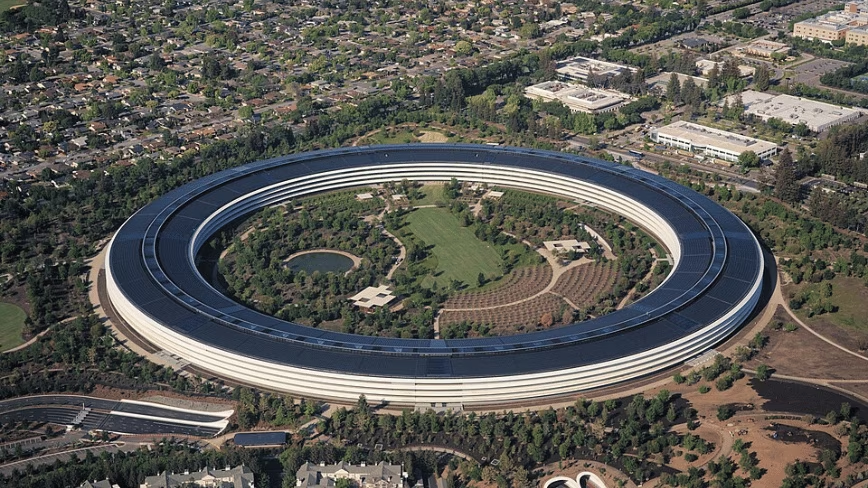
Apple rebuilds Siri on Google's Gemini and Nvidia GPUs, explains privacy safeguards at WWDC 2026
Apple’s most important AI announcement at WWDC 2026 was not a feature. It was an architecture. The rebuilt Siri runs on a custom 1.2-trillio
 thenextweb.com·1mo ago
Comments
Sign in to join the conversation.
No comments yet. Be the first.