
























GW231123: A Binary Black Hole Merger with Total Mass 190–265 M⊙
A. G. Abac et al 2025 ApJL 993 L25 The LIGO collaboration has discovered a remarkable pair of merging black holes; with estimated masses of 137 and 101 solar masses, these black holes appear to lie…
Read the full articleYou might also wanna read

LIGO Observatories Detect Most Massive Black Hole Merger in History
Gravitational waves from massive black holes challenge current astrophysical models
caltech.edu·1y ago
Astronomers Discover Massive Black Hole Merger Defying Expectations
The powerful merger, designated GW231123, produced an extremely large black hole about 225 times the mass of our Sun.
gizmodo.com·1y ago
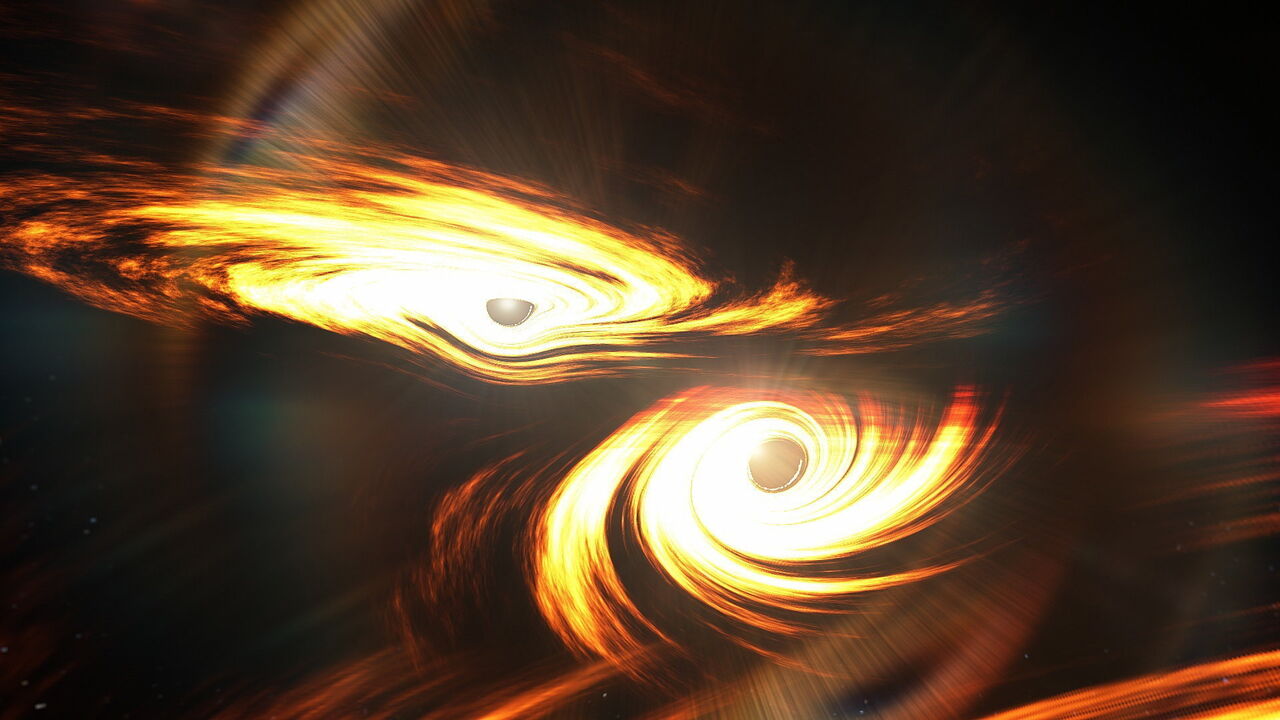
LIGO detects gravitational waves from black hole merger 1.3 billion light-years away
They make the universe’s most extreme gravitational laboratories
 economist.com·22h ago
Study proposes primordial black hole origin for gravitational wave event GW231123
GW231123 defies our best models of stellar collapse, hosting two black holes that shouldn't exist. A new paper proposes a radical solution:
 astrobites.org·26d ago
Study Suggests Most Black Hole Mergers Occur in Triple Star Systems
With hundreds of pairs of merging black holes now detected via gravitational waves, researchers can investigate the sites of black hole merg
 AAS Nova·1mo ago
Study Suggests Most Black Hole Mergers Occur in Triple Star Systems
With hundreds of pairs of merging black holes now detected via gravitational waves, researchers can investigate the sites of black hole merg
aasnova.org·1mo ago
The Pair Instability Mass Gap: Why Some Stars Are Too Massive to Form Black Holes
Some stars are too big to make black holes.
 three-alpha.space·9d ago
Comments
Sign in to join the conversation.
No comments yet. Be the first.