
























Synthesis of LLM Agent Failures: A Unified Taxonomy of Tool-Use, Planning, and Reasoning Limitations
By
[Submitted on 7 Jul 2026]
Summary
This paper synthesizes 27 benchmark, taxonomy, and audit papers (2023-2026) spanning 19 distinct benchmarks into a unified taxonomy of LLM agent limitations. It identifies six failure clusters: (1) tool invocation and parameter-level errors, (2) planning and constraint-satisfaction failures, (3) long-horizon degradation from context accumulation, (4) multi-agent coordination failures, (5) safety and security failures, and (6) measurement validity problems. Key findings include that failures compound nonlinearly with task length, strong sub-task performance doesn't guarantee end-to-end success, and additional scaffolding doesn't consistently improve reliability.
Source

 Twitter / XSynthesis of LLM Agent Failures: A Unified Taxonomy of Tool-Use, Planning, and Reasoning Limitationsarxiv.org
Key quotes
· 3 pulledTo our knowledge, this is the first synthesis that integrates evidence across tool use, planning, long-horizon reasoning, multi-agent coordination, safety, and measurement validity into a single, unified taxonomy of LLM agent limitations.
Across the literature, we find that failures compound nonlinearly with task length, that strong performance on individual sub-tasks does not reliably translate into end-to-end success, and that additional scaffolding does not consistently improve reliability.
Substantial progress has been demonstrated in single-turn tool use, short-horizon web navigation, and narrowly scoped coding tasks.
You might also wanna read


Comprehensive Survey of Reasoning Failures in Large Language Models
This article presents a comprehensive survey of reasoning failures in Large Language Models (LLMs), introducing a novel categorization frame
arxiv.org·4mo ago
Study Reveals "Constraint Decay" in LLM Agents for Backend Code Generation Under Structural Requirements
This paper presents a systematic study on how LLM agents handle structural constraints in multi-file backend code generation. The authors in
arxiv.org·1mo ago
Advancing Agent Architectures: Beyond Shallow LLM Implementations
The article discusses the limitations of simple agent architectures using LLMs (Large Language Models) and introduces solutions like plannin
 blog.langchain.com·11mo ago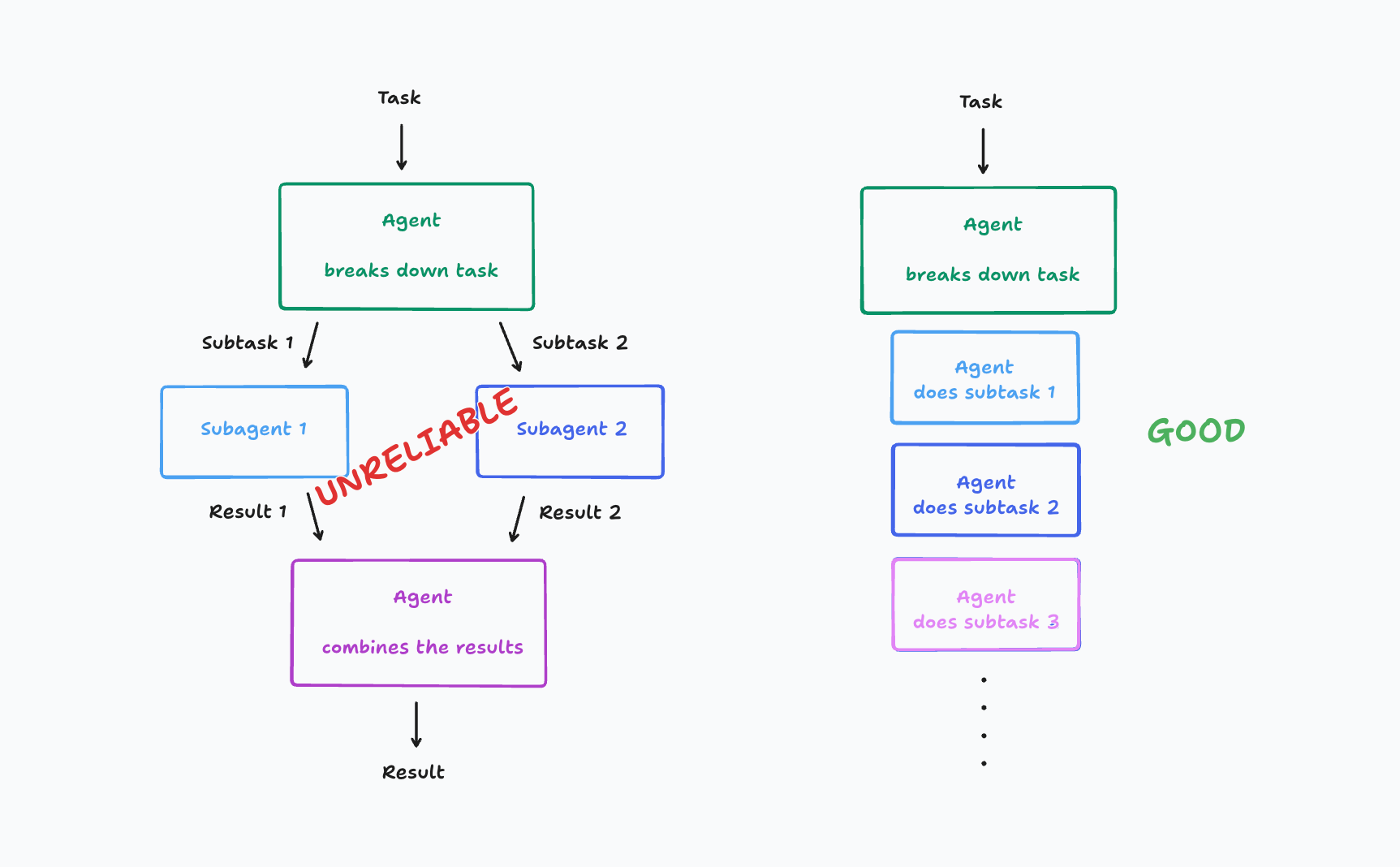
Principles for Effective LLM Agent Development: Avoiding Multi-Agent Pitfalls
The article critiques current LLM agent frameworks and proposes principles for building effective agents based on the author's practical exp
 cognition.ai·10mo ago
New Benchmark Reveals High Rates of Outcome-Driven Constraint Violations in Autonomous AI Agents
Researchers introduce a new benchmark for evaluating autonomous AI agents' safety, specifically focusing on outcome-driven constraint violat
arxiv.org·4mo ago
Critical Analysis of LLM Limitations in Software Development
The article critiques the limitations and problems with Large Language Models (LLMs) and generative AI, using a personal experience with a n
 deobald.ca·4mo ago
Comments
Sign in to join the conversation.
No comments yet. Be the first.