
























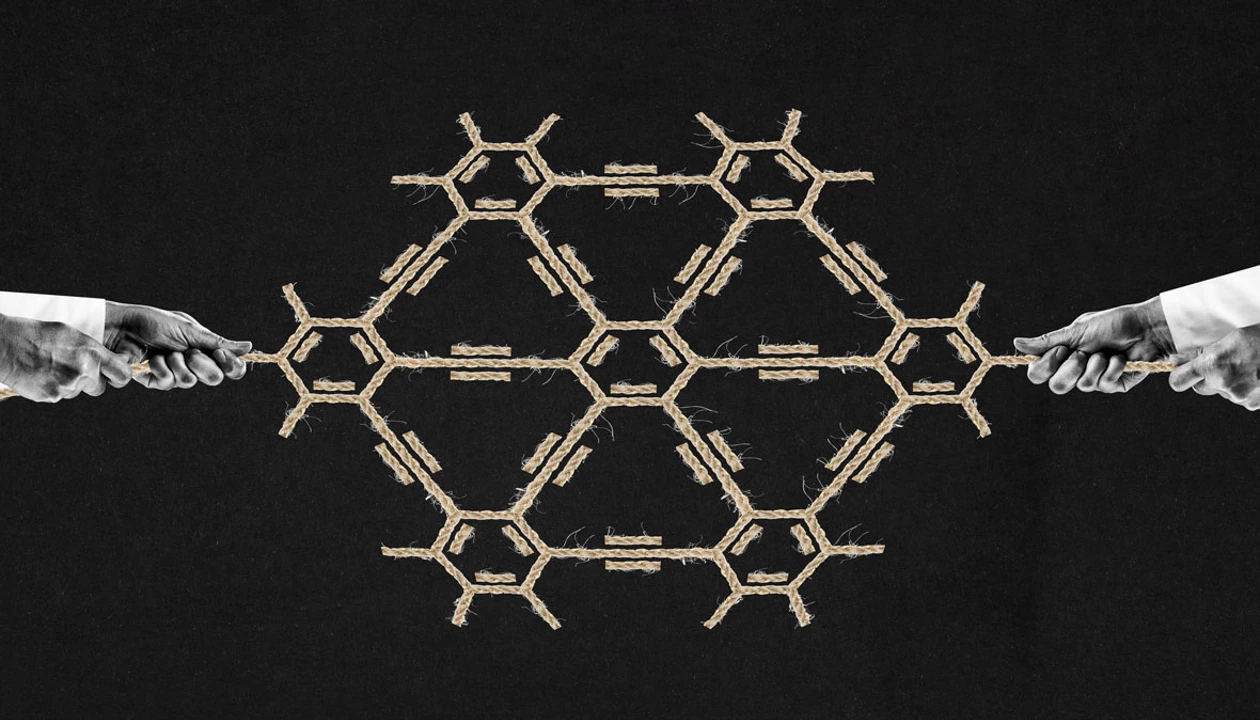
Professional rivalries and retractions hinder graphyne research progress
By
Dalmeet Singh Chawla, special to C&EN
Summary
This article explores the contentious scientific landscape surrounding graphyne, a promising carbon material. It centers on organic chemist Valentin Rodionov, who rejected a paper during peer review that had previously caused him significant personal and professional distress. The piece delves into how professional rivalries, academic gatekeeping, and interpersonal conflicts within a small, insular field are impeding progress on graphyne research. It examines the broader implications of retractions, bad blood between chemists, and how these dynamics slow down scientific advancement for a material with substantial potential.
Source
 bskyProfessional rivalries and retractions hinder graphyne research progresscen.acs.org
Key quotes
· 3 pulledValentin Rodionov, an organic chemist at Case Western Reserve University, recently rejected a paper he was peer-reviewing. This review was not his first encounter with the study. It had already caused him a lot of heartache.
Professional rivalries in an insular field impede progress for a promising new material
The study had already caused him a lot of heartache.
You might also wanna read


Reflections on 2024 Bio-ML Predictions: Generative Chemistry and Molecular Dynamics Challenges
The article reflects on the author's 2024 predictions about bio-ML (biological machine learning) from a 2026 perspective, focusing on genera
 owlposting.com·5mo ago
Single-crystalline twelve-connected nanographene-based covalent organic frameworks expand reticular chemistry complexity
This article reports the design and synthesis of single-crystalline twelve-connected nanographene-based covalent organic frameworks (COFs),
 go.acs.org·3d ago
Two Decades After Discovery: Assessing the Commercial Reality of Graphene
This article examines the current state of graphene commercialization two decades after its discovery at the University of Manchester in 200
 theguardian.com·8mo ago
OpenAI and Molecule.one demonstrate GPT-5.4-powered AI chemist improving medicinal chemistry reactions
OpenAI and Molecule.one demonstrate a near-autonomous AI chemist using GPT-5.4 that successfully improved a challenging reaction in medicina
 openai.com·12d ago
447 TB/cm² at zero retention energy – atomic-scale memory on fluorographane

Atomically precise carbon structure fabrication demonstrated using inverted-mode STM mechanosynthesis
Researchers demonstrate atomically precise mechanosynthesis of carbon structures on a hydrogen-passivated Si(100) surface using inverted-mod
 arxiv.org·1mo ago
Comments
Sign in to join the conversation.
No comments yet. Be the first.