
























From Quill to Code- George Washington Debates the Patent Future of Artificial Intelligence on America’s 250th Birthday
From the article
As America celebrates its 250th year, the pulse of innovation that animated the Founders beats louder than ever. From the first patent debates to today’s courtroom clashes over artificial intelligence, George Washington’s legacy as a mill owner, pragmatic leader, and founding architect of the U.S. patent system remains strikingly relevant. Drawing on Washington’s own letters and historic drive for progress, we confront a question that now defines our technological era: When a machine surpasses its maker, who gets to claim the spark of invention, the human or the machine? Imagine a frosty December morning in 1790 in Philadelphia. President George Washington—equal parts statesman, tinkerer, and entrepreneur—stands before Oliver Evans’ astonishing automaton . This isn’t just another machine: it’s an engineering leap, grinding grain into superfine flour at a speed no human crew could match, demanding barely a touch from its operators. When Washington signs the third U.S. patent for the Evans system, he’s not just endorsing invention—he’s witnessing a technological revolution poised to transform his own fortunes and the young nation’s future. Evans’s mill was, by 18th-century standards, an automaton—a machine that could outwork skilled hands, deliver better results, and do it all with mechanical precision. Washington saw it with his own eyes and recognized its potential. Washington mill was an important source of his income as he boasted in an April 12, 1785, letter to Robert Lewis & Sons, that “my Mill [which did not at that time use the Evans system] has the reputation of turning out superfine flour of the first quality: it commands a higher price in this country and the West Indies, than any other.” Nonetheless, Washington, ever the practical visionary, purchases a patent license in 1791 and upgrades his gristmill at Mount Vernon. He sends his millwright, William Ball, to inspect a neighboring Evans system first. Then two of Evans’s brothers travel to Mount Vernon to oversee the upgrade themselves. Evans’s invention was not just an upgrade; it was Washington’s ticket to the cutting edge of quality and innovation. Washington had signed the Patent Act of 1790 into law on April 10, 1790. Under that Act, the President was required to personally sign each patent granted. Washington did so for more than 150 patents during his presidency. The first went to Samuel Hopkins of Philadelphia for a new process to make pot ash and pearl ash. The second went to a Boston candlemaker, Joseph Stacey Sampson, for a new method to aid in the manufacturing of candles. The third went to Oliver Evans for his automated mill. Fast-forward to 2026: The tools have changed, but the changes brought by innovation are ever more astonishing. Today, the “millwright” is replaced by something far stranger—a machine that thinks. AI systems now draft legal briefs, design new drugs, and compose symphonies in the blink of an eye, achieving feats that would have left even Washington speechless. As we celebrate the Semiquincentennial, the legal world faces a dilemma Washington never could have imagined: When the automaton outpaces its maker, who truly deserves the title of inventor— the human or the machine? Let’s channel Washington’s own words as we navigate today’s thorniest patent puzzles, as the questions that once kept the Founders up at night now reverberate through every courtroom and innovation lab in the age of AI. When Evans built the first automaton: The AI parallel Evans’s automated mill was the 18th-century version of AI. Evans’ described his mill as “a flour mill, which should take the grain from the wagon, and carry it through all the operations necessary to manufacture it into superfine flour…without the aid of manual labor in the attendance[.]” The mill thus became a relentless mechanical operator, replacing skilled millers one job at a time, and yet always remaining a tool, never a master. Evans’s contraption ran faster, smoother, and more profitably than any human crew. In the eyes of the law, it was revolutionary, but it still needed a human mind to claim its place in the patent record. No one in 1790—not Washington, not Thomas Jefferson, not even Evans himself—suggested that the mill should be named the inventor. The mill was the product; Evans was the inventor . For the founding generation, that distinction was self-evident. Fast-forward to our own century: In 2022, the Federal Circuit confronted the same question—except the “mill” was a cutting-edge AI. Thaler v. Vidal : “The task begins and ends with the statute” In Thaler v. Vidal (Fed. Cir. 2022) , Stephen Thaler tried to name his AI DABUS (“Device for the Autonomous Bootstrapping of Unified Science”), as sole inventor on two patent applications. The United States Patent and Trademark Office (USPTO) said “no,” and the Federal Circuit affirmed—with logic that George Washington would have recognized across the centuries. The court explained that its task “begins—and ends—with consideration of the applicable definition” in the Patent Act. Congress used personal pronouns in 35 U.S.C. § 115—“himself” and “herself”—to describe an inventor. Those pronouns, the court reasoned, refer to natural persons . An AI system, however sophisticated, is not a “himself” or a “herself.” Accordingly, the Patent Act requires a human being. For Washington, who personally signed every early patent, the outcome would have been obvious: his mill didn’t sign its own patent—Oliver Evans did. The harder question: AI as an extraordinarily powerful tool The Thaler case was the easy part. But what happens when AI acts as a tool so powerful it blurs the line between creator and creation? This is a dilemma that looms over the USPTO. To tackle this dilemma, the USPTO issued its first guidance on AI-assisted inventorship in 2024, analyzing whether a human made a “significant contribution” to the invention. By late 2025, the rule was even clearer: AI is a tool, like a flask or a database. No matter how clever, a generative AI can’t sign the dotted line as an inventor—just as Evans’s mill couldn’t. The 2025 rules couldn’t be plainer: an AI cannot be listed as an inventor in any shape or form. Yes, AI sometimes can do things that, if done by a human, can seem to involve inventorship. But clever conveyor belts never kept Evans from being an inventor on his patent, and clever code won’t do it for inventors now. The critical question isn’t whether the AI achieved something remarkable: it’s whether a natural person made a genuine, independent contribution to the conception of the invention. Washington nailed it in 1790, and the USPTO echoed him in 2025: patents are for “the exertions of skill and genius”—the kind of spark that only human minds can ignite. The Copyright Parallel: Thaler v. Perlmutter Courts have spoken with similar unity in copyrights. Thaler also filed for copyright registration of an AI-generated image called “A Recent Entrance to Paradise” that was purportedly created entirely by DABUS. The U.S. Copyright Office rejected it. The U.S. District Court for the District of Columbia affirmed in 2023, writing that “[h]uman authorship is a bedrock requirement of copyright.” The D.C. Circuit affirmed that ruling in 2025. On March 2, 2026, the Supreme Court denied certiorari, leaving those rulings intact and Thaler’s appeals exhausted. In January 2025, the U.S. Copyright Office provided guidance for applicants seeking protection of works that include AI-generated content, requiring that applicants show that there was “sufficient human control over the [work’s] expressive elements.” Courts have ruled consistently: Intellectual property requires a human in the loop. However, that doesn’t mean the fight is over. New cases, like Allen v. Perlmutter (D. Colo.), where the plaintiff shaped an AI image through hundreds of prompts, may provide guidance as to what counts as “sufficient human control.” What the Semiquincentennial teaches us Two and a half centuries ago, the Founders—farmers, lawyers, dreamers—made protecting human creativity a bedrock American value. In 1788, George Washington wrote Lafayette , “I hope, some day or another, we shall become a storehouse and granary for the world.” That ambition became law with the Patent Act of 1790. For Washington, innovation was a human pursuit fueled by “skill and genius,” and the patent system was designed to reward those who dared to not only invent, but also shared their inventions. Today, AI is the Evans mill on overdrive—an engine that supercharges what humans can achieve. A researcher with AI can now do a decade’s work in a month. The law’s answer: it’s still the human who guides and shapes the result that stands as inventor. Evans didn’t split his patent with his machinery, and neither should we. But even the Evans analogy has its limits, and the law is catching up. The USPTO now admits that AI can sometimes mimic inventorship so closely it’s hard to tell the difference. No court has yet drawn a bright line on what’s “enough” human input. That boundary once again will be defined by Congress or the courts, just as Washington and his peers did for their own era, albeit in the context of more complicated politics and markets. For example, our legislative and judiciary bodies must further consider how—and whether—to protect American inventors facing global competition. Practical guidance for innovators in 2026 For practitioners and companies navigating this landscape today, current law counsels the following: Document human contributions with precision. The USPTO’s 2025 Revised Inventorship Guidance requires clear evidence that a natural person made a genuine contribution to the conception of the claimed invention—not merely that a human set the AI in motion. Detailed contemporaneous records of human reasoning, creative direction, and judgment that shaped the AI’s output are essential to establishing and defending inventorship. Likewise, the U.S. Copyright Office’s Guidance recommends applicants include a detailed statement of their human contributions when seeking copyright protection for works that include AI-generated elements. Treat AI as a sophisticated tool, not a collaborator. Under current law, an AI system occupies the same legal category as a centrifuge or a mass spectrometer. That AI can explain its output in natural language does not change its status. An AI system is the Evans mill, not Oliver Evans. Prepare for doctrine to evolve. The Supreme Court’s denial of certiorari in Thaler v. Perlmutter settled the current rule but wrote no new law on where the human contribution threshold falls. Future USPTO guidance may further refine the “significant contribution” standard. Washington signed the first American patent law with the pragmatism of a farmer who’d just souped up his own mill. Protecting human ingenuity wasn’t just nice; it was necessary for survival. The fledgling Republic had to invent, build, and create to escape foreign shadows. Two hundred and fifty years later, the law is drawing the same line Washington would have drawn—no translation needed: inventors are people. Tools—no matter how miraculous—are not. As Washington stated during his First Annual Message to Congress on January 8, 1790: “I cannot forbear intimating to you the expediency of giving effectual encouragement . . . to the [human] exertions of skill and genius.”
Continue reading on The National Law ReviewYou might also wanna read


New Google Ad Imagines America's 'Declaration of Independence' Written With AI Help
Slashdot·3d ago

New Google commercial imagines a Declaration of Independence written with help from AI
techcrunch.com·4d ago
New Google commercial imagines a Declaration of Independence written with help from AI
TechCrunch·4d ago

Google ad depicting founding fathers using AI to write Declaration of Independence draws criticism
A critical review of a Google Workspace commercial that imagines the founding fathers using Gemini AI and collaboration tools to draft the D
 The Verge·3d ago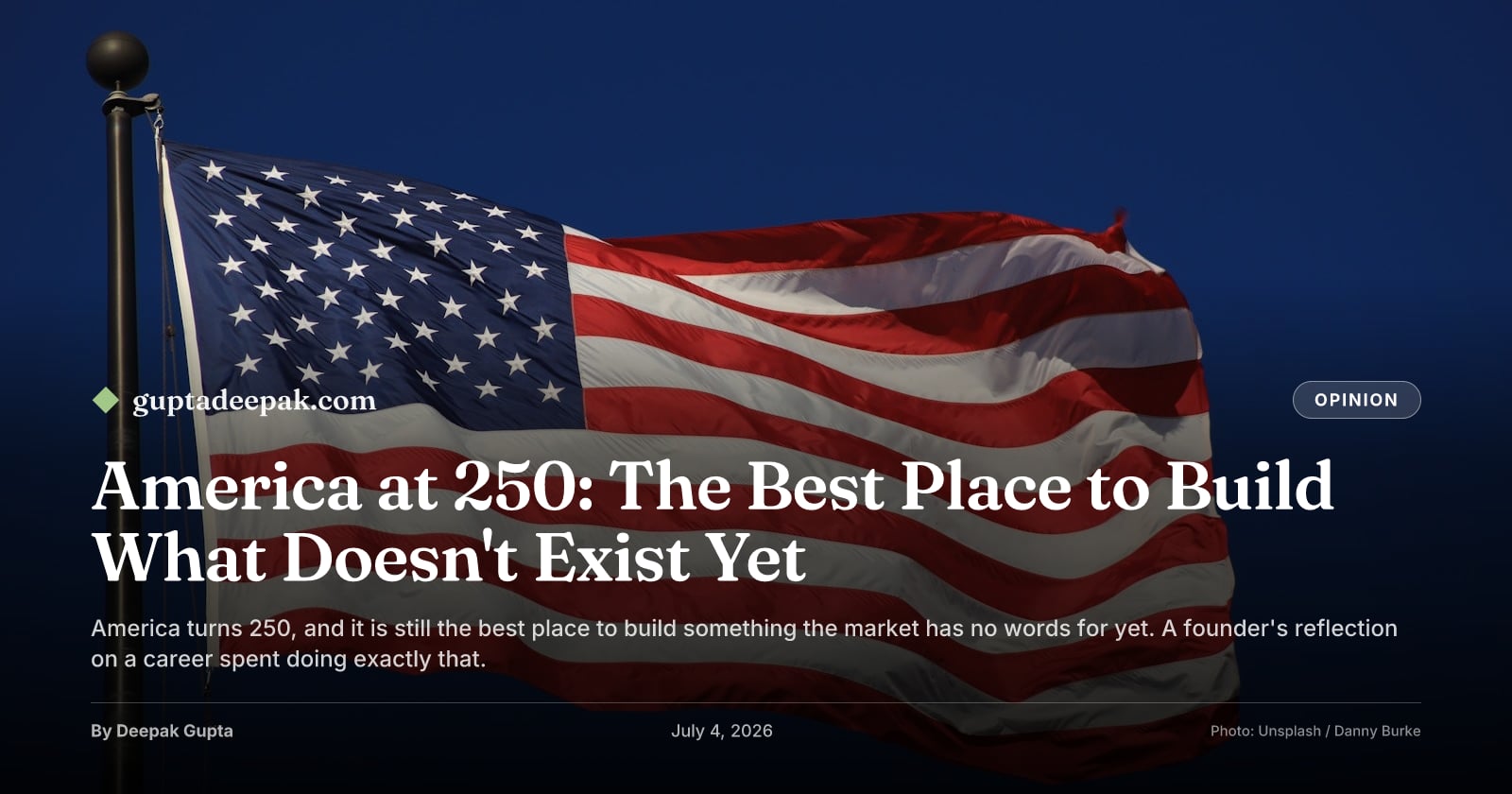
America at 250: Why the US remains the best place to build transformative companies in the AI era
A reflective piece on America's 250th anniversary from a founder/entrepreneur's perspective, arguing that the United States remains the best
 guptadeepak.com·3d ago
The times they are a-changin’: Washington suddenly warms to regulating AI
FORTUNE·1mo ago
Can 18th-Century American Democracy Survive 21st-Century Technology?
The article argues that America's 18th-century constitutional framework and democratic institutions are ill-equipped to handle the challenge
 theatln.tc·28d ago
Comments
Sign in to join the conversation.
No comments yet. Be the first.