
























Uppsala University scientists observe atomic rainbow by scattering xenon ions from graphene
12d ago· 4 min readenNews
Summary
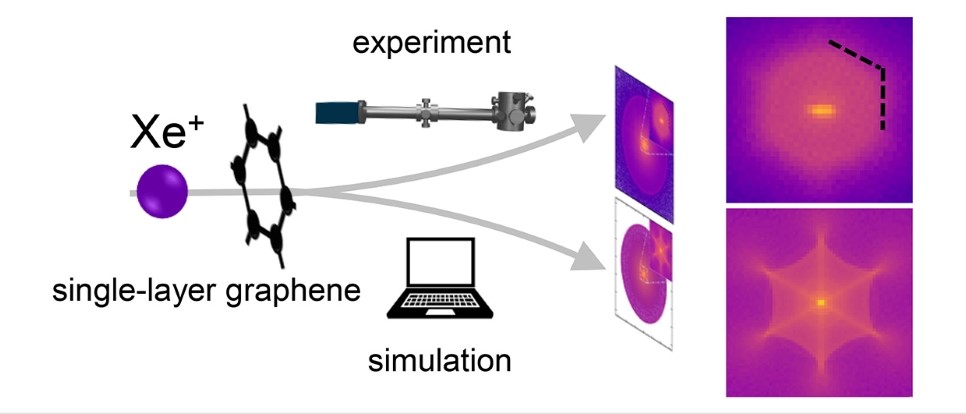
Scientists at Uppsala University's Ångström Laboratory have created an atomic rainbow by scattering xenon ions from graphene, a single-layer carbon material. The experiment required an ultraclean graphene sample and a detector with extreme resolution. This marks the first observation of the atomic rainbow effect from graphene, which is an ideal system for studying this phenomenon due to its two-dimensional honeycomb lattice structure.
Source
 bskyUppsala University scientists observe atomic rainbow by scattering xenon ions from grapheneuu.se
Key quotes
· 3 pulledGraphene is a two-dimensional material consisting of a single layer of carbon atoms arranged in a hexagonal honeycomb lattice.
This structure makes it an ideal system for investigating the atomic rainbow effect.
Decisive for the success of the experiments were the combination of an ultraclean graphene sample and a detector with extreme resolution.
We can observe a colourful rainbow in the sky when sun light scatters from water drops in the air. In a lab in the Ångström Laboratory’s basement, scientists have now created an atomic rainbow by scattering xenon ions from graphene. Decisive for the succe
You might also wanna read


Nanocrystal Light Emission Reveals Quantum Zero-Point Motion in Atomic Lattice
Researchers have observed unexpected light emission from a nanocrystal cooled to near absolute zero, which is shown to arise from quantum fl
 physics.aps.org·7mo ago
Nanodiamonds made from tiny graphene triangles
Nature Communications

Researchers Develop Materials for Light-Based Computer Chips to Improve Efficiency and Speed
Researchers are developing light-based computers that use photons instead of electricity, which could offer greater energy efficiency and fa
nyu.edu·7mo ago
447 TB/cm² at zero retention energy – atomic-scale memory on fluorographane
zenodo.org·2mo ago
Encapsulation enhances surface structure imaging of 2D quantum material
iop.org·11d ago

NASA’s Cold Atom Lab is creating one of the weirdest forms of matter in space
ScienceDaily·12d ago
Comments
Sign in to join the conversation.
No comments yet. Be the first.