
























Dartmouth study models how social pressure drives 'overarming' of firearms in the U.S.
By
Written byOffice of Communications
Summary
A Dartmouth study published in Science Advances uses evolutionary game theory to model how social pressure and personal choice drive firearm ownership in the U.S., leading to a phenomenon called "overarming" — where the collective societal costs of gun ownership outweigh individual benefits. The research is the first to map the interplay between social networks and individual incentives that has resulted in the U.S. having 120 firearms per 100 people, making it one of the most heavily armed countries in the world.
Source

 Hacker NewsDartmouth study models how social pressure drives 'overarming' of firearms in the U.S.home.dartmouth.edu
Key quotes
· 3 pulledThe researchers describe in Science Advances how individual incentives to buy firearms can lead to a phenomenon they call 'overarming.'
In an overarmed society, the collective cost of firearm ownership outweighs the individual benefits of possessing a gun.
The team developed an evolutionary game theory model of how social factors drive someone to buy a firearm, how their choice...
You might also wanna read

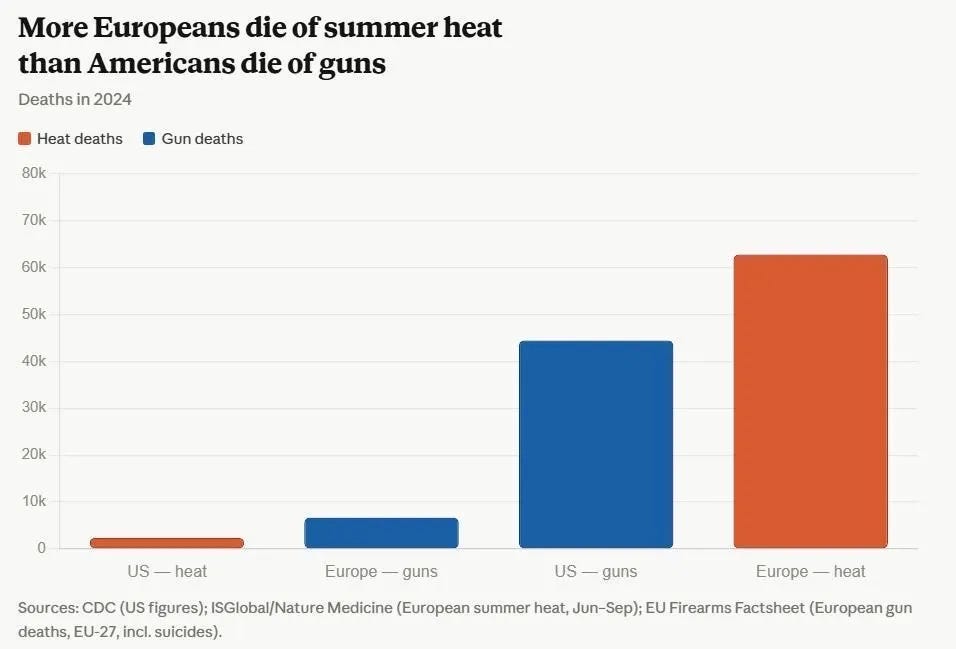
A flawed viral chart comparing European heat deaths to American gun deaths
This article critiques a viral chart comparing heat-related deaths in Europe to gun deaths in America. The author argues the comparison is f
 hannahritchie.substack.com·1d ago
Critique of Jonathan Haidt's "The Anxious Generation" Questions Scientific Rigor of Social Media Claims
This article critiques Jonathan Haidt's book "The Anxious Generation," arguing that Haidt's claims about social media causing a teen mental
 reason.com·4d ago
Analyzing Heterogeneous Treatment Effects and Causal Mechanisms in Social Science Research
This article from the American Political Science Review examines how social scientists make causal claims about treatment effects, specifica
 doi.org·5h ago
Rebalancing power in infectious disease modelling: Toward inclusive and contextual approaches
This article, published in PLOS Global Public Health, argues for rebalancing power dynamics in infectious disease modelling. It critiques th
 journals.plos.org·14d ago
Examining socio-structural factors and harms in the biopsychosocial model of chronic illness and disability
This article critically examines the biopsychosocial (BPS) model of health and illness, focusing on a particular variant dominant in UK heal

Spatial Analysis Reveals Socioenvironmental Drivers of Hidradenitis Suppurativa in Boston Area
This cross-sectional study uses spatial epidemiological methods to analyze how environmental and social factors influence the distribution o
 doi.org·13d ago
Comments
Sign in to join the conversation.
No comments yet. Be the first.