





















Evolution of Calculators: From Bulky Boards to Integrated Chipsets
By
Bogdanp

Front-window bakery material. Catches the eye, delivers the goods.
Summary
The article discusses the evolution of calculators, highlighting the transition from bulky calculators with multiple circuit boards to more integrated designs like the Sharp QT-8B chipset.
Key quotes
· 2 pulledInside the Canon Canola 130S. This is a typical calculator of about 1968 and requires 13 circuit boards full of components.
The degree of integration was gradually improved. Here the Sharp QT-8B of 1970 has a 4-piece chipset manufactured by Rockwell.
Article URL: http://www.vintagecalculators.com/html/the_calculator-on-a-chip.html
Comments URL: https://n
You might also wanna read


Google's Debug program seeks EPA approval to release 64 million modified mosquitoes in California and Florida
Google's Debug program plans to release up to 64 million genetically modified "good" mosquitoes in California and Florida over two years to
 bit.ly·32m ago
The dangers of anthropomorphising AI: Why we must see machines as machines
This article argues that anthropomorphising AI—projecting human thoughts, feelings, and intentions onto machines—is a natural but dangerous
 ethics.org.au·2h ago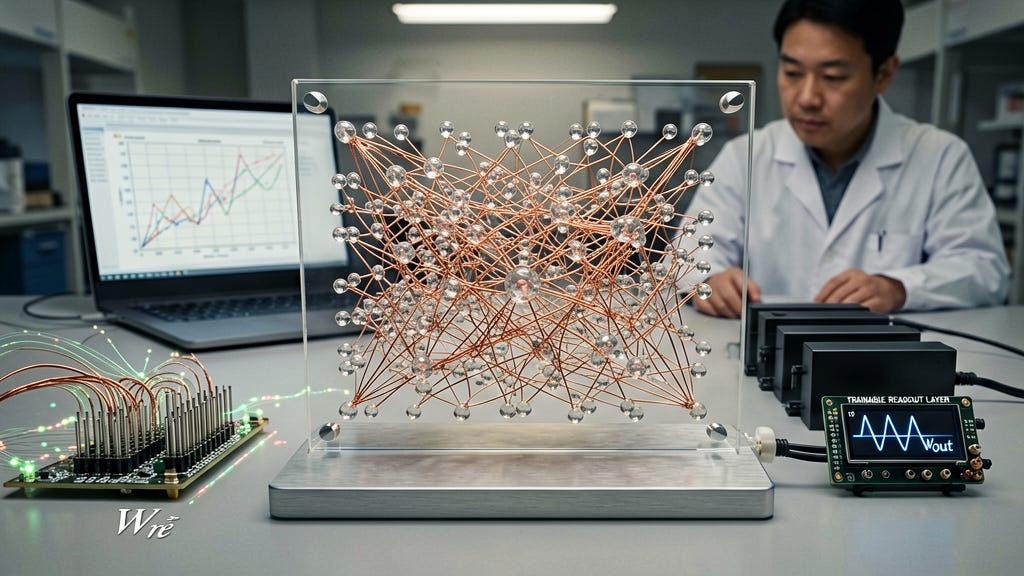
Researchers Work to Decode the "Black Box" of Reservoir Computing and Brain-Inspired AI
This article explores Reservoir Computing (RC), a specialized form of recurrent neural networks (RNNs) that mimics biological brain processe
 akmaier.substack.com·3h ago
Vera C. Rubin Observatory Set to Discover Millions of Asteroids and Transient Phenomena in Big-Data Astronomy Era
The Vera C. Rubin Observatory in Chile is preparing to begin operations, designed to capture the entire Southern Hemisphere night sky every
 quantamagazine.org·4h ago
Experimental demonstration of quantum communication advantage for Euclidean distance calculation using coherent state fingerprints
This paper presents an experimental demonstration of quantum advantage in communication complexity for the Euclidean distance problem. The r
 arxiv.org·4h ago
Quantum research reveals when entanglement hinders rather than helps channel discrimination
This research paper investigates the role of entanglement in quantum channel discrimination, challenging the common assumption that more ent
arxiv.org·4h ago