
























Two-Way Classical Communication Boosts Error Tolerance in Quantum Conference Key Agreement
By
[Submitted on 5 Jul 2026]
Summary
This paper analyzes the security of Quantum Conference Key Agreement (QCKA) using two-way classical communication with tripartite GHZ states and two measurement bases. It builds on Gottesman and Lo's preprocessing procedures (B-step and P-step) originally developed for bipartite QKD. The authors derive secure key rates analytically and demonstrate that iterative B-steps can increase the tolerable error threshold beyond 20%, significantly improving upon the ~11% threshold without two-way classical communication and the ~15% threshold with a single B-step. The findings show that two-way classical communication substantially enhances the robustness of practical QCKA protocols for multi-user quantum networks.
Source

 bskyTwo-Way Classical Communication Boosts Error Tolerance in Quantum Conference Key Agreementarxiv.org
Key quotes
· 3 pulledQuantum conference key agreement (QCKA) enables multiple users to establish a common secret key with information-theoretic security and is regarded as a key primitive for secure communication in future quantum networks.
We derive the corresponding secure key rate analytically and demonstrate that iterative B-steps can increase the tolerable error threshold beyond 20%, significantly improving upon the approximately 11% threshold achievable without two-way classical communication.
Our results show that two-way classical communication can substantially enhance the robustness of practical QCKA protocols.
You might also wanna read
Analysis of NSA Influence on IETF Post-Quantum Cryptography Standardization
This article is part of a series examining the conflict between the NSA and IETF regarding post-quantum cryptography standardization. The au
Ultra-compact sensor paves the way for more powerful and scalable silicon quantum processors

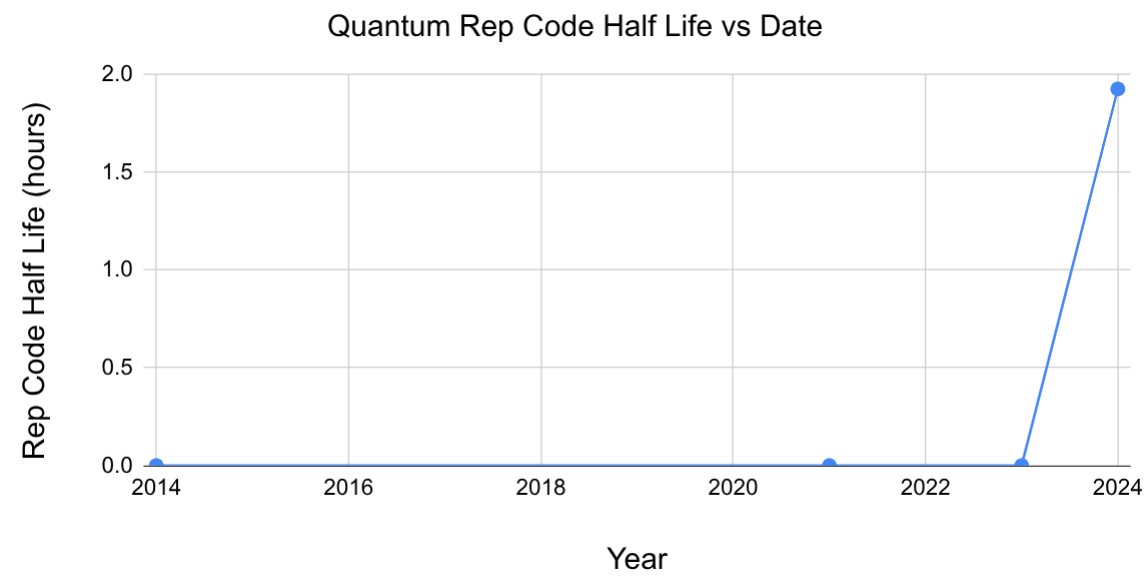
Quantum Error Correction Progress and Future Outlook for Qubit Quality
The article discusses the rapid advancement of quantum error correction, predicting that maximum achievable qubit quality will drastically i
 algassert.com·6mo ago
ACM Transactions on Quantum Computing (tqc) Vol 7, Issue 2
ACM Transactions on Quantum Computing (tqc) Vol 7, Issue 3

Generating Gottesman–Kitaev–Preskill Qubit States Using Integrated Photonic Chip
The article discusses the generation of Gottesman–Kitaev–Preskill (GKP) qubit states using an ultra-low-loss integrated photonic chip, pavin
nature.com·1y ago
Comments
Sign in to join the conversation.
No comments yet. Be the first.