
























Duke and IonQ Achieve Three-Node Quantum Entanglement with Trapped Atomic Ions
By
Mohamed Abdel-Kareem
Summary
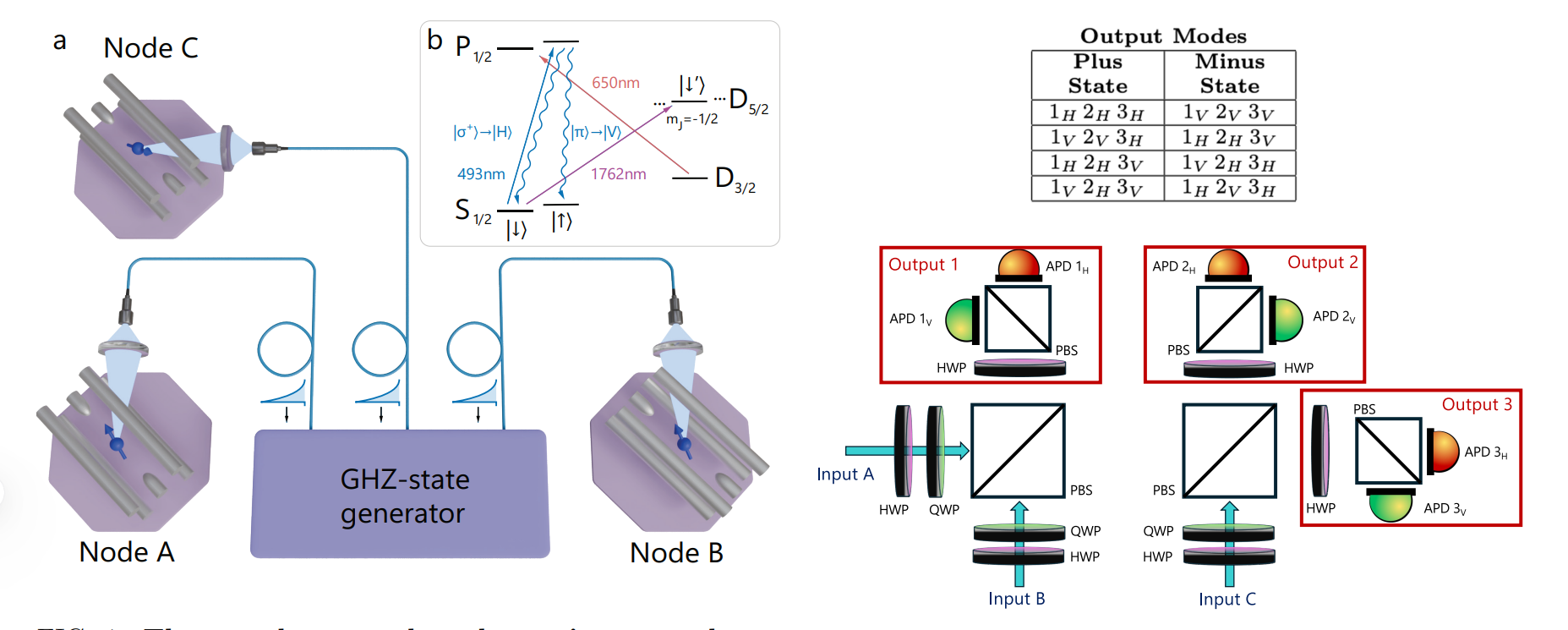
Researchers from Duke Quantum Center and IonQ have successfully demonstrated the distributed generation of a Greenberger–Horne–Zeilinger (GHZ) state — a form of tripartite quantum entanglement — across a three-node quantum network using trapped atomic ions. The experiment used three spatially separated hardware modules positioned about 2 meters apart, linked by 3-meter optical fiber connections. This achievement represents a significant step toward distributed quantum computing, where multiple smaller quantum processors can be networked together to solve problems beyond the capability of individual systems.
Source
 bskyDuke and IonQ Achieve Three-Node Quantum Entanglement with Trapped Atomic Ionsquantumcomputingreport.com
Key quotes
· 2 pulledResearchers from the Duke Quantum Center and IonQ have demonstrated the distributed generation of a Greenberger–Horne–Zeilinger (GHZ) state across a three-node quantum network using individual trapped atomic ions.
The experimental configuration consisted of three spatially separated hardware modules positioned approximately 2 meters apart, linked by 3-meter optical fiber connections.
You might also wanna read


A quantum computer based on trapped ions can connect any two quantum bits, reaching performance levels that conventional computers cannot match

Researchers Achieve Quantum Teleportation Using Standard Internet Infrastructure
German researchers have successfully demonstrated quantum teleportation using existing internet infrastructure, teleporting information betw
 cordis.europa.eu·6mo ago
A Classical RAM Design That Mimics Quantum Collapse and Entanglement"
University of Pennsylvania Engineers Achieve Quantum Networking Over Commercial Fiber Using Standard Internet Protocol
Engineers at the University of Pennsylvania have successfully demonstrated quantum networking over commercial Verizon fiber-optic cables usi
 phys.org·9mo ago
Comments
Sign in to join the conversation.
No comments yet. Be the first.