
























Declining mRNA synthesis capacity drives organismal aging across species
The abundance of mRNA sets a ceiling on a cell’s capacity to produce protein and carry out its functions. Here, we describe a pathological decline in absolute mRNA abundance that occurs in most cell…
Read the full articleYou might also wanna read
Aging rewires RNA production, favoring short genes over long neuronal ones
A new Northwestern Medicine study published in the Proceedings of the National Academy of Sciences has explored the impacts of aging on esse


Ribonuclease DIS3 delays aging and senescence by generating tRNA halves
Ribonuclease DIS3 extends aging by generating crucial tRNA halves in C. elegans. 5'-tRH-Gln is vital for longevity via various interventions
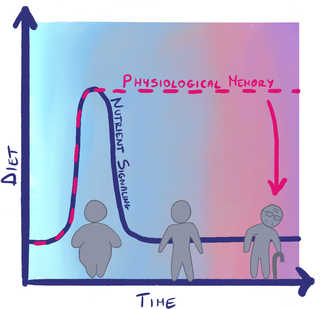
Toward a life-course biology of aging: How early-life conditions shape late-life health and longevity
In the last few years, evidence has emerged from the basic biology of ageing suggesting that ageing can be influenced by transient condition
 plos.io·1mo ago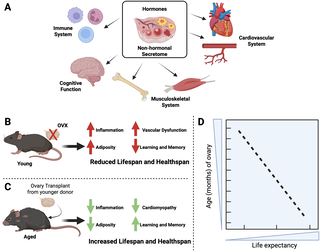
Ovarian biology as a blueprint for rejuvenation: Exploring germline immortality and somatic longevity
Oocytes give rise to embryos that begin life with restored developmental potential and youthful molecular organisation. This Essay reframes
plos.io·1mo agoAn antagonistically pleiotropic gene regulates vertebrate growth, maturity, and lifespan
Gene vgll3, crucial for growth, maturity, lifespan in vertebrates, reveals aging trade-offs in turquoise killifish. Early-life vs late-life

Energy constraint model of human health: How metabolic trade-offs shape aging and disease
Evolved constraints to human energy transformation force the body–brain system to operate an economy of energy. To survive and thrive, an or
Energy constraint model of human health: How metabolic trade-offs shape aging and disease
Evolved constraints to human energy transformation force the body–brain system to operate an economy of energy. To survive and thrive, an or
Comments
Sign in to join the conversation.
No comments yet. Be the first.