
























CVE-2026-13117: Technical Analysis of OpenVPN tls-crypt-v2 Heap Use-After-Free Vulnerability
By
HackMoN Ai
Summary
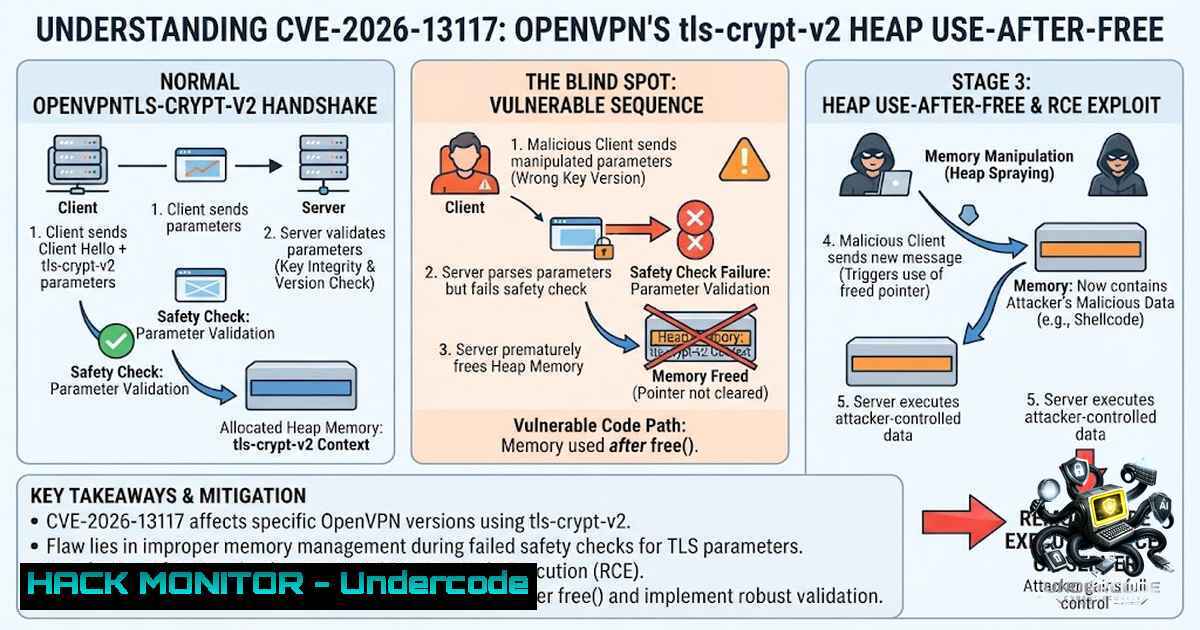
A detailed technical analysis of CVE-2026-13117, a critical heap use-after-free vulnerability in OpenVPN's tls-crypt-v2 mechanism. The vulnerability stems from a blind spot in a safety check during key renegotiation, allowing the server to free a buffer it is about to send and then transmit data from freed memory to the client. This opens the door to potential Remote Code Execution (RCE). The article explains the technical mechanics of the flaw, the affected component, and the implications for OpenVPN deployments.
Source
 bskyCVE-2026-13117: Technical Analysis of OpenVPN tls-crypt-v2 Heap Use-After-Free Vulnerabilityundercodetesting.com
Key quotes
· 3 pulledA safety check added specifically to prevent use-after-free conditions has a critical blind spot during key renegotiation.
This oversight allows the server to free a buffer it is about to send, then transmit whatever data now resides in that freed memory to the client — a classic heap use-after-free.
A single blind spot in a safety check opens the door to RCE.
You might also wanna read

Proof-of-Concept Exploit Released for Critical NGINX Heap Buffer Overflow (CVE-2026-42945)
A proof-of-concept exploit for CVE-2026-42945, a critical heap buffer overflow vulnerability in NGINX's ngx_http_rewrite_module that has exi
 github.com·1mo ago
Technical Analysis of CVE-2025-53149: Heap-based Buffer Overflow in Windows Kernel Streaming Driver
Researchers discovered CVE-2025-53149, a heap-based buffer overflow vulnerability in the Windows Kernel Streaming WOW Thunk Service Driver (
 crowdfense.com·10mo ago
OpenSSL Vulnerability CVE-2025-15467: Stack Overflow with Remote Code Execution Risk
JFrog Security Research team reports on a newly disclosed OpenSSL vulnerability, CVE-2025-15467, which is a stack overflow issue that could

Critical FreePBX Zero-Day Vulnerability CVE-2025-57819 Exposed and Exploited
A critical zero-day vulnerability (CVE-2025-57819) has been discovered in FreePBX, a popular open-source PBX system. The article details how
 labs.watchtowr.com·10mo ago
WAF - WAF Release - 2025-05-19
Comments
Sign in to join the conversation.
No comments yet. Be the first.