
























Copy Fail: Critical Linux Kernel Vulnerability (CVE-2026-31431) Grants Root Access Across Major Distributions
Xint Code disclosed CVE-2026-31431, an authencesn scratch-write bug chaining AF_ALG + splice() into a 4-byte page cache write. A 732-byte PoC gets root on Ubuntu, Amazon Linux, RHEL, SUSE.
Read the full articleYou might also wanna read
From Exploit Code to Production Detection: Building a CVE-2026-31431 (Copy Fail) detection with Agents
CVE-2026-31431 (Copy Fail) lets any unprivileged user corrupt the Linux page cache via AF_ALG sockets to escalate privileges. This post cove


Ubuntu and Linux Kernel: Linux FUSE Vulnerability Allows Unprivileged Users to Pop a Root Shell
Critical Linux Kernel Flaw (CVE-2026-31694) Enables Local Privilege Escalation to Root A newly disclosed vulnerability in the Linux kernel’s

Working Exploit Released for Linux Kernel Use-After-Free Flaw CVE-2026-23111 Enabling Local Root Access
Security researchers released a working exploit for CVE-2026-23111, a Linux kernel use-after-free in nf_tables that can let an unprivileged
 hendryadrian.com·1mo ago
Linux Copy Fail zero-day enables privilege escalation
Copy Fail, a zero-day Linux vulnerability, is a local privilege escalation flaw that allows unprivileged users to gain root access.

Linux Kernel: Linux Kernel FUSE Vulnerability Lets Attackers Gain Root Privileges
Linux Kernel FUSE Vulnerability (CVE-2026-31694) Enables Local Privilege Escalation A critical vulnerability in the Linux kernel’s FUSE (Fil
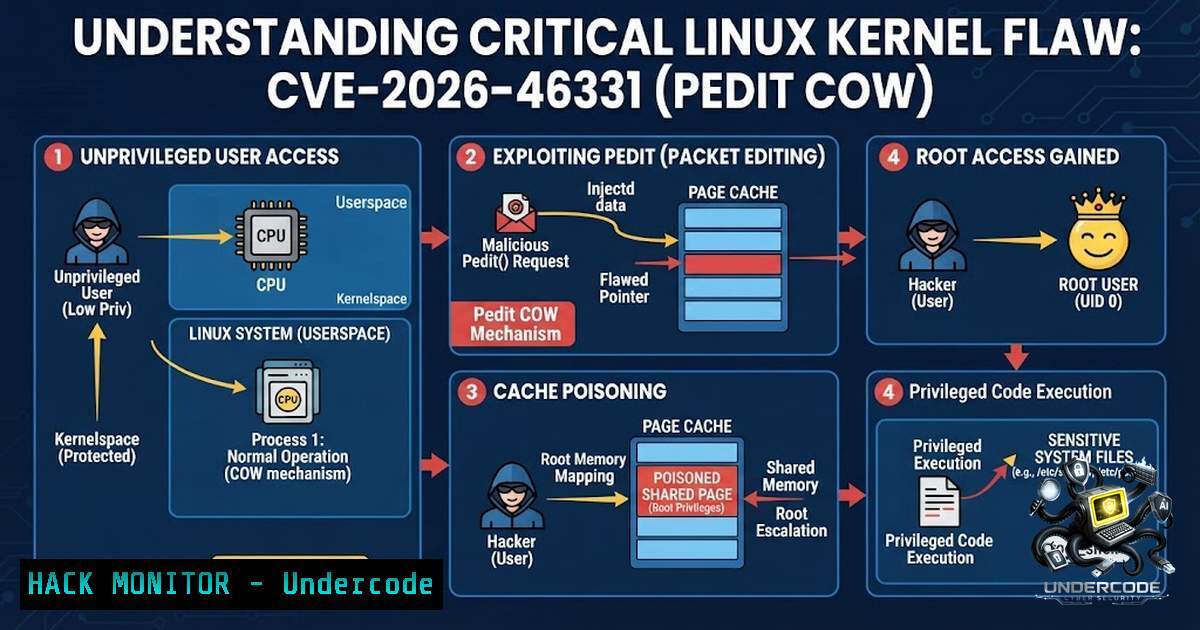
Critical Linux Kernel Flaw CVE-2026-46331 (Pedit COW) Enables Unprivileged Users to Gain Root Access via Cache Poisoning
Critical Linux Kernel Flaw CVE-2026-46331 (Pedit COW) Allows Any Unprivileged User to Gain Root Access via Cache Poisoning + Video - "Underc
 undercodetesting.com·12d ago
Comments
Sign in to join the conversation.
No comments yet. Be the first.