
























Configuring Banana Pi R4 (BPI-R4) as a DHCP Server for Multiple Subnets
Summary
This article provides a technical guide on configuring the Banana Pi R4 (BPI-R4) as a DHCP server capable of assigning IP addresses across multiple subnets. It explains how to utilize the device's four Ethernet ports (three LAN and one WAN) to create separate subnets with routed traffic between them, including connecting the WAN port to an internet-connected local network.
Source

 bskyConfiguring Banana Pi R4 (BPI-R4) as a DHCP Server for Multiple Subnetslinux.org
Key quotes
· 5 pulledWe are going to set up the Banana Pi R4 as a DHCP server that assigns IP addresses on multiple subnets.
The Banana Pi R3 has four 1-gigabit Ethernet ports, which we will use to create four subnets.
These four subnets will allow traffic to be routed between them.
There are three Local Area Network (LAN) ports and one Wide Area Network (WAN) port.
The three remaining ports will allow for three networks that are given automatic IP addresses through Dynamic Host Configuration Protocol (DHCP).
You might also wanna read


Introduction to Kea DHCP: Modern Open-Source DHCP Server for IPv4 and IPv6
The article provides an overview of Kea DHCP, a modern open-source DHCP server developed by Internet Systems Consortium (ISC). It covers the
 isc.org·6mo ago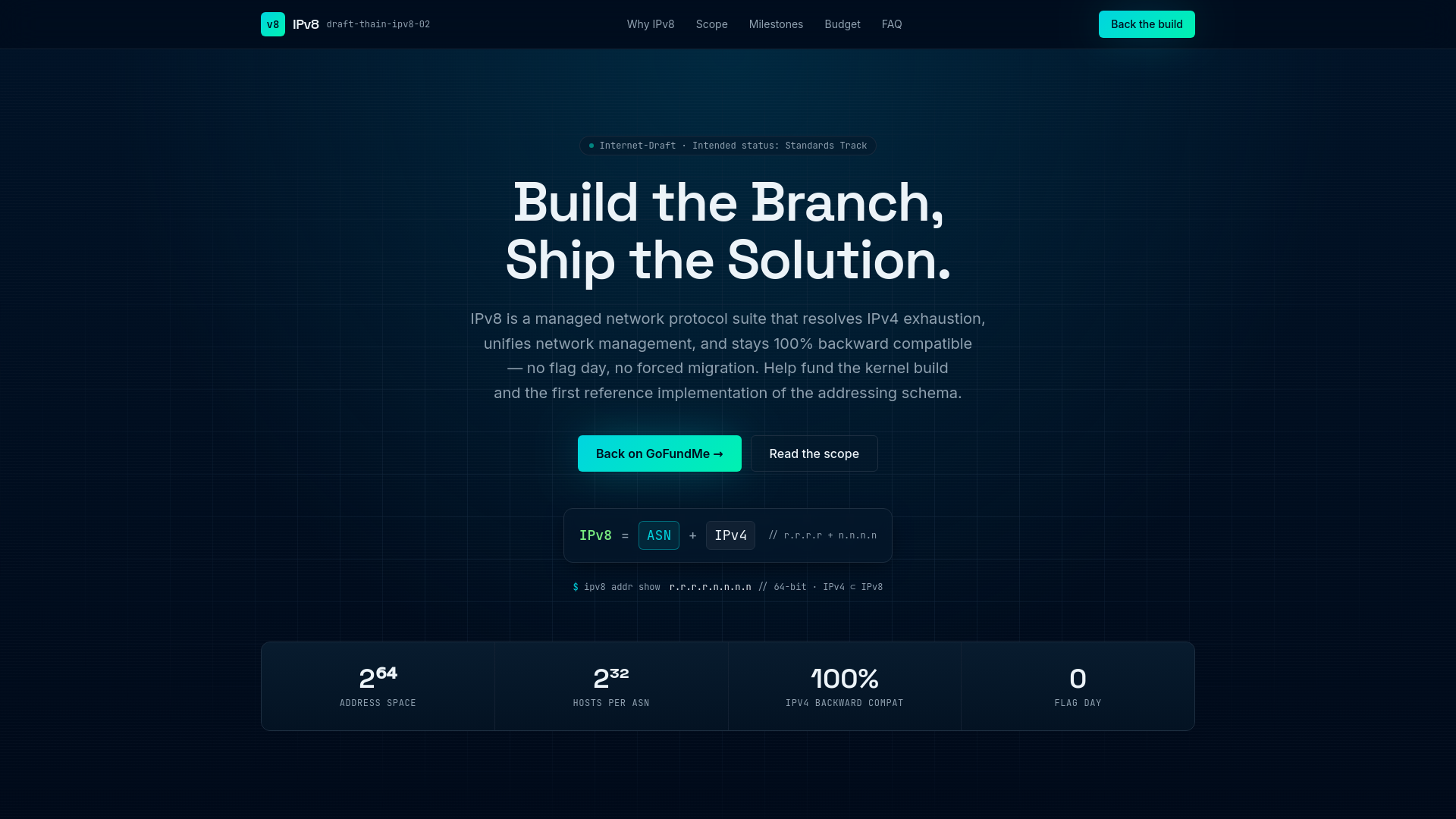
IPv8: An Alternative IPv4 Successor with Backward Compatibility and Integrated Network Management
This article introduces IPv8, an alternative successor to IPv4 that differs from IPv6 by focusing on integrated network management and singl
Solving Network Subnet Conflicts with WireGuard and NAT Overlay Addressing
This technical article addresses the common problem of conflicting IP subnets in network deployments, particularly for professionals managin
 netrinos.com·4mo ago
Setting Up a Personal DNS Server for Home Network Sovereignty - IPv4 Implementation
The author documents their journey to set up a personal DNS server at home as part of creating a self-sufficient home network that works eve
 jan.wildeboer.net·9mo ago
The Shift from Free Public IPv4 Addresses to NAT in India's Internet Infrastructure
The article reflects on the evolution of internet infrastructure in India over the past two decades, contrasting the early days when ISPs al

IPv4 Address Exhaustion: How Workarounds Like NAT Delayed the Inevitable and the Alternative Path of 64-bit IPv4
The article examines the ongoing challenge of IPv4 address exhaustion and explores an alternative history where IPv4 evolved with 64-bit add
 owl.billpg.com·3mo ago
Comments
Sign in to join the conversation.
No comments yet. Be the first.