All Topics
All Topics
Technology
Technology
AI
AI
Business
Business
Entertainment
Entertainment
News
News
Programming
Programming
Science
Science
Design
Design
Environment
Environment
Finance
Finance
Crypto
Crypto
Politics
Politics
Sports
Sports
Education
Education
Gaming
Gaming
Art
Art
Music
Music
Health
Health
Security
Security
Books
Books
Food
Food
Travel
Travel
Personal
Personal
Bluesky
Twitter

Asynchronous Distributed Learning Based on Gradient Coding

1mo ago

Source

IEEEAsynchronous Distributed Learning Based on Gradient Codingieee.org
Snippet from the RSS feed
In this paper, we study the problem of distributed learning (DL), where different devices take varying amounts of response time to complete local computations during training. To deal with this problem, existing gradient coding (GC) techniques are designed in a synchronous setting, where the server waits for a fixed number of the fastest devices to transmit the coded gradients in each iteration to fully recover the global gradient. However, there are significant inefficiencies in these GC techniques, since the computations performed by the slow devices are wasted and their information is not required by the server to update the global model. To overcome this limitation, we propose a novel asynchronous DL method based on GC (AGC). In AGC, the training data subsets are replicated and allocated to the devices redundantly, and the devices encode local gradients of its local subsets and send the coded gradients to the server. The server updates the global model in an asynchronous manner based on the coded gradients received from a certain number of devices, which may be computed from the global models back in history as well as the most recent one. In this way, the computations of the slow devices can also be exploited, helping to increase training efficiency and reduce training time. We provide a convergence analysis for AGC in asynchronous settings with frequent global synchronization, and show that it achieves an $\boldsymbol{O}\mathbf{(1}\boldsymbol{/\sqrt{T}}\mathbf{)}$ convergence rate. Finally, numerical results demonstrate the superiority of the proposed method compared to the baseline methods, where AGC achieves better learning performance after the same training time.

You might also wanna read

Fast-dLLM: Training-Free Acceleration Method for Diffusion Language Models Using KV Cache and Parallel Decoding

Researchers introduce Fast-dLLM, a training-free acceleration method for diffusion-based large language models that addresses their slower i

arxiv.org·8mo ago

Theoretical Analysis Reveals Why Linear RNNs Are More Parallelizable Than Nonlinear RNNs

This paper establishes a theoretical connection between types of RNNs and standard complexity classes to explain why linear RNNs (LRNNs) are

arxiv.org·1mo ago

Distributed Quantum Learning: Convergence Analysis and Adaptive Post-Quantum Security Framework

This paper presents a comprehensive study on Distributed Quantum Learning (DQL), focusing on two key aspects: convergence analysis under pra

arxiv.org·15d ago
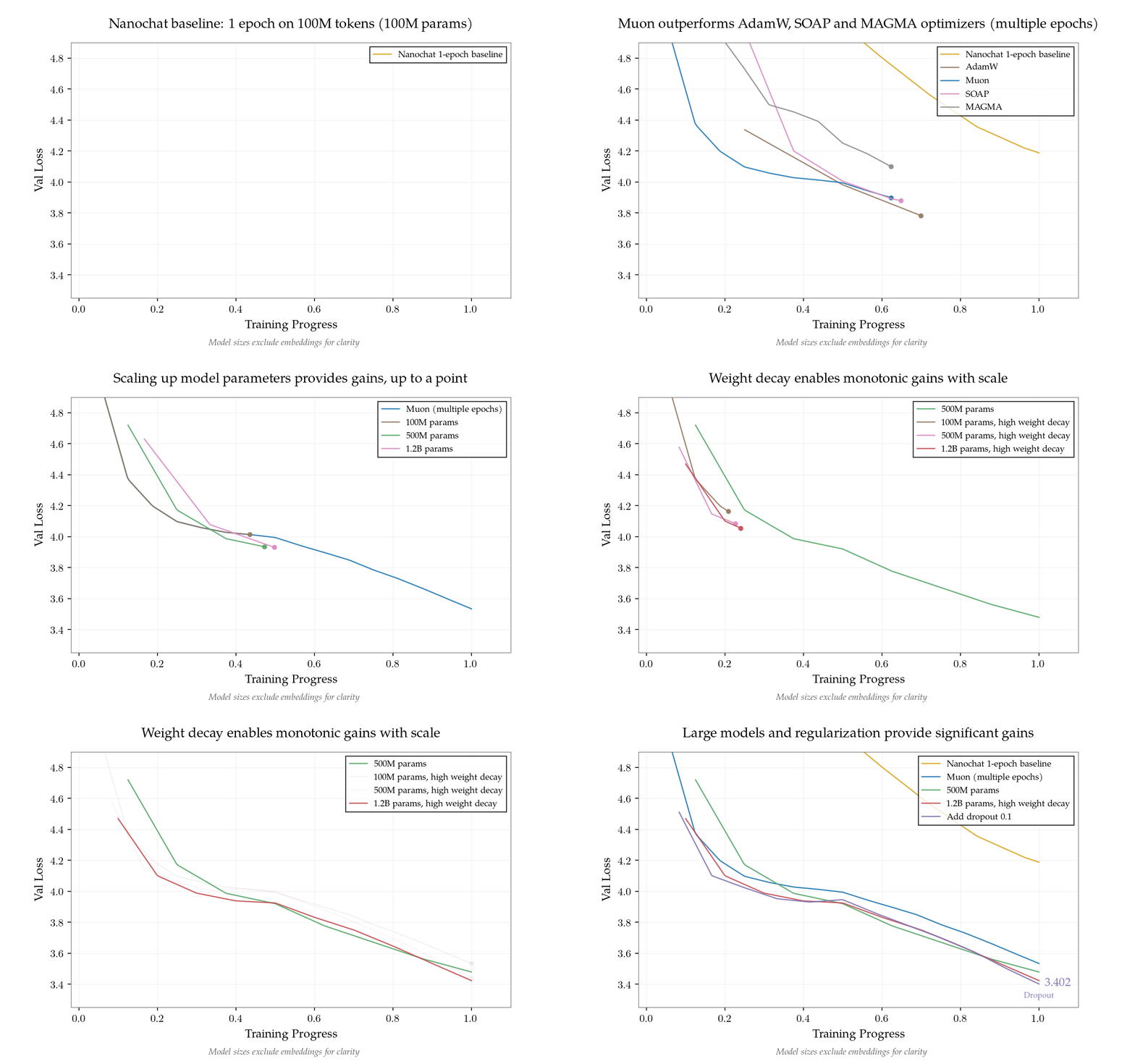
Data Scarcity as the Emerging Bottleneck in AI Scaling and Intelligence Development

The article discusses the asymmetry between compute and data growth in AI development, arguing that while compute capacity grows rapidly, da
qlabs.sh·4mo ago

Google's Decoupled DiLoCo enables distributed AI training across distant data centers with lower bandwidth and greater hardware resilience

Google has introduced a new distributed architecture called Decoupled DiLoCo for training large language models across distant data centers.

Google DeepMind·2mo ago

Transformers Can Learn to Predict Permuted Congruential Generator Sequences Through Curriculum Learning and Scaling Laws

This research paper investigates whether Transformer models can learn to predict sequences generated by Permuted Congruential Generators (PC

arXiv.org·2mo ago

Comments

Sign in to join the conversation.

No comments yet. Be the first.