
























Algorithmic method for computing fundamental domains of crystallographic groups
By
[Submitted on 2 Jul 2026]
Summary
This paper presents an algorithmic approach for computing fundamental domains of crystallographic groups. Crystallographic groups are infinite discrete subgroups of the Euclidean group with compact fundamental domains, making their computation algorithmically challenging. The authors address this by targeting Dirichlet cells, showing that the half-spaces defining such cells can be derived from group elements expressed as words of bounded length. They design an algorithm based on these results and apply it to study topological interlocking assemblies.
Source

 bskyAlgorithmic method for computing fundamental domains of crystallographic groupsarxiv.org
Key quotes
· 5 pulledA crystallographic group is a discrete subgroup of the Euclidean group E(n) that has a compact fundamental domain.
Since such a crystallographic group Γ is infinite, computing fundamental domains of Γ is algorithmically challenging.
We address this difficulty by targeting the computation of Dirichlet cells that can form fundamental domains of Γ.
We show that the half-spaces defining such a Dirichlet cell can be derived from elements of Γ acting on ℝⁿ that can be expressed as words of bounded length in a suitable generating set.
Based on these results, we design an algorithm for the computation of fundamental domains of crystallographic groups and exploit it to study the construction of topological interlocking assemblies.
You might also wanna read
A Family of Non-Periodic Tilings, Describable Using Elementary Tools


A Homological Separation of $\mathbf{P}$ from $\mathbf{NP}$ via Computational Topology and Category Theory
arxiv.org·8mo agoDiscrete Structures [pdf]
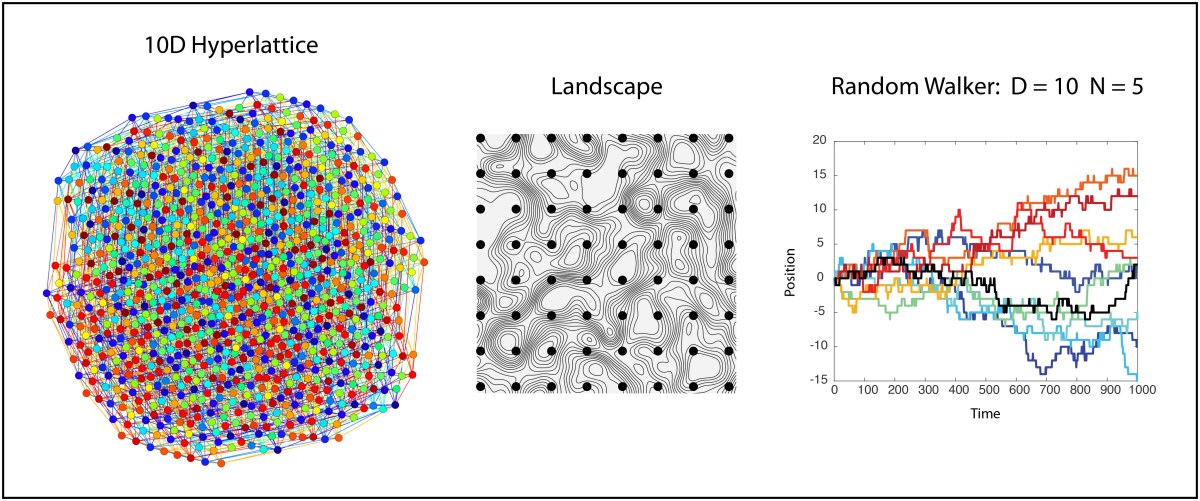
The Mathematics of Random Walks in High-Dimensional Spaces and Their Role in Deep Learning
The article explores the mathematics and physics of random walks in high-dimensional spaces, explaining how this concept underpins modern dy
 galileo-unbound.blog·10mo ago
Mathematicians Use Network Theory to Advance Understanding of Fourier Transform
Mathematicians have made significant progress on a long-standing problem related to the Fourier transform, a fundamental mathematical tool u
 quantamagazine.org·5mo ago
Understanding Abelian Sandpiles: Mathematical Patterns and Aesthetic Beauty
The article introduces abelian sandpiles, a mathematical concept that produces beautiful symmetric patterns on grids. It explains how sandpi
Comments
Sign in to join the conversation.
No comments yet. Be the first.