
























vLLM-Omni: Serving Qwen3-Omni with a Multi-Stage Pipeline for Multimodal Speech Generation
vLLM-Omni introduces a multi-stage serving pipeline for Qwen3-Omni, a multimodal model combining text, image, and audio understanding with speech generation. The system breaks inference into three stages: Thinker (multimodal reasoning), Talker (speech codec generation), and Code2Wav (waveform reconstruction). The post details optimizations including stage-level batching, CUDA Graphs, async chunk processing, async output streaming, per-stage replicas, and hot-path cleanup to achieve low-latency online serving. It also covers OpenAI-compatible API endpoints, performance validation results, and lessons learned from deploying this architecture in production.
Key quotes
vLLM-Omni's Qwen3-Omni serving stack includes: A three-stage pipeline: Thinker for multimodal reasoning, Talker for speech codec generation, and Code2Wav for waveform reconstruction.
OpenAI-compatible serving: /v1/chat/completions is the primary endpoint for Qwen3-Omni text and audio generation.
Batching, CUDA Graphs, async chunk, async output, replicas, and hot-path cleanup: stage-level batching and per-stage
From the article
You might also wanna read

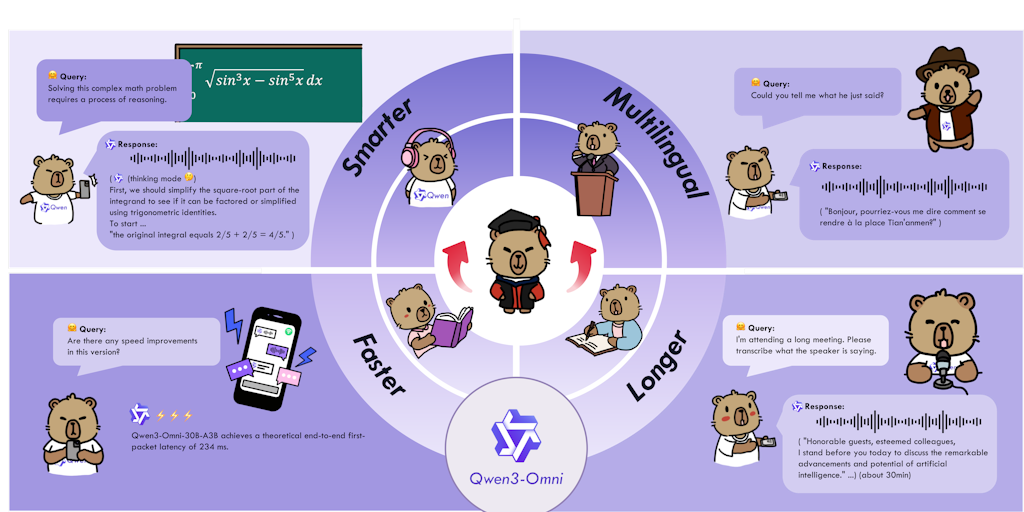
Alibaba Cloud Launches Qwen3-Omni: Native Multimodal AI Model with Real-Time Speech Generation
Qwen3-Omni is a new multimodal large language model from Alibaba Cloud's Qwen team that can process text, audio, images, and video natively
 Product Hunt·2mo ago
Alibaba Cloud Releases Qwen3-Omni: Native End-to-End Multimodal AI Model
Qwen3-Omni is a natively end-to-end, omni-modal large language model developed by Alibaba Cloud's Qwen team. It represents a significant adv
 github.com·9mo ago
Qwen3: The LLM With Million-Token Memory
Multi-Stream LLMs: A Parallel Architecture to Overcome Single-Stream Bottlenecks in Language Models
This paper introduces "Multi-Stream LLMs," a novel approach to overcoming the limitations of current language model architectures that rely
 arxiv.org·1mo ago
Qwen-VL: Multimodal AI Model for Visual Understanding and Reasoning
Qwen-VL is a powerful multimodal AI model from the Qwen team that excels in visual understanding capabilities including image question answe
Product Hunt·10mo ago
Google Gemini Omni: Multimodal AI That Processes Video, Audio, Images, and Text Simultaneously
Google's Gemini Omni is a new multimodal AI model that can process and generate content across video, audio, images, and text simultaneously
 deepmind.google·1mo ago
Comments
Sign in to join the conversation.
No comments yet. Be the first.