
























Agents, Workers - Agents SDK v0.14.0: Agent Skills, messengers, scheduled tasks, Workflows, and hardened chat recovery
1mo ago
Source
CloudflareAgents, Workers - Agents SDK v0.14.0: Agent Skills, messengers, scheduled tasks, Workflows, and hardened chat recoverycloudflare.comThe latest release of the Agents SDK adds four new ways to build with @cloudflare/think : on-demand Agent Skills, chat messengers (starting with Telegram), declarative scheduled tasks, and durable reasoning steps inside Workflows. This release also significantly hardens durable chat recovery, so turns reliably ride through deploys, evictions, and stalled model streams in production. Agent Skills (experimental) Give an agent a catalog of on-demand instructions, resources, and scripts. A skill source adds a catalog to the system prompt, and the model activates a skill only when a task matches — so a large library of capabilities does not bloat every prompt. JavaScript import { Think , skills } from "@cloudflare/think" ; import bundledSkills from "agents:skills" ; export class SkillsAgent extends Think { getSkills () { return [ bundledSkills , skills . r2 ( this . env . SKILLS_BUCKET , { prefix : "skills/" } ) , ] ; } } TypeScript import { Think , skills } from "@cloudflare/think" ; import bundledSkills from "agents:skills" ; export class SkillsAgent extends Think < Env > { getSkills () { return [ bundledSkills , skills . r2 ( this . env . SKILLS_BUCKET , { prefix : "skills/" } ) , ] ; } } The agents:skills import bundles a local ./skills directory through the Agents Vite plugin (one directory per skill, each with a SKILL.md ). Skills can also load from R2 or a manifest. When skills are available, Think exposes activate_skill , read_skill_resource , and an optional run_skill_script tool. Skill loading is resilient: a duplicate or failing source is skipped with a warning instead of breaking the agent. Agent Skills are experimental , and script execution in particular is early. The API may change in a future release. We would love your feedback — tell us what you are building and what is missing in the Agents repository . Messengers Connect a Think agent directly to a chat platform. Think owns the webhook route, conversation routing, durable reply fiber, and streamed delivery back to the provider. Telegram ships as the first provider. JavaScript import { Think } from "@cloudflare/think" ; import { defineMessengers , ThinkMessengerStateAgent , } from "@cloudflare/think/messengers" ; import telegramMessenger from "@cloudflare/think/messengers/telegram" ; export { ThinkMessengerStateAgent }; export class SupportAgent extends Think { getMessengers () { return defineMessengers ( { telegram : telegramMessenger ( { token : this . env . TELEGRAM_BOT_TOKEN , userName : "support_bot" , secretToken : this . env . TELEGRAM_WEBHOOK_SECRET_TOKEN , } ) , } ) ; } } TypeScript import { Think } from "@cloudflare/think" ; import { defineMessengers , ThinkMessengerStateAgent , } from "@cloudflare/think/messengers" ; import telegramMessenger from "@cloudflare/think/messengers/telegram" ; export { ThinkMessengerStateAgent }; export class SupportAgent extends Think < Env > { getMessengers () { return defineMessengers ( { telegram : telegramMessenger ( { token : this . env . TELEGRAM_BOT_TOKEN , userName : "support_bot" , secretToken : this . env . TELEGRAM_WEBHOOK_SECRET_TOKEN , } ) , } ) ; } } Each Chat SDK thread maps to its own Think sub-agent by default, so group chats and direct messages do not share memory. Multiple bots, custom conversation routing, and custom providers are all supported. Scheduled tasks Declare recurring, timezone-aware prompts and handlers with a typed domain-specific language (DSL). Think reconciles the declarations on startup and re-arms the next occurrence after each run, backed by durable idempotent submissions. JavaScript import { Think , defineScheduledTasks } from "@cloudflare/think" ; export class DigestAgent extends Think { getScheduledTasks () { return defineScheduledTasks ( { weeklyCommitReport : { schedule : "every week on monday at 09:00" , prompt : "Compile my GitHub commits for the last week and summarize them." , }, workout : { schedule : "every day at 08:00 in Europe/London" , prompt : "Start my workout." , }, } ) ; } } TypeScript import { Think , defineScheduledTasks } from "@cloudflare/think" ; export class DigestAgent extends Think < Env > { getScheduledTasks () { return defineScheduledTasks ( { weeklyCommitReport : { schedule : "every week on monday at 09:00" , prompt : "Compile my GitHub commits for the last week and summarize them." , }, workout : { schedule : "every day at 08:00 in Europe/London" , prompt : "Start my workout." , }, } ) ; } } Think Workflows Run a model-driven reasoning step inside a Cloudflare Workflow with ThinkWorkflow and step.prompt() , with durable typed structured output, long waits, and approval gates. JavaScript import { z } from "zod" ; import { ThinkWorkflow } from "@cloudflare/think/workflows" ; const draftSchema = z . object ( { title : z . string () , summary : z . string () , labels : z . array ( z . string ()) , } ) ; export class TriageWorkflow extends ThinkWorkflow { async run ( event , step ) { const draft = await step . prompt ( "triage-issue" , { prompt : `Triage issue # ${ event . payload . issueNumber } ` , output : draftSchema , timeout : "3 days" , } ) ; await step . do ( "apply-labels" , async () => { await this . agent . applyLabels ( draft . labels ) ; } ) ; } } TypeScript import { z } from "zod" ; import { ThinkWorkflow } from "@cloudflare/think/workflows" ; import type { ThinkWorkflowStep } from "@cloudflare/think/workflows" ; import type { AgentWorkflowEvent } from "agents/workflows" ; const draftSchema = z . object ( { title : z . string () , summary : z . string () , labels : z . array ( z . string ()) , } ) ; export class TriageWorkflow extends ThinkWorkflow < TriageAgent , Params > { async run ( event : AgentWorkflowEvent < Params >, step : ThinkWorkflowStep ) { const draft = await step . prompt ( "triage-issue" , { prompt : `Triage issue # ${ event . payload . issueNumber } ` , output : draftSchema , timeout : "3 days" , } ) ; await step . do ( "apply-labels" , async () => { await this . agent . applyLabels ( draft . labels ) ; } ) ; } } Production hardening for durable chat recovery Durable chat turns have always been designed to survive a mid-turn deploy or Durable Object eviction. This release is a major hardening pass on that machinery for production. Better recovery during deploys. Turns now ride through continuous deploys and evictions without losing completed work or re-running tools that already ran. A live "recovering…" signal. useAgentChat exposes a new isRecovering flag, so a recovering turn shows progress instead of looking frozen. Most UIs render isStreaming || isRecovering as "busy". Stalled streams recover. Set chatStreamStallTimeoutMs to route a hung provider stream into the same recovery path instead of leaving an infinite spinner. Sub-agents re-attach. On parent recovery, an in-flight agentTool() child is re-attached to its result rather than abandoned and re-run, so long-running children no longer lose work under deploys. MCP transport improvements Resumable streams — In-flight tool calls over Server-Sent Events (SSE) survive a dropped connection. Clients reconnect with Last-Event-ID and replay anything they missed. Readable server IDs — addMcpServer accepts an optional id , so tools surface as readable keys (for example tool_github_create_pull_request ) instead of opaque connection IDs. Better handling of concurrent requests — Overlapping JSON-RPC requests are now correctly correlated to their responses across the HTTP and RPC transports. Other improvements Compaction — A Session 's tokenCounter now also drives the compaction boundary decision ("what to compress"), not just the fire/no-fire trigger. @cloudflare/worker-bundler — Adds a virtualModules option to createWorker to provide in-memory module source during bundling. Client-tool continuations — Parallel tool results now coalesce into a single continuation, immediate resume requests attach to the pending continuation, and server-side needsApproval continuations resume reliably after approval. Upgrade To update to the latest version: npm i agents@latest @cloudflare/think@latest @cloudflare/ai-chat@latest yarn add agents@latest @cloudflare/think@latest @cloudflare/ai-chat@latest pnpm add agents@latest @cloudflare/think@latest @cloudflare/ai-chat@latest bun add agents@latest @cloudflare/think@latest @cloudflare/ai-chat@latest Refer to the Agents API reference and Chat agents documentation for more information.
You might also wanna read

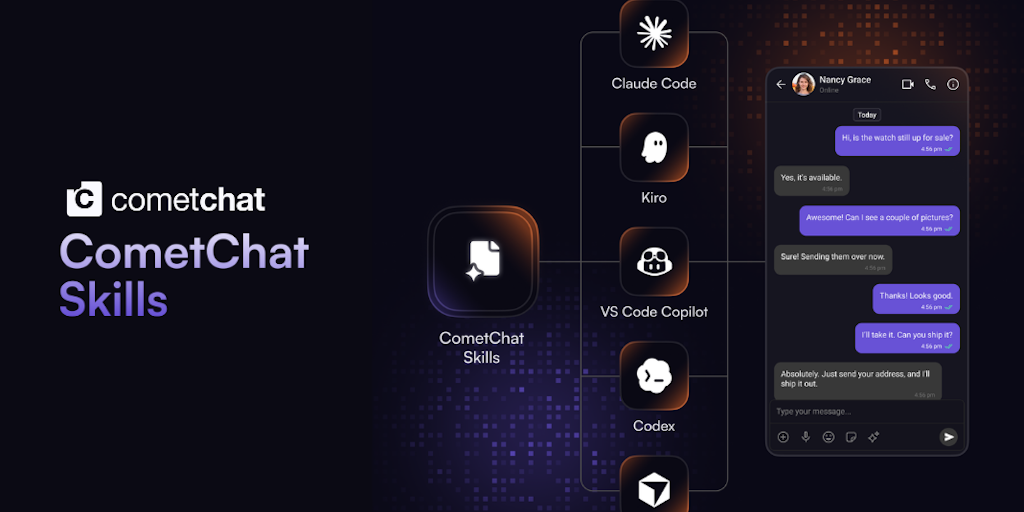
Chat Skills for AI Agents: Add Chat Functionality to React Apps with Single File Integration
Chat Skills for AI Agents is a product that enables developers to add fully functional chat capabilities to React applications using AI agen
 Product Hunt·1mo ago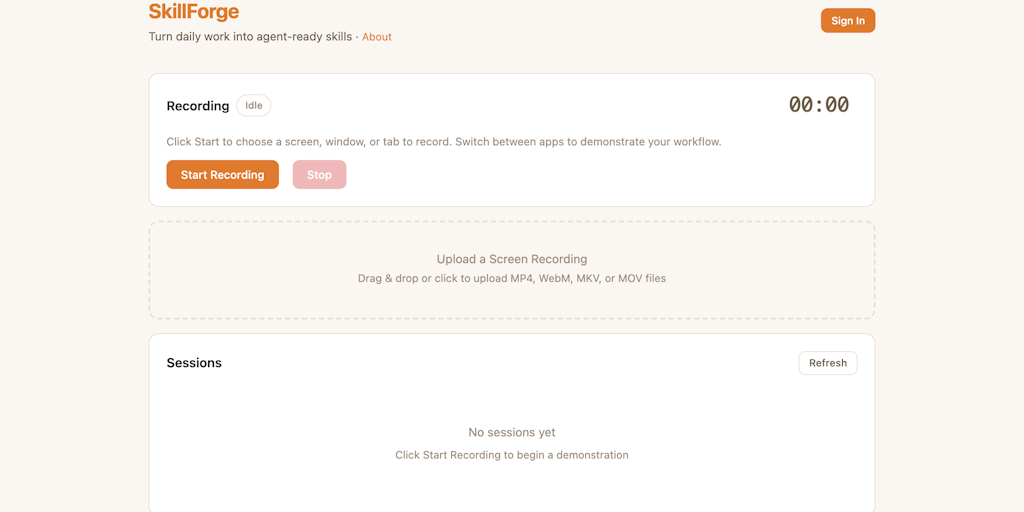
SkillForge: Convert Screen Recordings into AI Agent Skills
SkillForge is a new application that converts screen recordings of daily workflows into structured, replayable skills for AI agents. Instead
Product Hunt·4mo ago
Skillfile: Declarative Management Tool for AI Skills and Agents Across Coding Platforms
Skillfile is a tool for managing AI skills and agents declaratively, similar to package managers for software dependencies. It allows develo
 github.com·3mo ago
New Alibaba AI framework skips loading every tool, cutting agent token use 99%
VentureBeat·2d ago
Agent Skills Directory: Cross-Platform Search for AI Agent Capabilities
The article presents a cross-platform directory for AI agent skills called 'Agent Skills' that aggregates over 100,000 skills across 30+ pla
Product Hunt·4mo ago
Extending OpenAI Codex with Agent Skills for Task-Specific Workflows
The article explains how to use agent skills to extend OpenAI's Codex with task-specific capabilities. Skills package instructions, resource
 developers.openai.com·6mo ago
Comments
Sign in to join the conversation.
No comments yet. Be the first.