
























Systematic Study of Agent Memory Systems for LLMs Reveals No One-Size-Fits-All Architecture
By
[Submitted on 23 Jun 2026]
Summary
This paper presents a systematic experimental study of agent memory systems for LLM agents from a data management perspective. It proposes an analytical framework decomposing agent memory into four core modules: memory representation/storage, extraction, retrieval/routing, and maintenance. The authors evaluate 12 memory systems and two baselines across five benchmark workloads spanning 11 datasets. Key findings include: no single architecture dominates all scenarios; effectiveness depends on alignment between memory structure and workload bottleneck; and localized maintenance is more cost-efficient than global reorganization. The paper identifies promising directions for building truly agent-native memory systems.
Source

 Twitter / XSystematic Study of Agent Memory Systems for LLMs Reveals No One-Size-Fits-All Architecturearxiv.org
Key quotes
· 5 pulledMemory for large language model (LLM) agents has rapidly evolved from simple retrieval-augmented mechanisms into a data management system that supports persistent information storage, retrieval, update, consolidation, and dynamic lifecycle governance throughout agent execution.
Our extensive end-to-end evaluation shows that no single architecture dominates across all scenarios; instead, effectiveness depends heavily on how well the memory structure aligns with the workload bottleneck.
We reveal cost-performance trade-offs under realistic workloads, showing localized maintenance is more cost-efficient than global reorganization.
Based on these findings, we identify promising directions towards building truly agent-native memory systems.
Critical system-level concerns, including operational costs, architectural trade-offs across memory modules, and robustness under dynamic knowledge updates, remain insufficiently explored.
You might also wanna read


Agent Memory Is Distributed State Management, Not Magic
The article argues that "agent memory" in AI systems is fundamentally just distributed state management rebranded. It draws parallels betwee

Memori launches agent-native persistent memory infrastructure using structured knowledge graphs from agent trace data
Memori is a new agent-native memory infrastructure that enables AI agents to create structured, long-term persistent memory directly from ag
 Product Hunt·1mo ago
Redesigning Data Systems for LLM Agent Workloads: Addressing Agentic Speculation Challenges
This research paper argues that data systems need to be redesigned to better support LLM agents, which are predicted to become the dominant
arxiv.org·9mo ago
Advancing Agent Architectures: Beyond Shallow LLM Implementations
The article discusses the limitations of simple agent architectures using LLMs (Large Language Models) and introduces solutions like plannin
 blog.langchain.com·10mo ago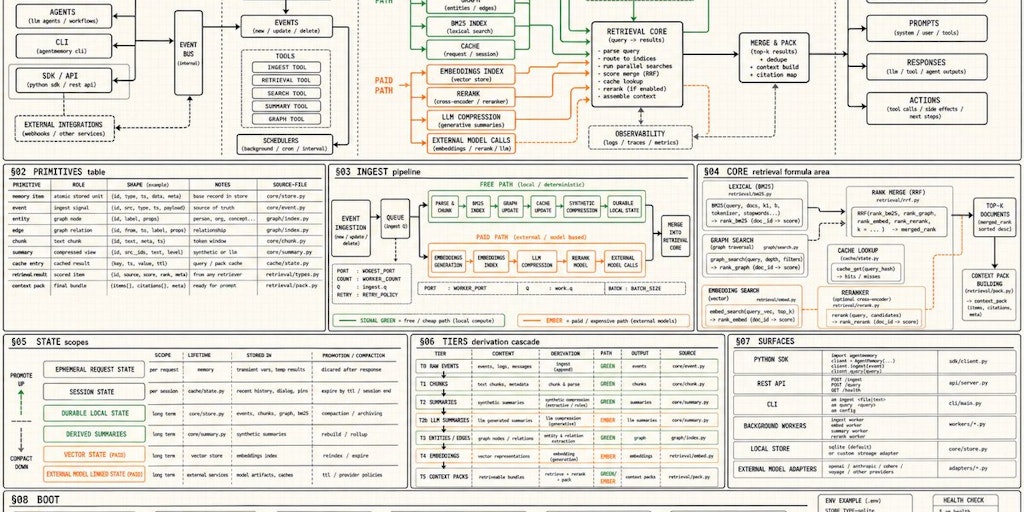
AgentMemory: Open-source persistent memory tool for AI coding agents
AgentMemory is an open-source tool that gives AI coding agents (like Claude Code, Codex, Cursor, etc.) persistent memory across sessions, so
Product Hunt·1mo ago
Deployment-Time Memorization in Foundation-Model Agents: Privacy-Utility Tradeoffs in Persistent Memory Systems
This paper introduces the concept of "deployment-time memorization" in foundation-model agents, where memory is an explicit function during
arxiv.org·10d agoComments
Sign in to join the conversation.
No comments yet. Be the first.