





















LinkedIn Researchers Propose Unified SLM Framework for Industrial Semantic Search Query Understanding
By
[Submitted on 22 May 2026]

Baker's choice. Dense with flavour, light on filler.
Summary
This paper presents a unified structured query understanding framework for industrial semantic search, developed and deployed at LinkedIn. The authors propose consolidating multiple task-specific query understanding components into a single Small Language Model (SLM) using schema-constrained generation. To address data bottlenecks, they introduce Query Illuminator, a dual-purpose framework serving as both a teacher model for auto-annotation/distillation and a surrogate judge for scalable evaluation. The approach was validated through offline and online tests within LinkedIn's Job Search system, with a cross-domain case study on People Search. Results show improved user engagement and reduced operational costs while meeting strict low-latency constraints on limited GPU resources.
Key quotes
· 4 pulledQuery understanding in large-scale industrial search systems is typically implemented as a cascade of disparate, task-specific components.
We propose and deploy a unified structured query understanding system that consolidates these heterogeneous functions into a single Small Language Model (SLM) that performs schema-constrained generation.
To address the data bottlenecks inherent in unified modeling, we introduce Query Illuminator, a dual-purpose framework serving as: (i) a teacher model for high-quality auto-annotation and distillation, and (ii) a surrogate judge for scalable evaluation where human labels are scarce.
The results show improved user engagement and reduced operational costs, achieved while satisfying strict low-latency serving constraints on limited GPU resources.
You might also wanna read


LinkedIn Launches AI-Powered People Search with Natural Language Queries
LinkedIn is introducing an AI-powered search feature that allows users to find people by describing who they're looking for using natural la
 The Verge·6mo ago
LMSYS Announces Day-0 Open-Source Support for DeepSeek-V4 with SGLang and Miles Stack
LMSYS Blog announces Day-0 support for DeepSeek-V4, a new AI model, with SGLang and Miles forming the first open-source stack for both infer
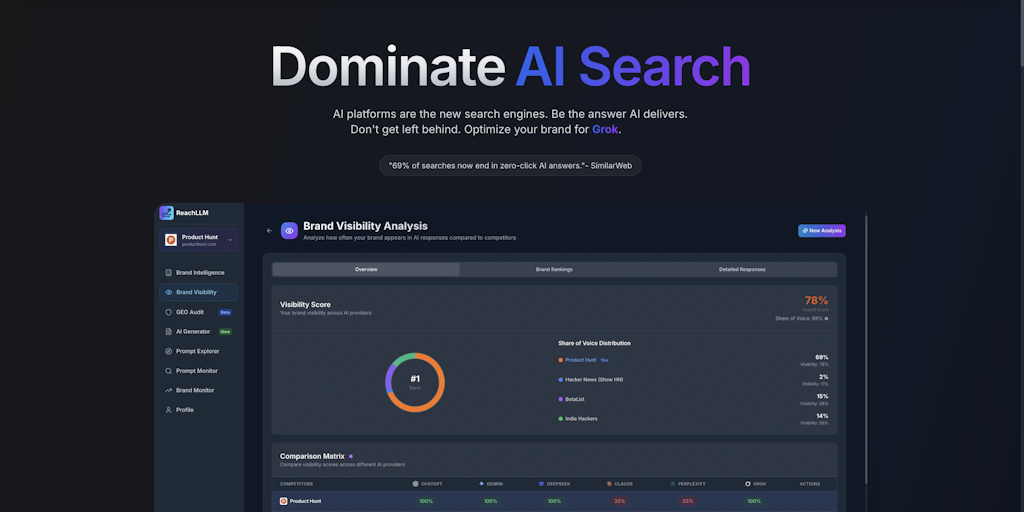
ReachLLM: AI Brand Monitoring and Optimization Platform for Generative Search Engines
ReachLLM is an AI-powered platform that helps businesses monitor how major language models (ChatGPT, Gemini, Claude, Perplexity, Grok, and D
 Product Hunt·9mo ago
Large Language Models Enable Effective Deanonymization of Pseudonymous Online Users
Researchers demonstrate that large language models can effectively perform large-scale deanonymization attacks, re-identifying pseudonymous
 arxiv.org·3mo ago