
























Disassembling the 80386 Microcode: A Deep Dive into Intel's Processor Architecture
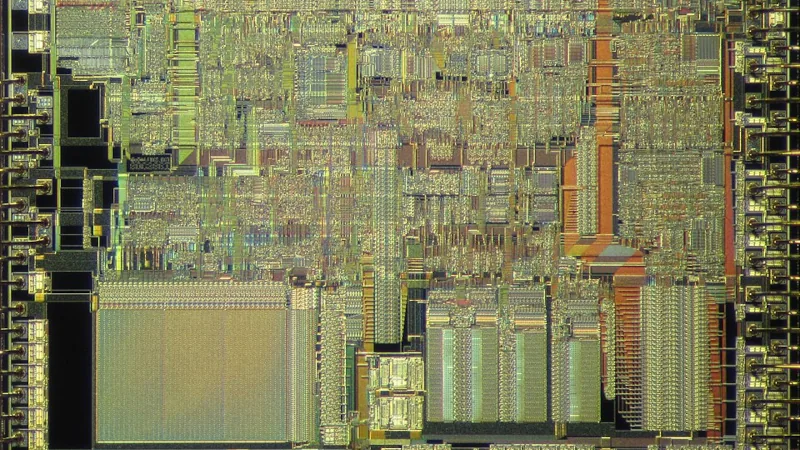
After I posted 8086 microcode disassembled, Ken Shirriff sent me a high-resolution image of the microcode ROM from the 80386. I didn't expect I would ever do anything with it for a couple of reasons…
Read the full articleYou might also wanna read

Open-Source z386 FPGA Core Gets Early Start Memory Access Feature
The Intel 80386 is a rather fascinating slice of computer history. It marked the first 32 bit X86 processor, and was a staple of early deskt
 hackaday.com·11d ago
Exploring new lands on Intel CPUs (SINIT code execution hijacking)
Today we're releasing a new paper where we describe exploiting a bug in Intel SINIT authenticated code module that allows for arbitrary code

User titles . reduce chip sets used, adding M1/M2/M3 chips .
Subject: User titles ... condensing the chip sets used, adding Mac Silicon chips .. Where's the M1/M2/M3 and their chip variants in the list
How Intel's 4004, the World's First Microprocessor, Shaped Modern IoT
Released in November 1971, the Intel 4004 became the world's first commercially available microprocessor, packing approximately 2,300 transi

Linux kernel 7.1 drops Intel 486 support, removes over 140,000 lines of legacy code
More than 140,000 lines of code bite the dust as ancient CPUs, bus mice, and other legacy leftovers face the chop
 theregister.com·1mo ago
Comments
Sign in to join the conversation.
No comments yet. Be the first.