
























2026 Enterprise Security Hardening: A Zero-Trust Implementation Guide for Linux and Windows Systems
By
HackMoN Ai
Summary
A comprehensive 2026 enterprise security hardening guide focused on zero-trust implementation for Linux and Windows systems. The article covers the current cybersecurity landscape where 30% of breaches stem from vulnerability exploitation and 70% from human errors, misconfigurations, and identity flaws. It emphasizes that over 90% of web applications expose attack surfaces through APIs, and provides command-level walkthroughs for system hardening, including SSH configuration, kernel parameter tuning, file permission management, and Windows security policy enforcement. The guide also addresses API security, identity management, and proactive monitoring strategies for enterprise environments.
Source
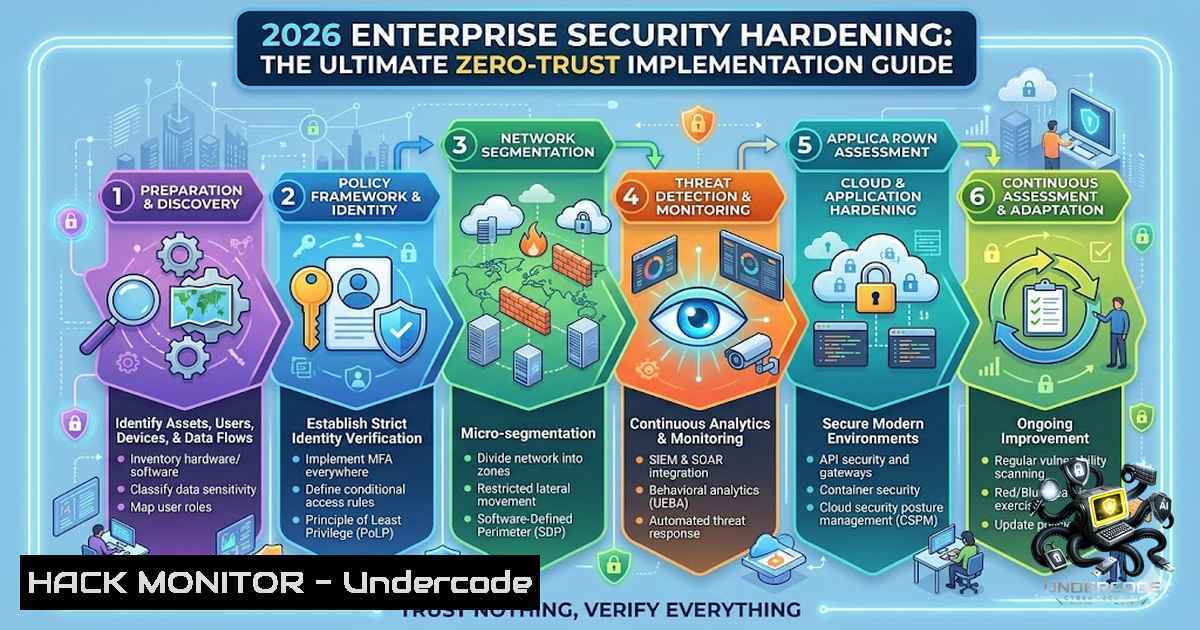
 bsky2026 Enterprise Security Hardening: A Zero-Trust Implementation Guide for Linux and Windows Systemsundercodetesting.com
Key quotes
· 3 pulledVulnerability exploitation now accounts for approximately 30% of initial breach vectors, while a staggering 70% of breaches stem from human errors, misconfigurations, and identity flaws.
With APIs controlling money, access, and core business logic, and over 90% of web applications exposing attack surfaces through APIs, organizations can no longer afford reactive security postures.
Monitor hackers like a pro. Get real-time
You might also wanna read


Exploiting CVE-2024-50264: Using Kernel-Hack-Drill to Overcome Linux Kernel Vulnerability Challenges
This technical article details the exploitation of CVE-2024-50264, a challenging Linux kernel vulnerability that won the Pwnie Award 2025 fo
 a13xp0p0v.github.io·10mo ago
CVE-2026-31431 "Copy Fail" Linux Kernel LPE Exploit Proof-of-Concept Released
This article presents a proof-of-concept exploit toolkit for CVE-2026-31431 ("Copy Fail"), a Linux kernel vulnerability in the algif_aead/au
 GitHub·2mo ago
Building Scalable Permission Systems for Enterprise Software
The article discusses the challenges of implementing permission systems for enterprise software as companies scale. It explains how naive pe
 eliocapella.com·6mo ago
Enhancing Confidential Computing: Rethinking Linux Cloud Infrastructure for Secure Virtual Machines
This article discusses the limitations of privacy in public cloud computing and explores technical approaches to enhance confidentiality for
 lwn.net·10mo ago
2026 Cybersecurity Assessment: The Gap Between Awareness and Resilience
Analyzing CVE-2026-31431: How Rootless Podman Containers Mitigate the "Copy Fail" Privilege Escalation
A technical deep-dive into CVE-2026-31431 ("Copy Fail"), a Linux kernel vulnerability. The author documents setting up a lab to run the expl
Comments
Sign in to join the conversation.
No comments yet. Be the first.