





















FeedBagel reads a few thousand articles a day, and more of them are written by AI every month. We went looking for a tool that could spot them, and found a lot of options at wildly different prices.
By FeedBagel, August 2026
Three things are worth knowing before you pick one:
- The 99% claims do not hold up. Nearly every company advertises about 99% accuracy. When Scribbr tested twelve of them, the ten it scored averaged 60%.
- Rewriting the text beats most of them. Run AI text through a rewriter and the best tools drop by about ten points. The weaker ones collapse.
- They wrongly accuse people writing in a second language. A Stanford study found detectors flagged 61% of real essays by people sitting an English exam as AI written. Never use these to accuse a named person of anything.
With that in mind, here are the options, starting with the ones you pay for:
Paid tools you can plug into your software
1. Pangram, the most accurate in independent testing
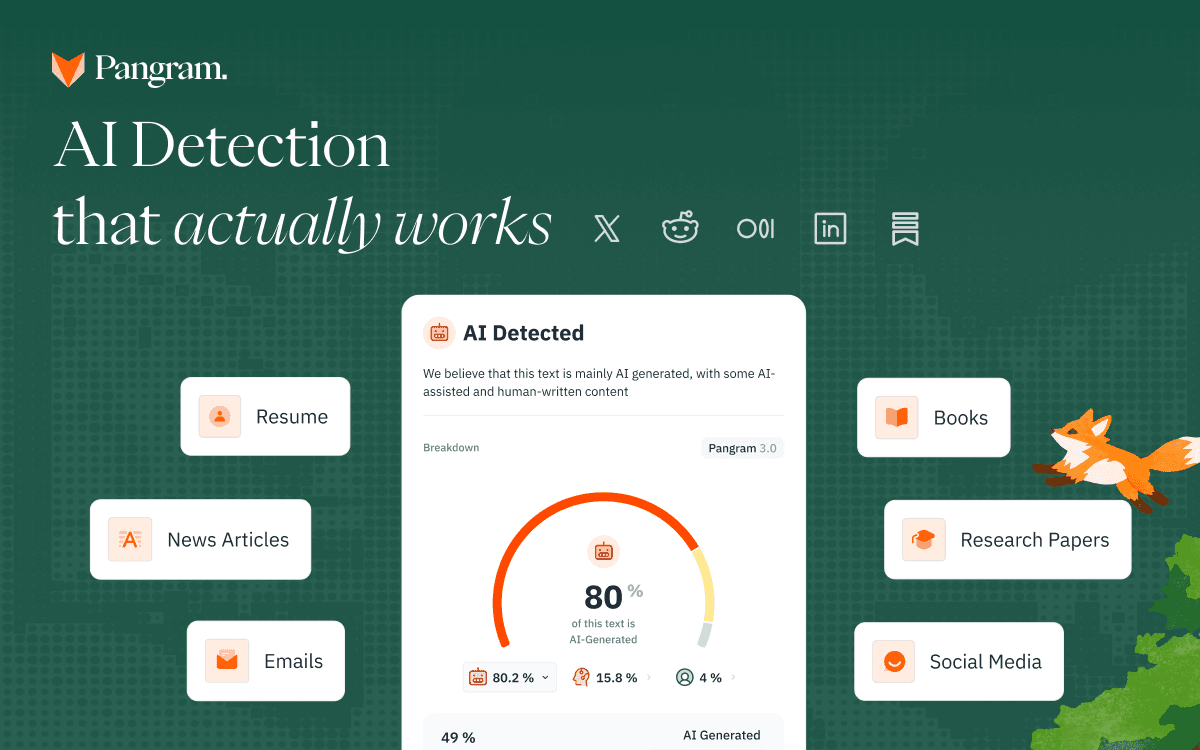
pangram.com · paid, free daily allowance
Pangram
Came out top in the Chicago Booth study, with almost no false accusals even on short text. The priciest option per word.
- Best evidence behind it. The only tool that came close to perfect in the one careful independent study we found, with a false accusal rate near zero.
- Handles short text better than most, which is where nearly everything else falls apart.
- Costs the most. Roughly 5p to 50p per thousand words depending on which version you use. Fine for a decision you have to justify, expensive for sorting a pile of articles.
- 2,000 words a day free if you just want to try it.
2. GPTZero, the safest bet on short text
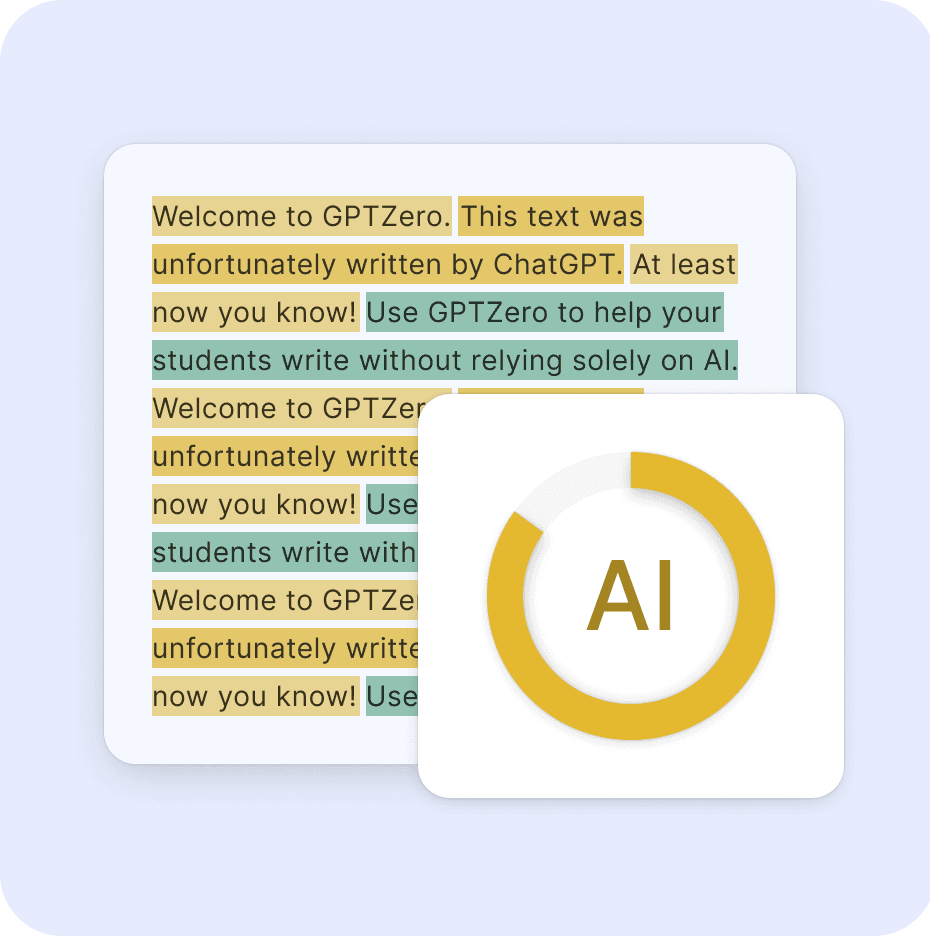
gptzero.me · paid, price on request
GPTZero
Scores 96% on short passages and rarely flags a human by mistake. Highlights which sentences it thinks are AI.
- Lowest rate of wrongly accusing humans among the tools on the RAID scoreboard.
- Sentence-level results, so you can see which parts it objects to rather than getting one number.
- You have to ring a salesperson to get a price for software access, which is a nuisance if you just want to test it.
3. Originality.ai, the cheapest with a proper API
originality.ai · from $14.95 a month
Originality.ai
One credit covers 100 words. Works out at roughly 7.5p to 12p per thousand words, and bundles a plagiarism checker.
- Clear, public pricing. One of the few that tells you the per-word cost without a sales call.
- Aimed at publishers, so it handles bulk checking and adds plagiarism detection on the same credits.
- Software access needs the $179 plan. The cheap tier is website only.
- Independent testing puts its miss rate higher than Pangram's, somewhere between 10% and 40% depending on which AI wrote the text.
4. Winston AI, the simplest pricing
gowinston.ai · from $10 a month
Winston AI
500,000 credits for $26 a month paid yearly, with a documented API. The pricing page does not say how many words a credit buys.
- Cheap at volume compared with everything else that publishes a price.
- Free trial of 2,000 credits, no card needed.
- Thin independent evidence. It has never appeared on the RAID scoreboard, so you are taking its own numbers on trust.
5. Copyleaks, if you already use it for plagiarism
copyleaks.com · from $16.99 a month
Copyleaks
The long-standing plagiarism checker, now with AI detection bolted on. Advertises 99.12% accuracy.
- Worth it if you are already a customer, since the AI check runs on the same credits as your plagiarism scans.
- Enterprise features like team accounts and reporting that the smaller tools do not have.
- The advertised accuracy is not backed up. It does not appear on any independent scoreboard we could find, and it scored well below its claim in Scribbr's testing.
6. Sapling, the easiest to try
sapling.ai · free tier, then paid
Sapling AI detector
Documented, self-serve API with a free tier. Claims 97% detection and under 3% false accusals on longer text.
- Sign up and start calling it, no sales conversation. The quickest way to get a real score into your own code.
- The free tier handles 2,000 characters a go, which is enough to test properly.
- Built by ex-Berkeley, Stanford, Meta and Google researchers, though like Copyleaks it has no independent scoreboard entry.
Free tools
7. Zhuque by Tencent, the best free one
matrix.tencent.com · free, website only
Zhuque AI Detection Assistant
Tops every setting on the RAID scoreboard, beating all the paid tools. Free, and it handles Chinese as well as English.
- Best scores on the board, including on rewritten text, which is where the paid tools struggle.
- Free with no account faff, and it does images as well as text.
- No way to plug it into your own software. It is a website you paste into, so it cannot check a few thousand articles a day.
8. ModernBERT AI detection, the best model to self-host
Hugging Face · free · around 1,300 downloads a month
modernbert-ai-detection-raid-mage
Trained on the RAID and MAGE datasets. Scores 0.99 on clean text and holds 0.93 on rewritten text, which beats several paid tools.
- Free forever, no per-article cost. The only ongoing cost is keeping it current as new AI models come out.
- Runs on an ordinary computer. There is a packaged version that needs no graphics card.
- Holds up when text has been rewritten better than most free options, and better than GPTZero on that specific test.
9. Desklib, the most used free model
Hugging Face · free · around 34,000 downloads a month
desklib/ai-text-detector-v1.01
The most downloaded credible free detector, with a separate version tuned for academic writing.
- Popular and well documented, so there is plenty of example code to copy.
- A version tuned for essays and papers, if that is what you are checking.
- Weaker on rewritten text, dropping to 0.84 where the ModernBERT model holds 0.93.
10. Open-Detector, the most recently updated
GitHub · 238 stars · updated March 2026 · MIT
Imalwayshere/Open-Detector
A BERT-based detector aimed at academic writing, updated in March 2026 and released under the MIT licence.
- Actively maintained, which matters more than raw score in a field that moves this fast.
- MIT licence, so you can use it commercially without worrying.
- No independent score yet. It has not been submitted to RAID, so you would need to test it yourself.
11. Binoculars, no training data needed
GitHub · 406 stars · updated May 2024 · BSD-3
ahans30/Binoculars
Spots AI text by comparing how two language models react to it, rather than by learning from examples.
- Nothing to retrain. Because it never learned from a fixed set of examples, it cannot be quietly overfitted to one benchmark.
- Very strong on ChatGPT text specifically, scoring 0.997 on that column.
- Uneven everywhere else, averaging 0.79, and it needs a language model loaded to run, so it is not cheap to operate.
12. Fast-DetectGPT, the quicker version of the same idea
GitHub · 424 stars · updated February 2026 · MIT
baoguangsheng/fast-detect-gpt
A faster take on the original DetectGPT method, published at ICLR 2024 and still being updated.
- Much faster than the method it replaces, which needed hundreds of rewrites of every document.
- Still maintained, unlike most research code from 2023.
- Scores below the trained models on the scoreboard, and it did not complete every column.
13. RADAR by IBM, built to survive rewriting
GitHub · 76 stars · updated September 2025 · Apache-2.0
IBM/RADAR
Trained against a rewriter on purpose, so it is meant to hold up when someone tries to disguise AI text.
- Barely drops on rewritten text, going from 0.66 to 0.62 where others lose ten points or more.
- Backed by IBM Research and published at NeurIPS.
- Its starting score is low. Being steady at 0.65 is worse than being shaky at 0.93, so treat it as a research reference rather than a tool.
14. slop-cop, spots AI writing habits in the browser
GitHub · 159 stars · updated May 2026 · MIT
awnist/slop-cop
Looks for the stylistic tells of AI writing rather than trying to prove a machine wrote it. Runs entirely in the browser.
- Answers a more useful question. Whether writing is thin and formulaic matters more than who typed it.
- Nothing leaves the browser, so there is no privacy worry and no server to run.
- Not a detector. It will not tell you a machine wrote something, and it should not be used as if it did.
15. distil-ai-slop-detector, the same idea, offline
GitHub · 93 stars · updated February 2026 · Apache-2.0
distil-labs/distil-ai-slop-detector
A small model that detects AI-generated text locally in your browser, with nothing sent anywhere.
- Fully offline, which makes it usable on text you cannot send to a third party.
- Small enough to be quick on ordinary hardware.
- New and unproven, with no independent score behind it.
Two places to check any of these claims
The RAID scoreboard
GitHub · 208 stars · updated August 2026 · MIT
liamdugan/raid
Ten million documents, eleven types of writing and twelve disguise tricks, with the answer key kept secret. Run by researchers at the University of Pennsylvania.
- The only place paid tools and free models are scored on the same hidden test.
- You can filter by disguise trick, which is the single most useful thing on the site. Compare a tool on clean text and on rewritten text and the marketing falls away.
- It only covers AI models from 2023 and 2024. There is no Claude, Gemini, GPT-5, DeepSeek or Qwen on it, so read every score as a floor rather than a promise.
- The live board is at raid-bench.xyz.
The Chicago Booth study
Chicago Booth Review · September 2025
Do AI Detectors Work Well Enough to Trust?
Two researchers tested four detectors on 2,000 pieces of human writing and AI copies of each, at four different lengths.
- Properly independent, with no product to sell, which rules out most of what you find searching for detector comparisons.
- Tests short text, and shows that everything falls apart under fifty words.
- Only covers four tools, so it settles less than you would like.
Where this leaves us
For FeedBagel the answer is a free model we run ourselves, scoring every article and feeding that into the ranking that already decides which stories cluster together. A rough signal on everything is worth more to us than a good signal on the few we could afford to send to a paid service, and no score will ever be shown as a label on a named writer.
If you are picking one for yourself, the honest summary is that Pangram wins on accuracy, Originality and Winston win on price, Zhuque wins on being free, and the free ModernBERT model is close enough to the paid tools that it is worth trying first. Whatever you choose, test it again in a few months, because every number here has a short shelf life.
Sources
- Scribbr, 12 Best AI Detectors - the 60% average, GPTZero at 52%. Scribbr sells a detector and ranked its own first.
- Dugan et al., RAID, ACL 2024 - how the scoreboard is built and why the answer key is secret.
- Chicago Booth Review on the Jabarian and Imas study - the under 1% false accusal figures and the Pangram result.
- Liang et al., GPT detectors are biased against non-native English writers - the 61.22% figure, and 89 of 91 essays flagged by at least one tool.
- University of Waterloo, on switching off Turnitin's AI detection - September 2025, including human writing marked 100% AI.
Useful links
- How stories group on FeedBagel - the sorting a detector score would feed into.
- Who was scraping FeedBagel at 1,000 requests a minute - the other half of our machine traffic problem.
- About FeedBagel - what happens to articles once they are in.