





















Living a Solstice Year: Reflections on Completing Month 1 of a 13-Month, 28-Day Calendar
By
Amanda

Front-window bakery material. Catches the eye, delivers the goods.
Summary
A personal reflection on adopting a 13-month calendar system where the year begins at the Winter Solstice instead of January 1. The author describes completing the first 28-day month of this alternative calendar in 2026, exploring how changing the structure of time perception—without changing daily routines—altered their experience of time passing. The piece is a lived, introspective account of how arbitrary calendar conventions shape our relationship with time.
Key quotes
· 5 pulledI just reached the end of Month 1 in 2026.
This year, as I've lived it, didn't begin on January 1. It began at the Winter Solstice.
I didn't change my job. I didn't change my routines. I didn't leave the world everyone else is living in.
But something shifted anyway.
Time felt different.
You might also wanna read


Ancient Monuments Aligned with Winter Solstice Sunrise and Sunset
The article explores ancient monuments across the Northern Hemisphere that align precisely with the winter solstice sunrise and sunset. Thes
 bbc.com·5mo ago
One year without alcohol: A personal journey of sobriety and reflection
The author recounts quitting alcohol for a full year starting in January 2025, driven partly by spite after a conversation about "damp Janua
 DYNOMIGHT·1mo ago
Analyzing Calendar Coincidences: Why Ash Wednesday Wasn't Included in Previous Post
The article discusses calendar coincidences, specifically addressing why the author didn't include Ash Wednesday in a previous post about Ra
 leancrew.com·2mo ago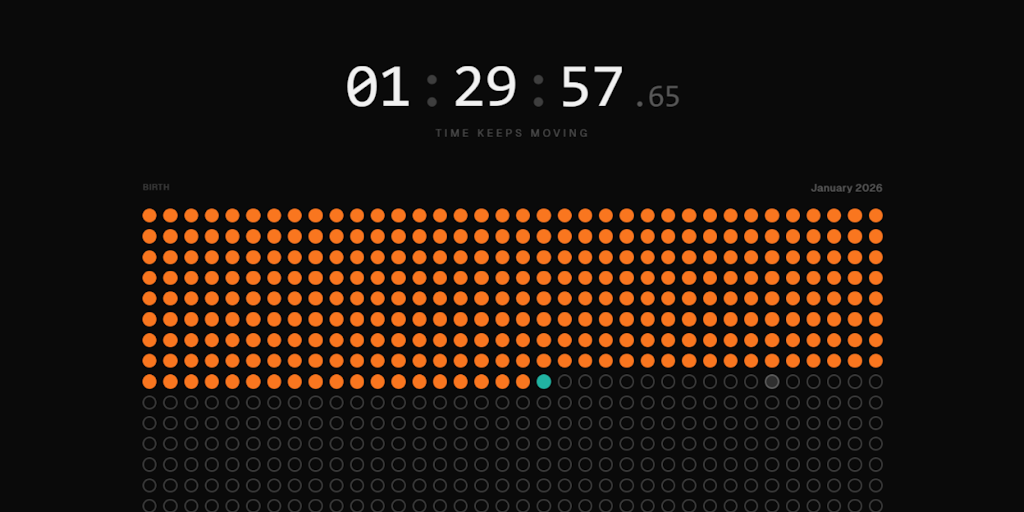
intnt: Visualize Your Life as 1,080 Months to Focus on One Goal at a Time
intnt is a digital tool that visualizes a person's entire life as a grid of 1,080 months (assuming a 90-year lifespan), inspired by Tim Urba
 Product Hunt·5mo ago
Why Successful Creatives Use January for Foundation-Building, Not Goal-Setting
The article challenges conventional January productivity advice for creatives, arguing that setting massive goals immediately after the holi
 Creative Boom·5mo ago
British Columbia to End Seasonal Time Changes, Adopt Permanent Daylight Time Starting March 8
British Columbia will permanently adopt daylight time starting March 8, ending the practice of changing clocks twice a year. Premier David E
 cbc.ca·3mo ago