





















Technical Analysis of Local RAG Implementation: Tradeoffs Between Inference Speed and Retrieval Accuracy
By
tmaly

Pulled from the oven just right. Trustworthy, fact-dense, deeply satisfying.
Summary
The article discusses local RAG (Retrieval-Augmented Generation) implementation, focusing on model performance tradeoffs between inference speed and retrieval accuracy. The author shares insights from interactions with model creators, comparing different approaches including a 32M parameter model that uses tokenization + lookup table + averaging versus a 23M parameter transformer-based model. The discussion covers technical details about inference speeds (~22 documents per second on CPU) and the performance compromises involved in different architectural choices for local RAG systems.
Key quotes
· 4 pulledThe tradeoff here is that you get even faster inference, but lose on retrieval accuracy
Specifically, inference will be faster because essentially you are only doing tokenization + a lookup table + an average
So despite the fact that their largest model is 32M params, you can expect inference speeds to be higher than ours, which 23M params but it is transformer-based
I am not sure about typical inference speeds on a CPU for their models, but with ours you can expect to do ~22 docs per second
You might also wanna read


RTP-LLM: Alibaba's High-Performance Inference Engine for Large Language Model Deployment
This paper presents RTP-LLM, a high-performance inference engine developed by Alibaba for industrial-scale deployment of Large Language Mode
 arxiv.org·1d ago
Building a Minimal RAG System from Scratch: PDF to Highlighted Answers in ~100 Lines of Python
A hands-on tutorial that builds the smallest functional RAG (Retrieval-Augmented Generation) system from scratch using about 100 lines of Py
 towardsdatascience.com·23h ago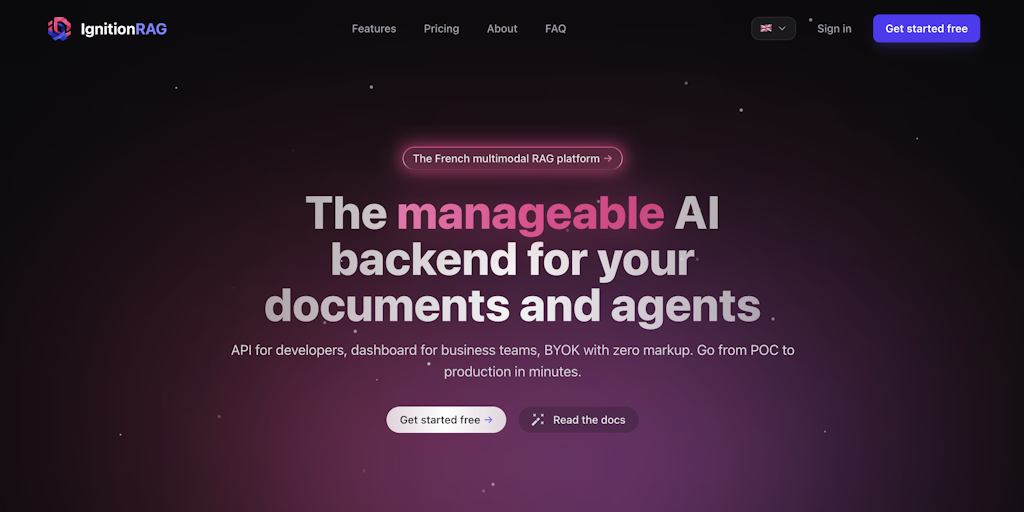
IgnitionRAG: Managed RAG Backend Platform for Document Ingestion and AI Agent Deployment
IgnitionRAG is a managed RAG (Retrieval-Augmented Generation) backend platform that enables users to ingest various document types (PDF, DOC
 Product Hunt·1mo ago