





















Siamese LLM Dual-Encoder with ROAR for Semantic Product Search in E-Commerce
By
[Submitted on 31 May 2026]

Right out the toaster. Reliable, with some real depth.
Summary
This paper presents a Siamese LLM dual-encoder for semantic retrieval in e-commerce search, addressing challenges of short, noisy queries over large product catalogs. The model uses a two-stage training pipeline: contrastive learning with a false-negative margin mask to handle near-duplicate products, followed by Relative Odds Alignment for Retrieval (ROAR), a preference optimization objective that extends Bradley-Terry to variable-sized graded relevance groups. Training data progresses from substitute query-product pairs (coarse semantic supervision) to graded relevance annotations (fine-grained ranking). The system accurately retrieves exact matches while ordering substitutes and complementary products, with gains confirmed across query-frequency strata and business verticals, validated through live A/B deployment at scale.
Key quotes
· 4 pulledSemantic retrieval in e-commerce must handle short, noisy, and colloquial queries over large product catalogs with fine-grained attribute distinctions.
We present a Siamese LLM dual-encoder trained through a two-stage pipeline: contrastive learning with a false-negative margin mask to prevent penalization of near-duplicate products, followed by Relative Odds Alignment for Retrieval (ROAR).
The resulting system accurately retrieves exact matches while correctly ordering substitutes and complementary products, with gains confirmed across query-frequency strata and business verticals.
Statistical significance validated through live A/B deployment at scale.
You might also wanna read


Direct Corpus Interaction: A New Retrieval Paradigm for Agentic Search Without Embedding Models
This research paper introduces Direct Corpus Interaction (DCI), a novel approach to retrieval for agentic search that bypasses traditional e
 arxiv.org·29d ago
Theoretical Limitations of Vector Embedding Models for Information Retrieval
This research paper examines the fundamental theoretical limitations of vector embedding models for retrieval tasks. The authors demonstrate
arxiv.org·9mo ago
LLMNet: Offline AI-Powered Search Engine for Local Knowledge Bases
LLMNet is an open-source project that provides an offline, private AI-powered search experience running entirely on local machines. It trans
 github.com·4mo ago
Building a Semantic Search Engine with PartyKit's Vector Database in 160 Lines of Code
The article explains how to build a highly effective search engine using PartyKit's new vector database and embedding model capabilities. It
 blog.partykit.io·5mo ago
Implementing Hybrid Semantic Search in SQLite with Binary Embeddings and Hamming Distance
This technical article demonstrates how to implement semantic search in SQLite using binary embeddings and Hamming distance, enabling hybrid
notnotp.com·3mo ago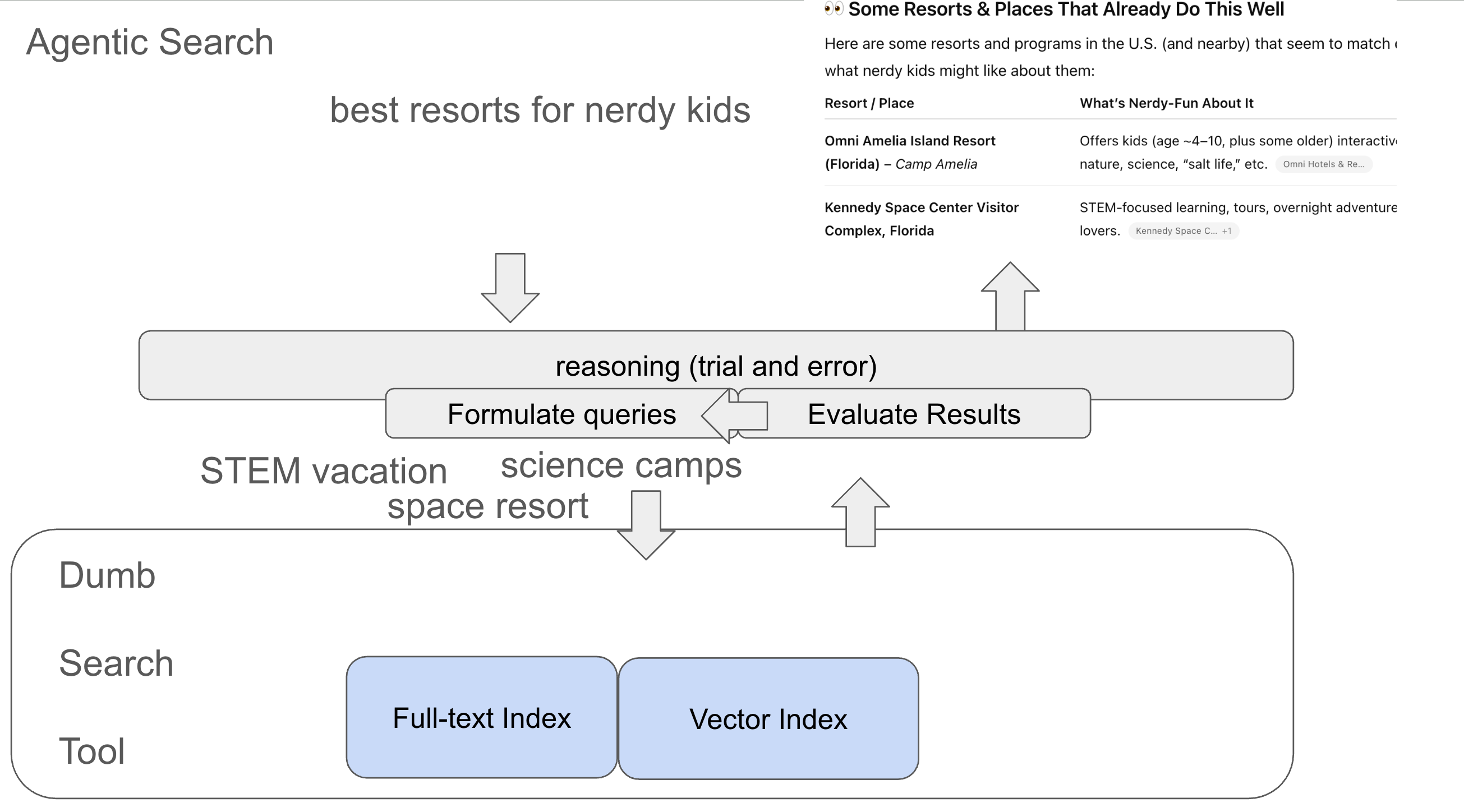
How AI agents are evolving RAG systems from keyword search to iterative, reasoning-based search experiences
The article discusses how AI agents are transforming traditional RAG (Retrieval-Augmented Generation) systems by moving beyond simple keywor
 softwaredoug.com·8mo ago