





















Ocean response to the February 2020 marine cold air outbreak in the Nordic Seas analyzed using GLORYS12 reanalysis
By
Svenya Chripko, Thomas Spengler, Stefanie Semper, and Kjetil Våge

The bagel they save for the regulars. Don't skim, savour.
Summary
This scientific article investigates the ocean response to the intense marine cold air outbreak (MCAO) that occurred in the Nordic Seas from 2–6 February 2020, using the GLORYS12 global eddy-resolving ocean and sea ice reanalysis. The study examines how different regions of the Nordic Seas responded to this event, finding that the western part (Greenland Sea and northern interior Iceland Sea) was primarily affected by air-sea heat exchanges, with mixed-layer cooling of approximately 0.02°C per day and deepening of over 30 meters per day in some areas. In contrast, the eastern part (Norwegian Sea) showed that air-sea heat exchanges were masked by stronger lateral oceanic heat transport, with cooling or warming an order of magnitude higher. The research highlights the large spatial variability in ocean mixed-layer response to a single MCAO event and provides results consistent with observational studies from the Iceland and Greenland Seas.
Key quotes
· 5 pulledThe western part of the Nordic Seas (Greenland Sea and northern interior Iceland Sea) was primarily affected by the air–sea heat exchanges, with an overall mixed-layer cooling of approximately 0.02 °C d−1 during the event in the interior Greenland Sea and a deepening of more than 30 m d−1 in some areas.
In the eastern part (Norwegian Sea), on the other hand, the air–sea heat exchanges were masked by stronger lateral oceanic heat transport, with a cooling or warming of an order of magnitude higher.
GLORYS12 generally provides consistent results with observational studies from the Iceland and Greenland Seas during MCAOs, highlighting the large spatial variability in the ocean mixed-layer response to a single MCAO event in the Nordic Seas.
Marine Cold Air Outbreaks (MCAOs) play a crucial role in wintertime water mass transformation in the Nordic Seas.
In the interior part of the northern Iceland Sea, the mixed-layer depth increased by approximately 5 m d−1, while it decreased near the boundary current in the western Iceland Sea by approximately 8 m d−1.
You might also wanna read

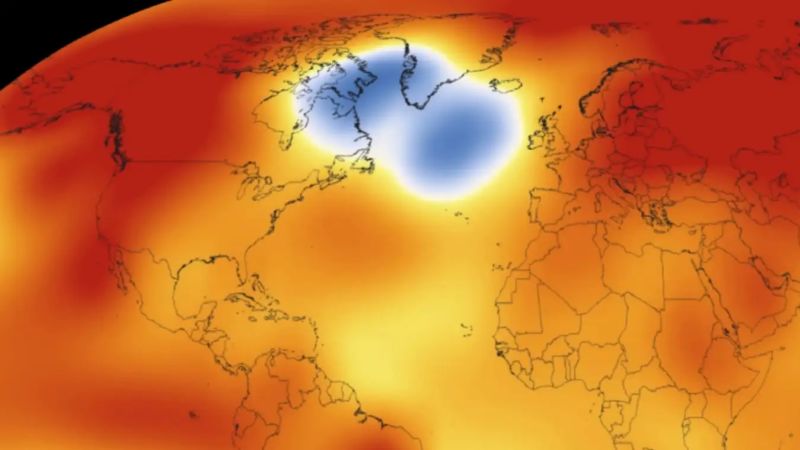
Study links North Atlantic 'cold blob' to potential AMOC collapse and climate tipping point
A large patch of water in the North Atlantic Ocean, south of Greenland and Iceland, has been cooling by nearly 1°C since 1900 while the rest
 cnn.com·1d ago
Study identifies three-phase mechanism driving Antarctic sea ice decline since 2015
This scientific study analyzes the drivers of Antarctic sea ice decline since 2015, using an observationally constrained sea ice–ocean model
 Science Advances·1mo ago
Scientists Warn Atlantic Ocean Current System (AMOC) May Be Nearing Collapse
Scientists are increasingly concerned that the Atlantic Meridional Overturning Circulation (AMOC), a critical ocean current system that tran
 Yale E360·1mo ago
Scientific Analysis: The Atlantic Meridional Overturning Circulation (AMOC) and Its Potential Collapse Due to Climate Change
The article discusses the potential collapse of the Atlantic Meridional Overturning Circulation (AMOC), also known as the Gulf Stream, which
 thatjoescott.com·4mo ago
Physics-Based Indicators for Predicting Atlantic Ocean Circulation Collapse Under Climate Change
This scientific research paper proposes physics-based indicators for detecting the onset of Atlantic Meridional Overturning Circulation (AMO
 agupubs.onlinelibrary.wiley.com·9mo ago
Iceland Declares Potential Ocean Current Collapse a National Security Threat
Iceland's government has declared the potential collapse of the Atlantic Meridional Overturning Circulation (AMOC) ocean currents a national
 edition.cnn.com·6mo ago