





















Python Type Checker Comparison: Evaluating Conformance to Typing Specifications
By
ocamoss

Hand-rolled, kettle-boiled, baked to perfection. Worth every minute at the bakery.
Summary
This article examines how well different Python type checkers conform to the official Python typing specification. It discusses the history of Python's type system starting with PEP 484 and mypy as the de-facto standard, then analyzes the conformance status of various type checkers including Pyrefly, Ty, Pyright, and Mypy. The article explains what typing spec conformance means, why it matters for developers, and what limitations exist in current conformance measurements.
Key quotes
· 3 pulledWhen you write typed Python, you expect your type checker to follow the rules of the language. But how closely do today's type checkers actually follow the Python typing specification?
Python's type system started with PEP 484. At the time, the semantics of the type system were mostly defined by the reference implementation, mypy. In practice, whatever mypy implemented became the de-facto specification.
Learn what it means to conform to the Python typing spec, why it matters, and the conformance status of each type checker including Pyrefly, Ty, Pyright and Mypy.
You might also wanna read

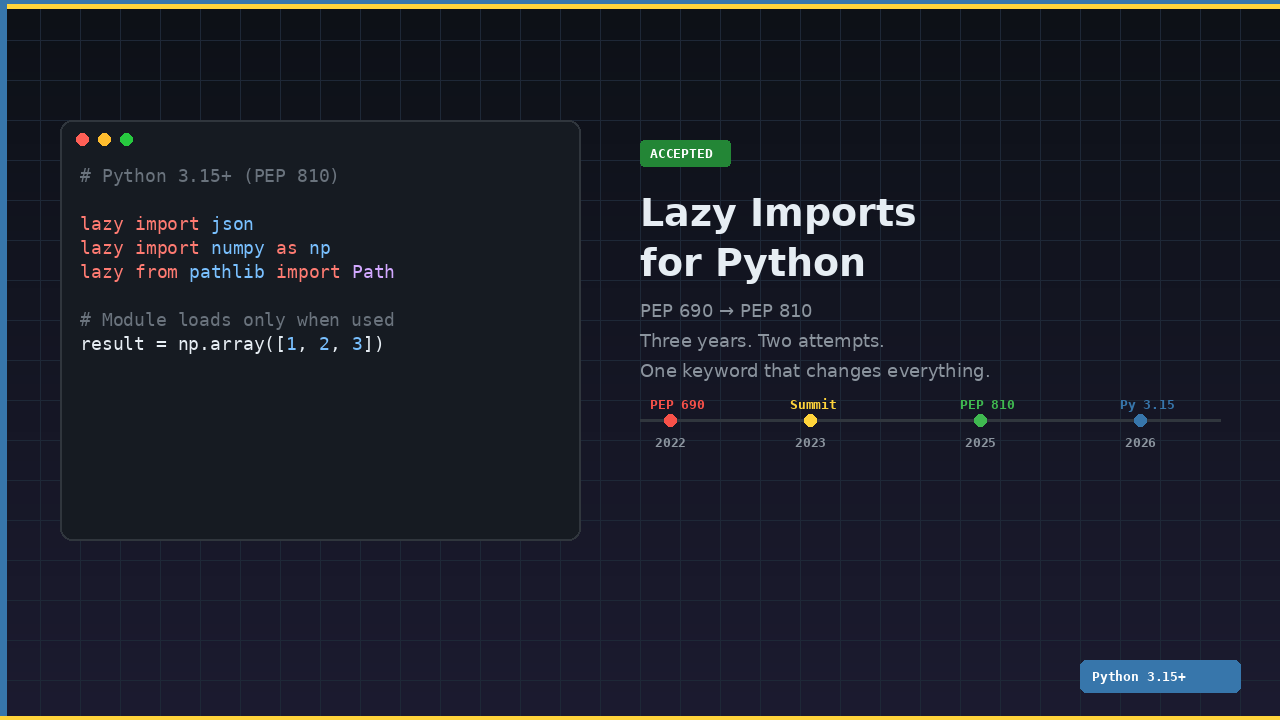
Python's Journey to Lazy Imports: How Production Needs Drove a Three-Year Development Process
The article details Python's journey to implementing lazy imports, a feature that allows modules to be loaded only when actually needed rath
 techlife.blog·2mo ago
Python 3 String Encoding Solution: Handling Mixed ASCII and UTF-8 Bytestrings
The article discusses a Python programming challenge involving mixed string encodings (ASCII and UTF-8) in Python 3 environments. The author
 engrenage.ch·3mo ago
Exploring Frozen Dictionaries in Python for Concurrent Programming
The article discusses the concept of a 'frozen' dictionary for Python, addressing the mutability issues of standard dictionaries in concurre
 lwn.net·5mo ago
Why Average LLM Use Is Likely Destroying Value in Software Development
The author argues that, contrary to prevailing hype, the average use of Large Language Models (LLMs) is likely destroying value rather than
 unessays.substack.com·16h ago
How AI Accelerated Prototyping: From Idea to Tangible in Record Time
The author reflects on how AI has transformed their prototyping workflow. Previously, the biggest bottleneck was the time needed to scaffold
 darylcecile.net·16h ago
GitLab 19.0 launches with Secrets Manager, agentic workflows, and self-hosted AI models
GitLab 19.0 has been released, positioning itself as an intelligent orchestration platform for DevSecOps. The release includes expanded secr
 bit.ly·1d ago