





















Nostr: An Open Protocol for Decentralized Communication
By
dtj1123

Lightly browned and well buttered. A solid pick from the rack.
Summary
The article describes Nostr, an open protocol and communication standard that enables decentralized information sharing through a scalable architecture of clients and servers. It emphasizes Nostr's apolitical nature, freedom from corporate or government control, and its accessibility for both developers and users to build and utilize the platform.
Key quotes
· 3 pulledNostr is an apolitical communication commons.
A simple standard that defines a scalable architecture of clients and servers that can be used to spread information freely.
Not controlled by any corporation or government, anyone can build on Nostr and anyone can use it.
You might also wanna read

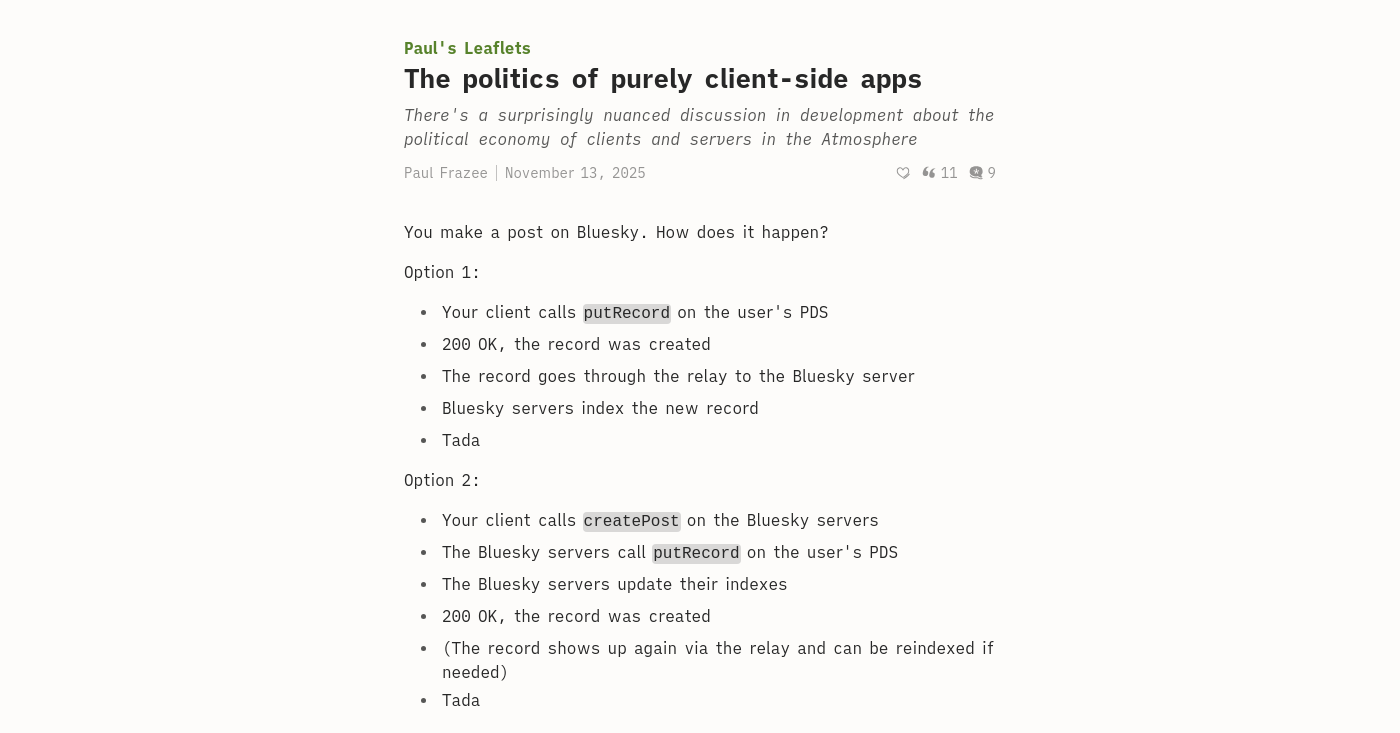
Architectural Politics: Client-Server Relationships in Atmosphere Platform Design
The article examines the political and architectural implications of client-server relationships in the Atmosphere platform, specifically co
 pfrazee.leaflet.pub·6mo ago
Comparative Analysis of Nostr and ATProto Protocols
This article provides a comparative analysis of Nostr and ATProto protocols, focusing on their technical and philosophical differences witho
 shreyanjain.net·7mo ago
Technical Overview of Bluesky's AT Protocol Architecture
This article provides a comprehensive technical overview of Bluesky's AT Protocol (ATProto), explaining the network architecture, server com
 mackuba.eu·9mo ago
NVIDIA Announces "Hack for Impact" London Event for Autonomous AI Agent Development
NVIDIA is hosting a "Hack for Impact" event in London, challenging participants to build autonomous agentic applications using open-source m
 luma.com·49m ago
Four practical steps to control Azure Foundry token costs for agentic AI workloads
This article provides practical guidance on controlling token costs in Microsoft Azure Foundry, particularly for agentic AI workloads where
 purplefrogsystems.com·2h ago
MerLean-Prover: A Recursive Agent Harness for Lean 4 Theorem Proving Outperforms Baselines
MerLean-Prover is an end-to-end Lean4 theorem prover that replaces 'sorry' declarations with kernel-checkable proofs using three agent types
 arxiv.org·2h ago