





















Latent learning: How episodic memory could improve machine learning generalization
By
Andrew Kyle Lampinen, Martin Engelcke, Yuxuan Li, Arslan Chaudhry, James McClelland

Pale and squishy. Not ruined, just not done.
Summary
This article examines why machine learning systems fail to generalize, drawing inspiration from cognitive science. It argues that parametric ML systems lack "latent learning"—the ability to absorb information not immediately relevant to the current task but potentially useful for future tasks. Using synthetic benchmarks, the research connects failures like the reversal curse in language modeling to new findings in agent-based navigation, suggesting that incorporating episodic memory mechanisms could improve generalization in ML systems.
Key quotes
· 3 pulledone weakness of parametric machine learning systems is their failure to exhibit latent learning---learning information that is not relevant to the task at hand, but that might be useful in a future task
we draw inspiration from cognitive science to argue that one weakness of...
we show how this perspective links failures ranging from the reversal curse in language modeling to new findings on agent-based navigation
You might also wanna read
The Significance of Generalization in AI Systems and the Quest for Consciousness
The blog post discusses the importance of generalization in building AI systems with deep learning, emphasizing the significance of diverse

AI agent memory libraries borrow cognitive science terms without the underlying architecture
This article critically examines how AI agent memory libraries borrow terminology from cognitive science (episodic, semantic, procedural mem
 brgsk.xyz·17d ago
Study Reveals LLMs' Simulated Reasoning Abilities Are Fragile and Limited
Researchers found that large language models (LLMs) exhibit "simulated reasoning" abilities, which they describe as a "brittle mirage." The
 arstechnica.com·10mo ago
Human Conversations Display LLM-Like Failure Modes: Limited Context, Overgeneration, and Hallucination
This reflective essay explores how classic Large Language Model (LLM) failure modes—such as limited context, overgeneration, poor generaliza

Why supervised learning AI cannot make truly novel scientific discoveries
The article presents a recorded speech arguing that generative AI trained via supervised learning is fundamentally incapable of making truly
 twitter.com·3d ago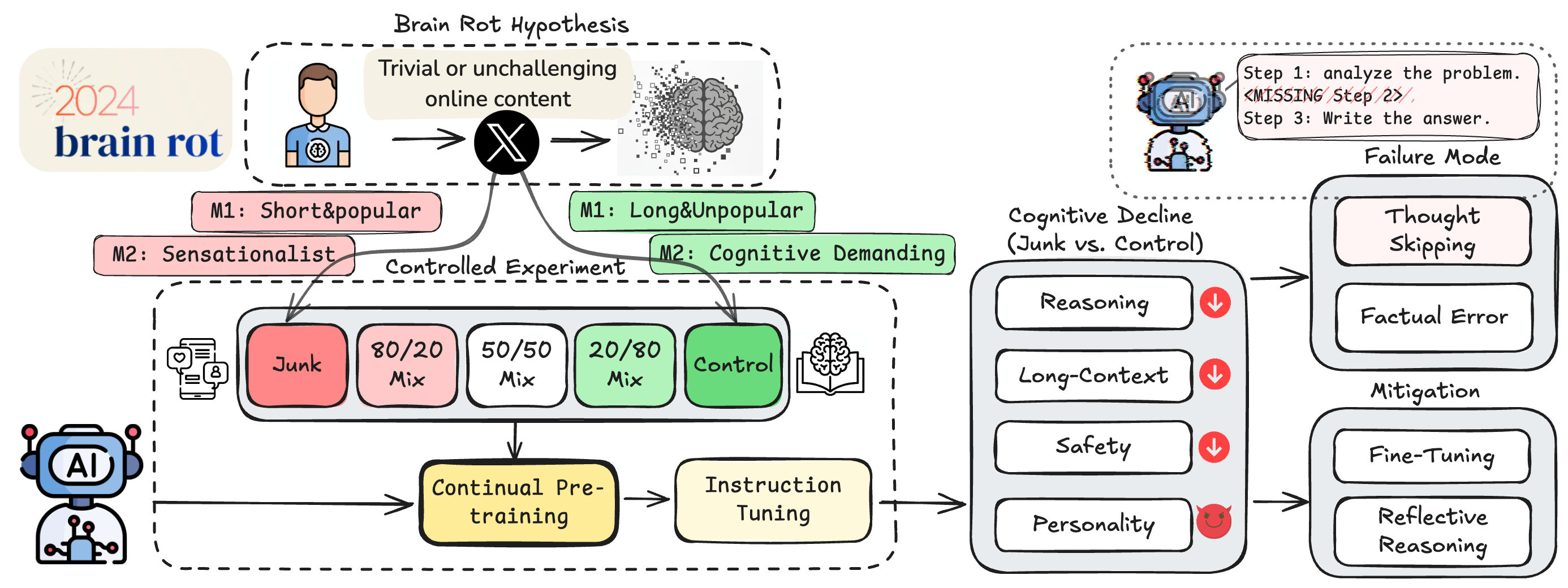
Research Shows LLMs Develop Cognitive Degradation from Social Media Training Data
This research paper introduces the concept of 'LLM Brain Rot' - a phenomenon where large language models (LLMs) experience cognitive degrada