





















JWST survey reveals how massive stars rapidly clear their birth cocoons in nearby galaxies
By
Philip Plait

Hot, fresh, and worth queueing round the block for.
Summary
A survey of four nearby galaxies using the James Webb Space Telescope reveals how massive stars clear away their surrounding gas and dust cocoons, allowing star clusters to emerge faster than previously thought. The study provides important new details about the birth process of massive stars and how they influence their galactic environments.
Key quotes
· 3 pulledMassive stars are the culprit, dissolving their cosmic chrysalises
Sometimes there are questions in astronomy that seem like they have easy answers, but then when you look into them a bit more carefully you find it gets confusing fast
A survey of four nearby galaxies reveals important details on how these beasts are born
You might also wanna read

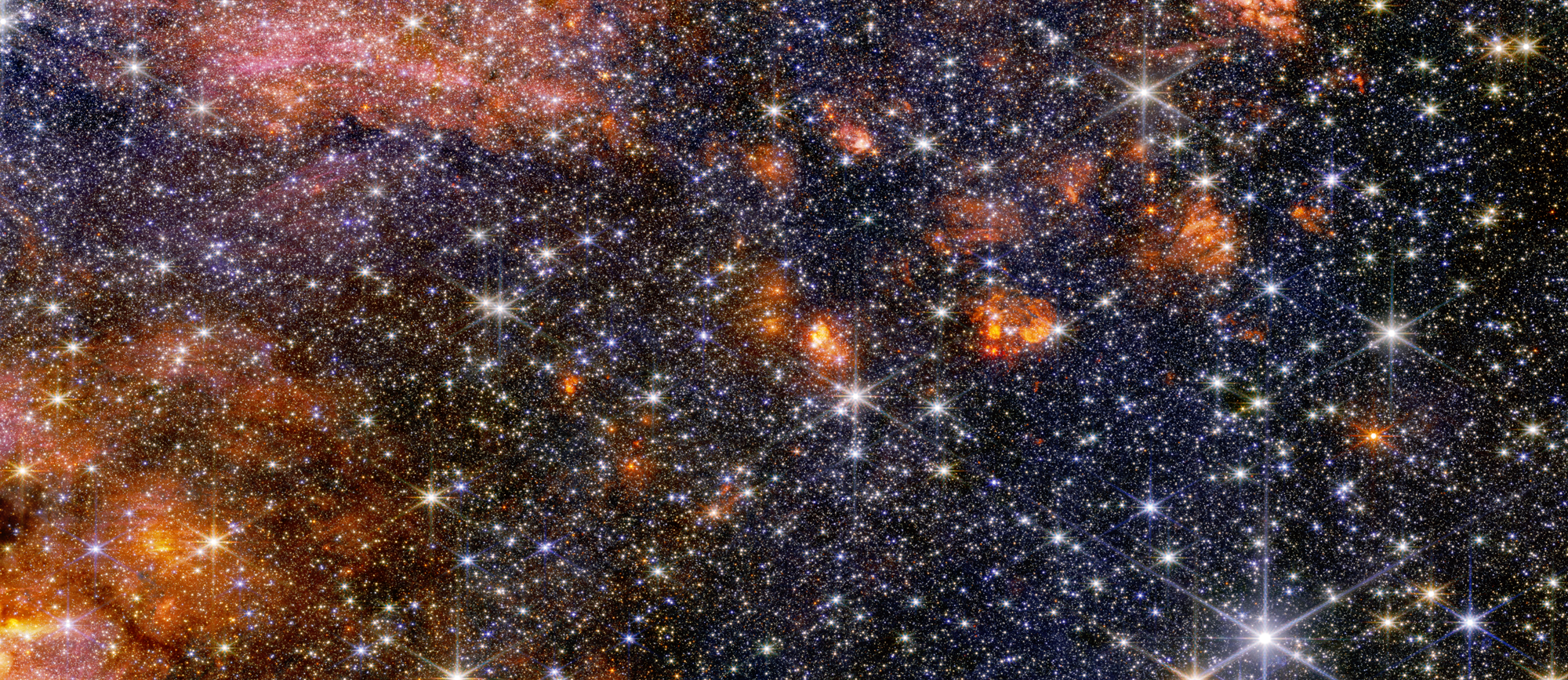
James Webb Space Telescope peers deep into the heart of star formation in our Milky Way galaxy
 space.com·8mo ago
JWST Discovers Mysterious 'Little Red Dots' in Early Universe, Possibly New Celestial Objects
NASA's JWST telescope has discovered hundreds of 'little red dots' in the early universe, which may represent a new type of celestial object
 science.org·10mo ago
JWST Confirms Discovery of Exceptionally Luminous Galaxy at z=14.44, 280 Million Years After Big Bang
The James Webb Space Telescope has confirmed the discovery of MoM-z14, an exceptionally luminous galaxy that existed just 280 million years
 astro.theoj.org·3mo ago
James Webb Telescope Discovers Massive Isolated Black Hole in Early Universe
The James Webb Space Telescope has discovered an enormous 'naked' black hole in the early universe that weighs 50 million solar masses and a
 quantamagazine.org·8mo ago
James Webb Space Telescope Captures First Direct Image of Exoplanet
The James Webb Space Telescope has captured its first direct image discovery of an exoplanet by identifying the infrared light of a likely p
smithsonianmag.com·11mo ago
Candidate Giant Planet Detected in Habitable Zone of α Cen A via JWST Observations
The article reports on coronagraphic observations of the star α Cen A using the James Webb Space Telescope's MIRI instrument. A candidate gi
 arxiv.org·10mo ago