





















A Technical Guide to Event-Driven Architecture for Production Multi-Agent Systems
By
Abhilash Pakalapati

Pulled from the oven just right. Trustworthy, fact-dense, deeply satisfying.
Summary
This article by Abhilash Pakalapati provides a technical guide on transitioning from brittle synchronous multi-agent AI systems to resilient Event-Driven Architecture (EDA) for production environments. It covers architectural patterns for coordinating enterprise agents asynchronously, enabling scalability, fault tolerance, and loose coupling in multi-agent systems deployed at scale.
Key quotes
· 3 pulledScale your AI. Discover how to transition from brittle synchronous chains to resilient Event-Driven Architecture (EDA) for enterprise agent coordination.
Your browser does not support the audio element.
AI Engineer and Data Engineer who built scalable cloud and Big Data platforms, deployed AI/ML and GenAI solutions, optimized complex data pipelines.
You might also wanna read

Production-Ready Patterns for Building Reliable AI Agents: A Practical Guide
This article serves as a comprehensive guide to building reliable, production-ready AI agents, focusing on practical patterns rather than th
 nibzard.com·4mo ago
StrongDM's Approach to Non-Interactive Agentic Software Development
StrongDM shares their approach to building a 'Software Factory' - a non-interactive development system where specifications and scenarios dr

How Telecom's Actor Model from 1986 Informs Modern AI Agent Architecture
The article argues that modern AI agent frameworks in Python and JavaScript/TypeScript are essentially reinventing concepts that were solved
 georgeguimaraes.com·3mo ago
Practical Challenges in AI Agent Design and Development
The article discusses the ongoing challenges in building AI agents, highlighting that despite advancements, agent design remains difficult a
 lucumr.pocoo.org·6mo ago
Parallel AI Agents: A Transformative Breakthrough in Software Development
The article presents a perspective from an experienced industry professional who believes parallel AI agents represent a fundamental breakth
 morningcoffee.io·9mo ago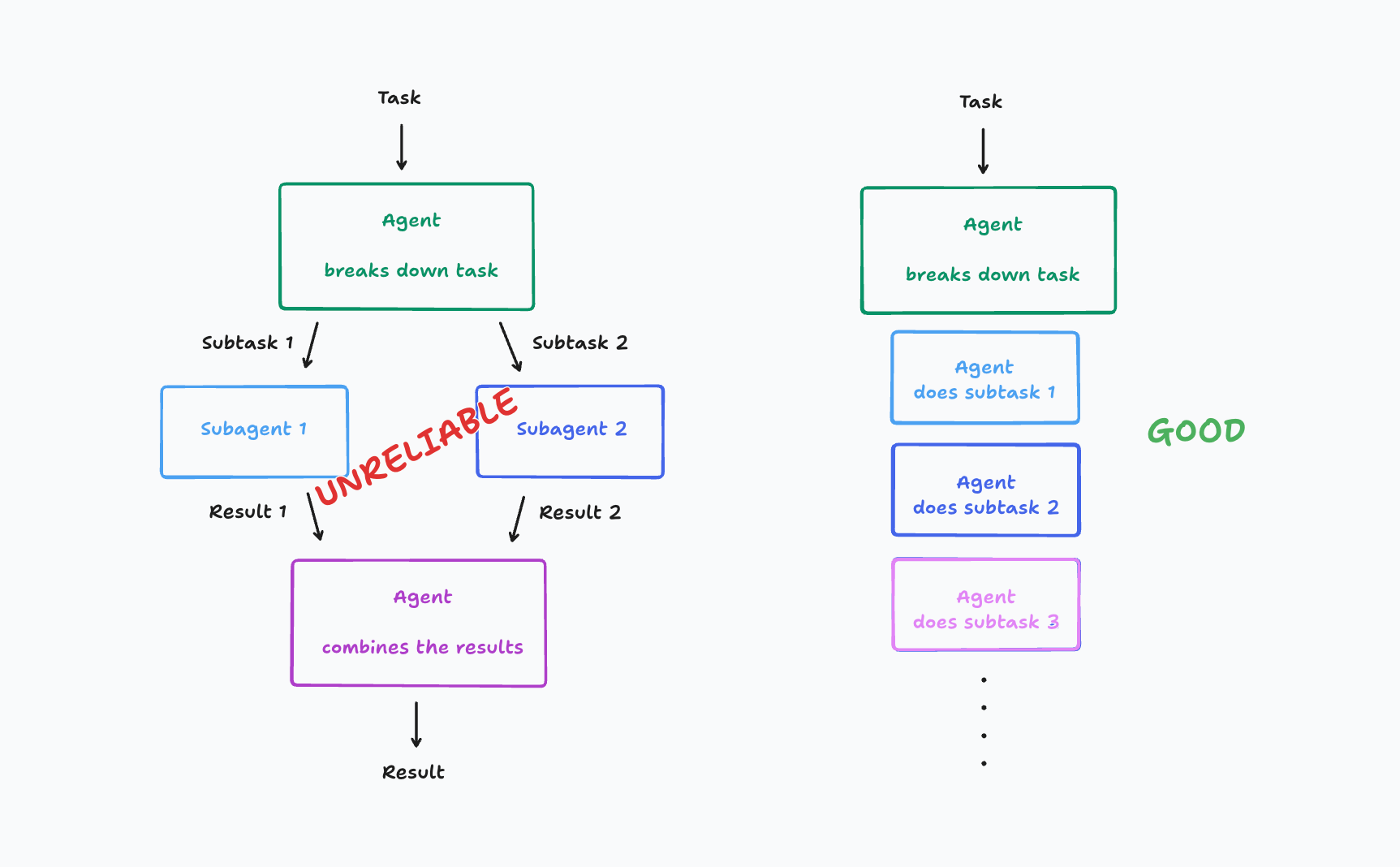
Principles for Effective LLM Agent Development: Avoiding Multi-Agent Pitfalls
The article critiques current LLM agent frameworks and proposes principles for building effective agents based on the author's practical exp
 cognition.ai·9mo ago