





















Quantum Limits of Exoplanet Detection: Current Telescopes Have Room to Improve
By
Annika Salmi

Sesame, salt, and substance. A flagship bake.
Summary
This article discusses a new scientific study published in Physical Review A that explores the fundamental quantum limits of detecting exoplanets near their host stars. Researchers from the University of Arizona mapped out the theoretical physical limits of how close-in Earth-like exoplanets can be detected, finding that current telescopes are not yet hitting these hard physical limits. The work provides a roadmap for future telescope and instrument design to find the faintest, most Earth-like worlds.
Key quotes
· 3 pulledExoplanets, planets orbiting distant stars shine mostly by reflecting starlight, with a faint thermal glow of their own, leaving them extremely dim when contrasted against their hosts.
There's a hard physical limit on spotting a planet next to its blinding star. However, it turns out today's telescopes aren't hitting it.
New work maps out exactly how close in we could still detect the faint, Earth-like worlds we want to find the most.
You might also wanna read

Astronomers Investigate Interstellar Object Speeding Through Solar System
Astronomers are racing to study an interstellar object spotted moving through the Solar System at high speed, sparking online interest and o
science.org·11mo ago
James Webb Space Telescope Captures First Direct Image of Exoplanet
The James Webb Space Telescope has captured its first direct image discovery of an exoplanet by identifying the infrared light of a likely p
smithsonianmag.com·11mo ago
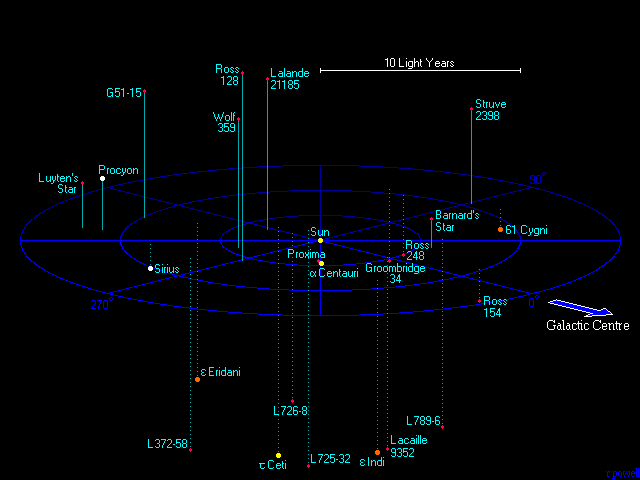
Astronomical Map of Star Systems Within 12.5 Light Years of the Sun
This article presents an astronomical map showing all star systems within 12.5 light years of our Sun, highlighting that most nearby stars a
 atlasoftheuniverse.com·9mo ago
NASA Discovers Exoplanet HD 101581 b With Conditions That Could Support Rocks
NASA researchers announced the discovery of exoplanet HD 101581 b, which has conditions that could potentially support rocks. The planet's w
 The Onion·5mo ago
Machine Learning Validates Unrecognized Transient Astronomical Phenomena in Historical Observatory Images
This research paper uses machine learning to validate the existence of previously unrecognized transient astronomical phenomena in historica
 arxiv.org·1mo ago
Candidate Giant Planet Detected in Habitable Zone of α Cen A via JWST Observations
The article reports on coronagraphic observations of the star α Cen A using the James Webb Space Telescope's MIRI instrument. A candidate gi
arxiv.org·10mo ago