





















General Physics Transformer Achieves Foundation Model Capabilities for Multiple Physical Systems
By
NeoInHacker

Toasted just enough. A reliable bake, gently seasoned.
Summary
Researchers present the General Physics Transformer (GPhyT), a physics foundation model trained on 1.8 TB of diverse simulation data that can simulate multiple physical systems without being told the underlying equations. The model demonstrates three key breakthroughs: superior performance across multiple physics domains (outperforming specialized architectures by up to 29x), zero-shot generalization to unseen systems through in-context learning, and stable long-term predictions through 50-timestep rollouts. This work establishes that a single model can learn generalizable physical principles from data alone, paving the way for a universal Physics Foundation Model that could transform computational science and engineering.
Key quotes
· 4 pulledFoundation models have revolutionized natural language processing through a "train once, deploy anywhere" paradigm
Access to a Physics Foundation Model (PFM) would be transformative -- democratizing access to high-fidelity simulations, accelerating scientific discovery, and eliminating the need for specialized solver development
Our key insight is that transformers can learn to infer governing dynamics from context, enabling a single model to simulate fluid-solid interactions, shock waves, thermal convection, and multi-phase dynamics without being told the underlying equations
GPhyT achieves three critical breakthroughs: (1) superior performance across multiple physics domains, outperforming specialized architectures by up to 29x, (2) zero-shot generalization to entirely unseen physical systems through in-context learning, and (3) stable long-term predictions through 50-timestep rollouts
You might also wanna read

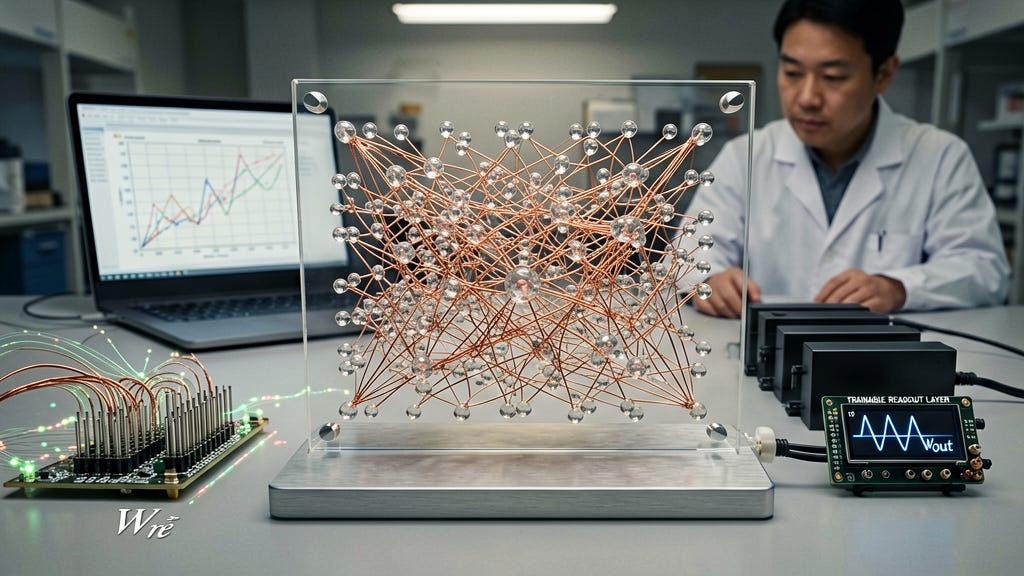
Researchers Work to Decode the "Black Box" of Reservoir Computing and Brain-Inspired AI
This article explores Reservoir Computing (RC), a specialized form of recurrent neural networks (RNNs) that mimics biological brain processe
 akmaier.substack.com·3h ago
AI-powered charging systems could extend EV battery life by up to 23%, researchers say
Researchers have developed AI-powered charging systems that could extend electric vehicle (EV) battery life by up to 23%. The technology opt
 bgr.com·9h ago
Study: 3-Year-Olds Read Intent in Human Eyes but Not in Robot Gaze
A pioneering international study in developmental psychology and AI reveals that children as young as 3 instinctively read intentions in hum
 neurosciencenews.com·11h ago
NVIDIA Launches Ising, Open Source Quantum AI Models to Advance Quantum Computing
NVIDIA announced the world's first family of open source quantum AI models, called NVIDIA Ising, designed to help researchers and enterprise
 nvidianews.nvidia.com·14h ago
AI method developed to automatically design efficient quantum circuits
Researchers led by Gorka Muñoz-Gil from the Department of Theoretical Physics, in collaboration with NVIDIA and the group of theoretical phy
 uibk.ac.at·14h ago
Scientists and engineers race to reduce AI's growing energy consumption
This article explores the massive and growing energy consumption of AI systems, particularly data centers powering large language models lik
 knowablemagazine.org·14h ago