





















Exploring Unix History Through 1980s Usenet Archives: From AT&T Bell Labs to Modern Operating Systems
By
gnyeki

Pulled from the oven just right. Trustworthy, fact-dense, deeply satisfying.
Summary
This article explores Unix's history and legacy through analysis of Usenet archives from the 1980s, covering discussions about Unix, BSD, and historical hardware. It examines Unix's origins at AT&T Bell Labs as a time-sharing system experiment, its core design principles of small combinable tools, and its evolution into modern operating systems like Linux, macOS, and Android. The piece uses historical Usenet discussions to understand Unix's early popularity and development.
Key quotes
· 5 pulledUnix has been enormously successful over the past 55 years.
It started out as a small experiment to develop a time-sharing system (i.e., a multi-user operating system) at AT&T Bell Labs.
The OS bundled many small tools that were easy to combine, as it was illustrated by a famous exchange between Donald Knuth and Douglas McIlroy in 1986.
Today, Unix lives on mostly as a spiritual predecessor to Linux, Net/Free/OpenBSD, macOS, and arguably, ChromeOS and Android.
Usenet tells us about the height of its early popularity.
You might also wanna read

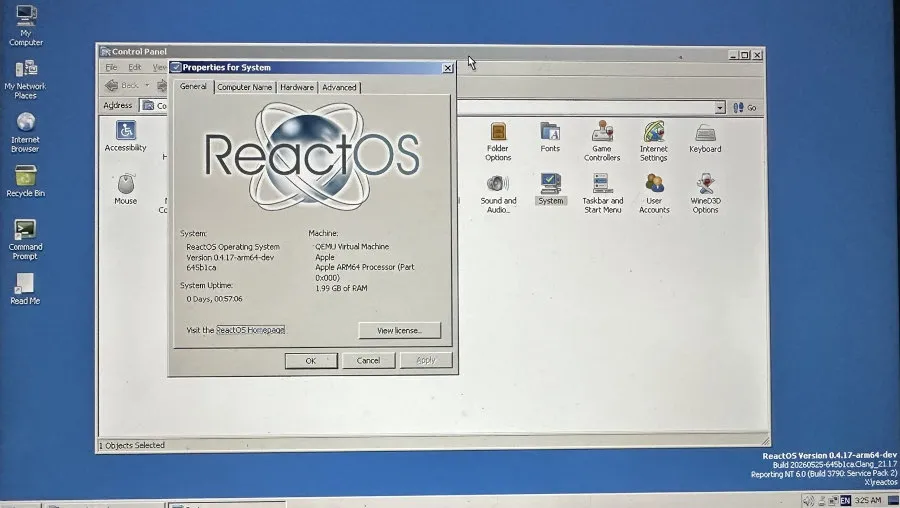
ReactOS Achieves Experimental ARM64 Support, Boots on Apple Silicon via QEMU
ReactOS, the open-source project aiming for binary compatibility with Microsoft Windows, has achieved experimental support for running on 64
 phoronix.com·4d ago
Understanding the Linux TTY Subsystem: History, Architecture, and Implementation
A comprehensive technical deep-dive into the TTY (teletype) subsystem in Linux and UNIX systems. The article traces the historical origins o
 linusakesson.net·12d ago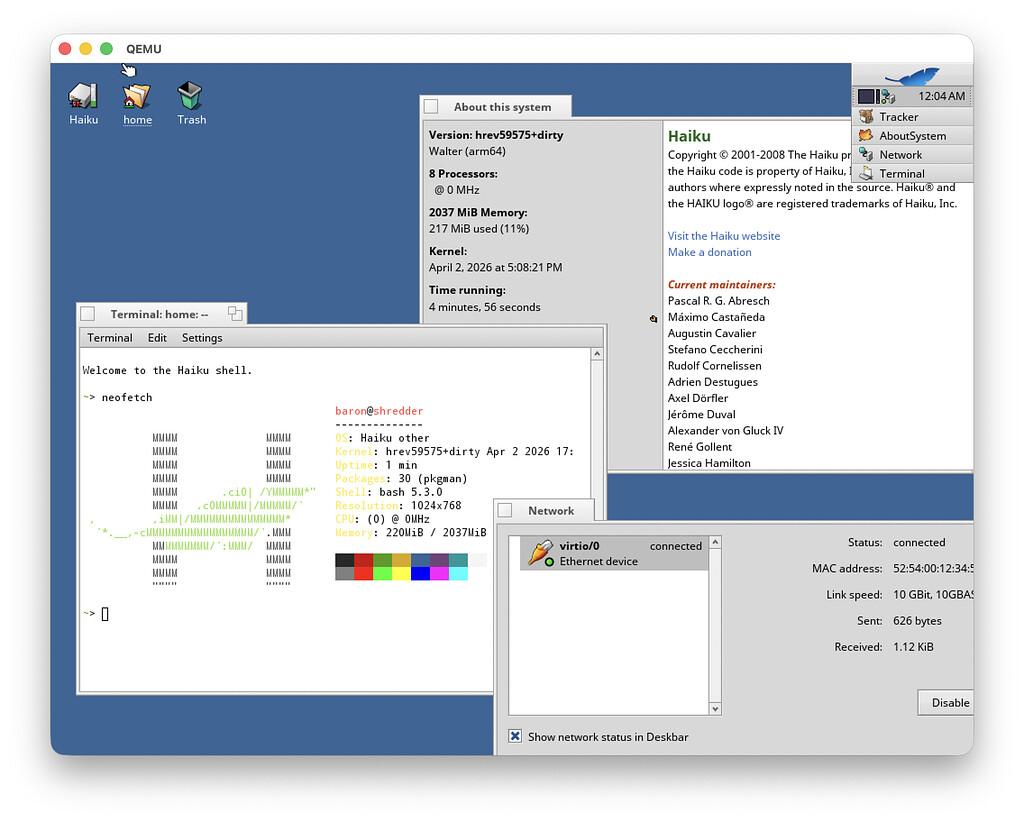
Progress on Haiku arm64 Port: Running Stably in QEMU, Targeting M1 MacBook Air
A developer is working on improving the arm64 port of Haiku, an open-source operating system, with the goal of eventually running it on an M
 discuss.haiku-os.org·13d ago
Haiku Project Releases Nightly Builds and April 2026 Activity Report
The Haiku Project provides nightly builds of its open-source operating system for testing purposes, offering bleeding-edge versions with the
 haiku-os.org·18d ago
Reefy: A Lightweight OS That Turns Any PC Into a Private AI Server
Reefy is a lightweight operating system that transforms any PC, laptop, mini PC, or GPU box into a private AI server with minimal setup. Use
 Product Hunt·24d ago
A practitioner's history of source control: From CVS to Git and thirty years of version control
A practitioner's first-hand history of source control systems from 1990 to present, covering CVS, SourceSafe, Subversion, BitKeeper, and Git
 evilgeniuslabs.ca·29d ago