





















Phishing Attack Uses IPv4-Mapped IPv6 Address to Bypass Security Controls
By
SANS Internet Storm Center
Summary
A security researcher detected a phishing email targeting a major Belgian bank. While the phishing itself is standard, the malicious link uses an IPv4-mapped IPv6 address (::ffff:5511:74be) to bypass simple security controls that extract domain names and IP addresses via regular expressions. The technique exploits URL parsers that interpret the bracket notation as a literal IPv6 address, allowing the attacker to hide the actual destination.
Source
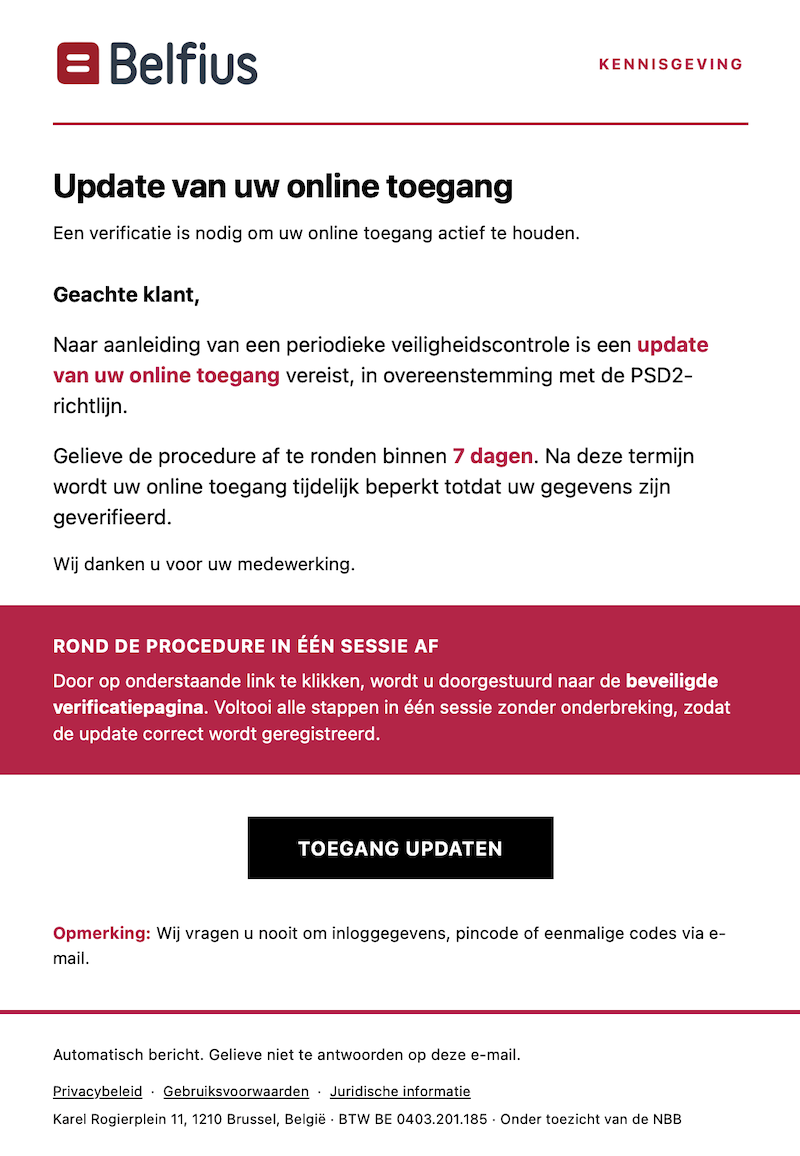
 bskyPhishing Attack Uses IPv4-Mapped IPv6 Address to Bypass Security Controlsisc.sans.edu
Key quotes
· 3 pulledThe technique used by the attacker is to bypass simple security controls trying to extract domain names and IP addresses via simple regular expressions.
The notation "[…]" tells the URL parser that what's inside is a literal IPv6 address. But it's not a real IPv6 address.
The started "::" in the address means that it can be expanded to this address: 0000:0
You might also wanna read
Beyond the Hook: A Technical Deep Dive into Modern Phishing Methodologies


Efficient IP Address Parsing: Fast Methods Without SIMD or Portability Issues
The article discusses efficient methods for parsing IP addresses, focusing on achieving high performance without relying on specialized SIMD
 lemire.me·5mo ago
Spoofing OpenPGP.js signature verification

Tool That Makes URLs Appear Malicious Through Redirection
This article describes a web tool that transforms any URL to make it appear malicious or 'phishy' through redirection, similar to how URL sh
phishyurl.com·9mo ago
How to Bypass Imgur's UK Geo-Block with a Network-Wide Proxy Solution
The article describes how the author responded to Imgur's geo-blocking of UK users by implementing a network-wide proxy solution rather than
 blog.tymscar.com·6mo ago
The Security Risks of 6-Digit Code Logins
The article criticizes the widespread use of 6-digit code logins as a replacement for passwords, highlighting their security vulnerabilities
blog.danielh.cc·10mo ago