





















DeepSeek's mHC Architecture: Transforming Transformer Design with Multiple Residual Streams
By
taykolasinski

If you only eat one bagel today, this is the bagel.
Summary
The article discusses DeepSeek's novel mHC (multi-head connection) architecture that fundamentally changes transformer design by introducing multiple parallel residual streams instead of the traditional single-stream residual connections used since 2016. The author explains how standard transformers use x + F(x) residual connections where information flows through one stream, while DeepSeek's approach creates multiple parallel streams that can process different aspects of information simultaneously. The article explores the technical implications, potential benefits for model performance and training stability, and how this architectural innovation could represent a significant advancement in transformer design beyond the current industry standard used by major AI models like GPT-5, Claude, Llama, and Gemini.
Key quotes
· 4 pulledEvery transformer you've ever used has the same residual connection design from 2016. GPT-5, Claude, Llama, Gemini. Under the hood, they all do the same thing: x + F(x). One stream of information flowing through the network, with each layer adding to it.
DeepSeek asked: what if it was wider? Standard residual connections are the backbone of every modern transformer. The idea is simple: x_{l+1} = x_l + F(x_l). The input flows through unchanged, plus the layer's output. One stream of information.
What goes in comes out, plus a learned update. DeepSeek's mHC architecture fundamentally changes this paradigm by introducing multiple parallel residual streams instead of the traditional single-stream approach.
This innovation could represent the first major architectural advancement in transformer design since the original residual connection concept was introduced, potentially offering improvements in model performance, training stability, and information processing capabilities.
You might also wanna read

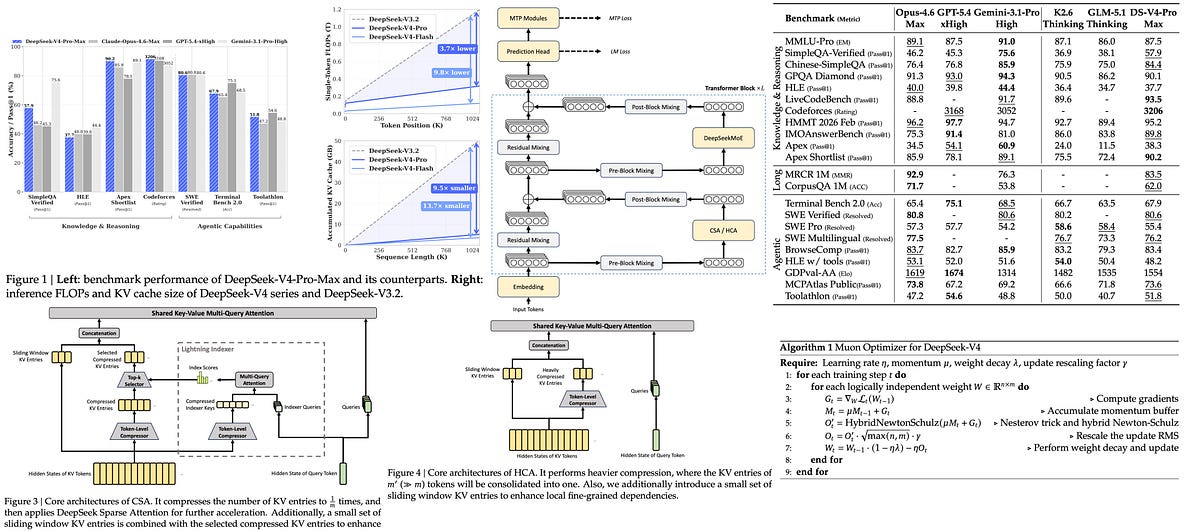
DeepSeek-V4: Hybrid Sparse-Attention Architecture Enables Efficient Million-Token Context Inference
DeepSeek-V4 introduces a hybrid sparse-attention architecture combined with on-policy distillation across domain specialists, enabling 1M-to
 artgor.medium.com·6h ago
DeepSeek-V3.1: Open-Source Language Model with Hybrid Inference for Advanced Reasoning and Coding
DeepSeek-V3.1 is an open-source large language model that introduces hybrid inference with both 'Think' and 'Non-Think' modes, optimized for
 Product Hunt·9mo ago