





















Carnegie Mellon researchers develop lens that focuses on multiple distances simultaneously
By
gnabgib

Sesame, salt, and substance. A flagship bake.
Summary
Researchers at Carnegie Mellon University have developed a groundbreaking new lens technology that can bring an entire scene into sharp focus at once, regardless of varying distances. This spatially selective focusing capability solves a century-old challenge in photography and could transform cameras, microscopy, and smartphone imaging by eliminating the need to choose which part of a scene to focus on.
Key quotes
· 3 pulledImagine snapping a photo where every detail, near and far, is perfectly sharp—from the flower petal right in front of you to the distant trees on the horizon.
For over a century, camera designers have dreamed of achieving that level of clarity.
In a breakthrough that could transform photography, microscopy, and even smartphone cameras, researchers at Carnegie Mellon University have developed a new kind of lens that can bring an entire scene into sharp focus at once—no matter how far away or close different parts of the scene are.
You might also wanna read


Study Finds Most AI Chatbots Prioritize Ad Revenue Over User Welfare in Conflict-of-Interest Scenarios
This research paper analyzes how large language models (LLMs) handle conflicts of interest when company revenue incentives (advertisements)
 arxiv.org·48m ago
German study finds POLO back-junction solar cells more cost-effective than PERC technology in Europe
A German research team from the German Aerospace Center (DLR) conducted a techno-economic analysis of POLO back-junction (BJ) solar cells in
 pv-magazine.com·58m ago
AI-powered whale detection system deployed in San Francisco Bay to prevent ship collisions
A new AI-powered whale detection system is being deployed in San Francisco Bay to prevent ship collisions with whales. The system uses under
 apnews.com·59m ago
Gabe Newell funds $815 million deep-sea research vessel to explore uncharted ocean depths
Gabe Newell, billionaire co-founder of Valve and Steam, is funding the construction of the RV11000, a massive $815 million deep-sea research
 luxurylaunches.com·1h ago
AI-Powered WildObs Platform Accelerates Australian Wildlife Conservation Data Analysis
Researchers at The University of Queensland, in partnership with ARDC, QCIF Digital Research, and TERN, have developed the Wildlife Observat
 ardc.edu.au·1h ago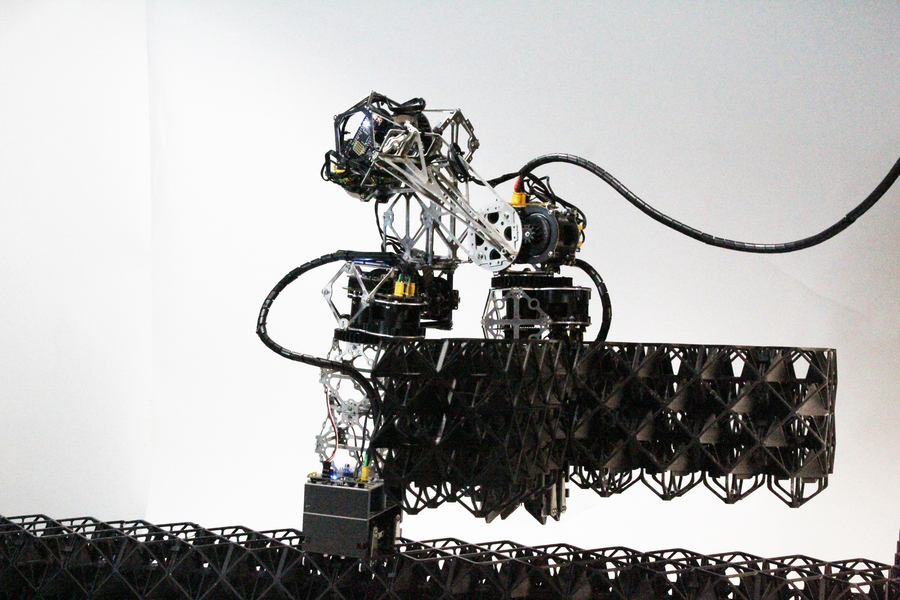
MIT researchers develop robotically assembled voxel building blocks for more sustainable construction
MIT researchers have developed robotically assembled building blocks called voxels that could make construction more efficient and sustainab
 robohub.org·2h ago