





















NSF VLA Reveals Supermassive Black Holes Emit Radio "Burps" Years After Destroying Stars

A respectable bake. You'd come back tomorrow for another.
Summary
Astronomers using the NSF Very Large Array have discovered that supermassive black holes continue to emit radio waves years after tearing apart a star in a tidal disruption event (TDE). These delayed "burps" of material slam into surrounding gas and glow in radio waves, providing new insights into how black holes grow and release energy into their galaxies. The research shows that the aftermath of these stellar destruction events is far more prolonged and complex than previously understood.
Key quotes
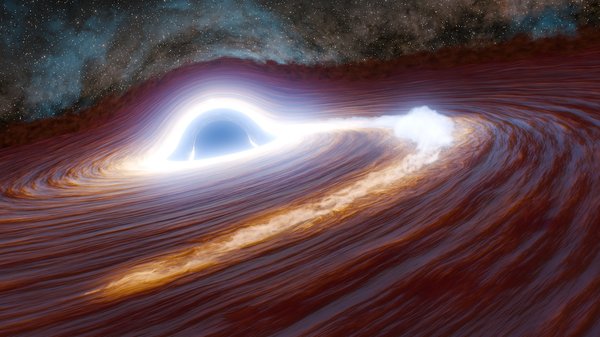
· 3 pulledAstronomers using the U.S. National Science Foundation Very Large Array (NSF VLA) have found that when a supermassive black hole tears apart an unlucky star, the fireworks are not over when the first flash fades.
Years after the initial outburst, many of these black holes 'burp' out streams of material that slam into surrounding gas and glow in radio waves.
Giving the NSF VLA a front‑row seat to how black holes grow and blast energy back into their galaxies.
You might also wanna read

Astronomers Discover Most Distant and Powerful Black Hole Flare from Star Destruction
Astronomers have discovered the most powerful and distant flare of energy ever recorded from a supermassive black hole, likely caused by a m
 caltech.edu·7mo ago
First Image Captured of Two Black Holes Orbiting Each Other in Distant Quasar
Scientists have captured the first confirmed image of two black holes orbiting each other in quasar OJ287, located five billion light-years
 helsinkitimes.fi·8mo ago
Study Reveals Starlink Satellite Emissions Disrupt SKA-Low Frequency Radio Astronomy
The article discusses the unintended impact of Starlink satellite broadband emissions on radio astronomy, particularly in the SKA-Low freque
 astrobites.org·10mo ago
Astronomers detect unusual repeating gamma-ray burst of unknown origin outside our galaxy
Astronomers have detected a mysterious gamma-ray explosion that repeated several times over the course of a day, an event unlike any previou
 eso.org·9mo ago
Astronomers Discover Massive Black Hole Merger Defying Expectations
Astronomers detect the most colossal black hole merger known to date, producing a gigantic black hole about 225 times the mass of the Sun.
gizmodo.com·11mo ago
Einstein Probe Detects X-ray Flare from Nearby Star 150 Light Years Away
Astronomers using the Einstein Probe (EP) have detected a new X-ray transient event identified as an X-ray flare from the star PM J23221-030
 phys.org·5mo ago