





















Building TREX: An execution layer for AI-powered code review that catches runtime bugs
By
Shlok Mehrotra

Hot, fresh, and worth queueing round the block for.
Summary
Shlok, a software engineer at Greptile, describes building TREX — an execution layer for AI code review that goes beyond static analysis by actually running the code and generating multi-modal artifacts. The article traces the evolution of code review from Michael Fagan's 1976 formal code inspection paper to modern AI-assisted review, arguing that most current AI tools still only read code and miss bugs that only manifest at runtime. TREX addresses this gap by executing code during review, catching runtime errors that static analysis would miss.
Key quotes
· 3 pulledIn 1976, Michael Fagan published a paper introducing formal code inspection at IBM. Developers would print out listings, sit in a room together, and read through the code line by line.
AI tools have made that faster, though most of them are still just reading the code. This approach works for a lot of bugs, the ones that announce themselves plainly in code.
The problem is there's
You might also wanna read

AI-Powered Code Review: A Framework for Agentic Workflows in Software Development
This paper examines the evolution of code review practices and proposes a vision for AI-powered, agentic code review workflows. It argues th
 arxiv.org·9d ago
AI's Impact on Software Engineering: Evolution or Replacement?
The article explores the complex relationship between AI tools like ChatGPT and software engineering, examining whether AI represents the en
 The Verge·9mo ago
AI-Assisted Development Demands a Rethink of Testing Strategy, Not Just Test Automation
The article explores the strategic decision teams face after merging AI-assisted code: whether to add traditional browser tests, use AI tool
 dev.to·12d ago
Haystack: AI-Powered Code Review Platform That Turns Pull Requests into Clear Narratives
Haystack is an AI-native code review platform that transforms pull request reviews from confusing jigsaw puzzles into clear narrative storie
 Product Hunt·1mo ago
Dual-Layer Testing Framework for AI-Infused Applications: Combining Deterministic and Probabilistic Quality Assurance
AI-infused applications that embed large language models, agents, RAG, and tool-calling workflows combine deterministic code with probabilis
 dzone.com·9d ago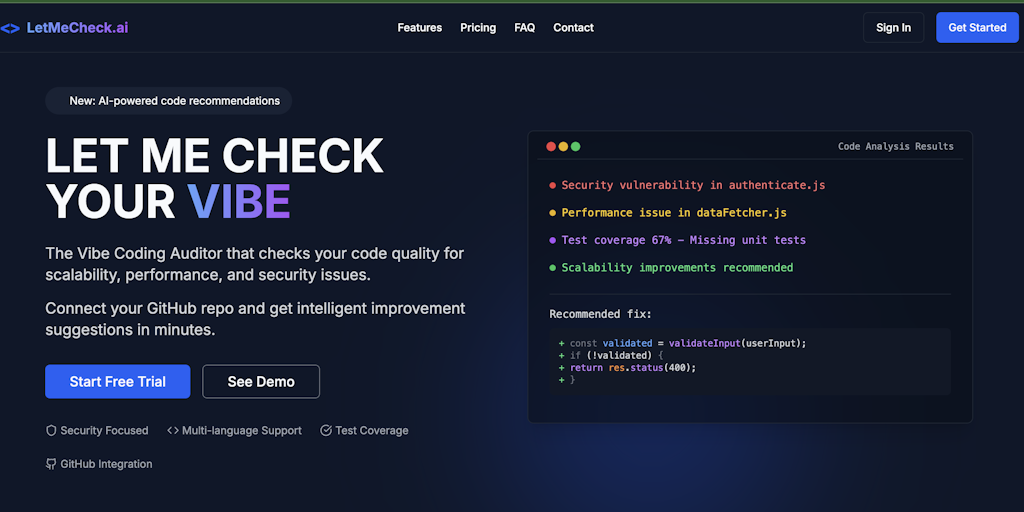
LetMeCheck.ai: Code Quality Analysis Tool for Technical Leaders
LetMeCheck.ai is a code analysis tool that provides code quality insights for founders, CTOs, and tech leads to assess their codebase health
Product Hunt·1y ago