





















The Science of Why the Sky Appears Blue: Rayleigh Scattering Explained
By
udit99

A five-star bake. Worth schmearing, sharing, saving.
Summary
This article explores the scientific explanation for why the sky appears blue, examining the physics of light scattering in Earth's atmosphere. It discusses how sunlight interacts with atmospheric molecules, particularly through Rayleigh scattering, which causes shorter blue wavelengths to scatter more than longer red wavelengths. The article explains that the sky's blue color results from this selective scattering, and addresses related questions about why the sky isn't violet (due to human eye sensitivity) and why sunsets appear red (as light travels through more atmosphere).
Key quotes
· 5 pulledThe color of anything is due to the wavelength of photons coming from that thing and hitting your eye.
The sky appears blue because of Rayleigh scattering - shorter blue wavelengths scatter more than longer red wavelengths when sunlight interacts with atmospheric molecules.
Sunlight appears white, but it's actually composed of all the colors of the rainbow, each with different wavelengths.
The sky isn't violet because our eyes are less sensitive to violet light and because some violet light gets absorbed by the atmosphere.
During sunsets, light travels through more atmosphere, scattering away more blue light and leaving the red and orange wavelengths to reach our eyes.
You might also wanna read


A visual introduction to differential geometry and Maxwell's equations through pictures
This article presents a pictorial introduction to differential geometry, aimed at making the mathematical foundation accessible to pre-unive
 arxiv.org·22h ago
Physicists Discover New Complex Phases of Ice, Simulations Suggest Thousands More Exist
Scientists have discovered over 20 phases of ice since 1900, many formed under extreme conditions, including hot ice and electrically conduc
 quantamagazine.org·1mo ago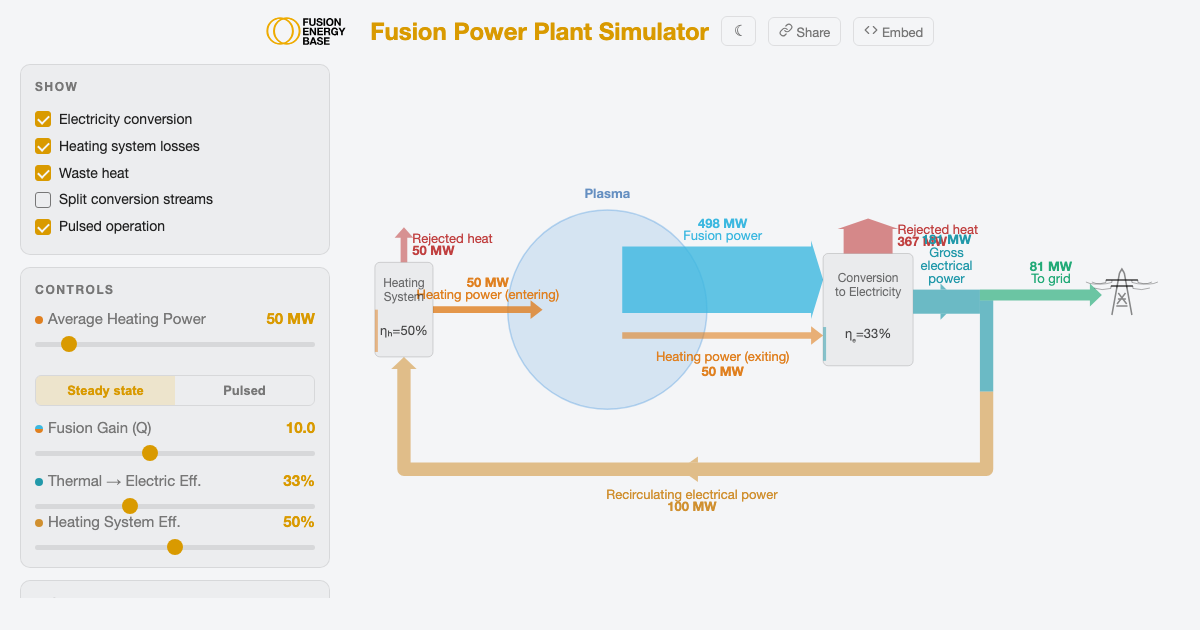
Interactive Fusion Power Plant Simulator: Exploring Energy Conversion Parameters
This is an interactive educational tool that simulates a fusion power plant, allowing users to adjust key parameters like heating energy, pu

Exploring Fluid Mechanics Concepts Through Real-Time Thinking and Problem-Solving
The article presents a personal exploration of fluid mechanics concepts, written as a real-time thinking trace over several hours. The autho
 tsvibt.blogspot.com·3mo ago
Decoherence: A Potential Bridge Between Quantum Mechanics and Classical Reality
The article explores the ongoing philosophical and interpretational challenges in quantum mechanics, focusing on how the phenomenon of decoh
quantamagazine.org·3mo ago
Caltech Launches Online Edition of The Feynman Lectures on Physics
Caltech's Division of Physics, Mathematics and Astronomy and The Feynman Lectures Website present an online edition of the classic physics t