





















The Diminishing Returns of Reason in Modern Discourse
By
enbywithunix

A second-rack bagel that's nearly first-rack. Tasty stuff.
Summary
The article explores the decline of reason and rationality in modern discourse, particularly since around 2016. The author observes that intelligent, reasonable people have increasingly embraced irrational thinking, conspiracy theories, and tribal politics. Friends who were once capable of nuanced thinking now treat political disagreements as moral corruption, see news as manufactured consent, and use political labels as personality disorders. The piece examines why being reasonable seems to have diminishing returns in a world that rewards emotional intensity, tribal loyalty, and performative outrage over careful analysis and evidence-based thinking.
Key quotes
· 5 pulledSomewhere around 2016, the smartest people I knew started saying increasingly stupid things.
These were folks who could parse dense academic papers, who understood reason, who were entirely capable of holding two competing ideas in their heads without their brains short-circuiting.
Another started treating political disagreement as evidence of moral corruption.
A third began using the word 'liberal' as if it was a personality disorder rather than loose coalitions of sometimes contradictory beliefs.
Is There Still a Return on Being Reasonable?
You might also wanna read

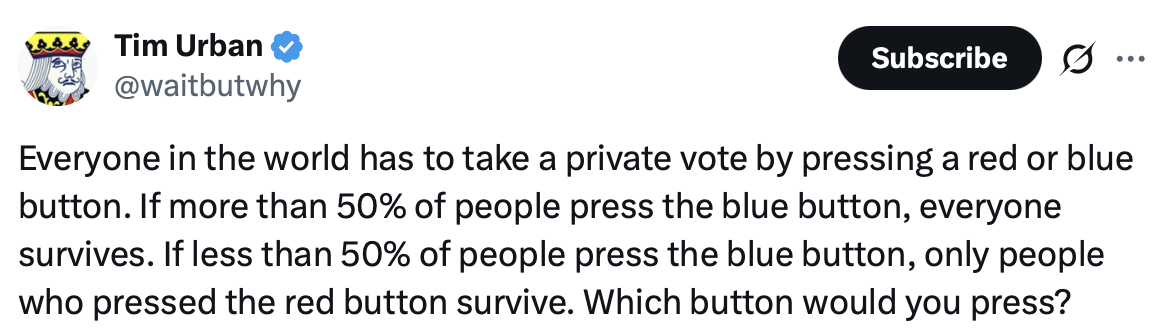
Why encouraging others to press the blue button in a survival dilemma may be immoral
The article discusses a moral dilemma (likely inspired by a viral thought experiment on X) where participants choose between pressing a blue

Cory Doctorow's Perspective on the Complex US Immigration System
Cory Doctorow reflects on the US immigration system based on his personal experience of going through the process over 25 years, culminating
 pluralistic.net·3mo ago
Weight-Loss Drugs Like Ozempic Shift Societal Attitudes on Body Image and Weight Loss
The article discusses how weight-loss drugs like Ozempic are changing societal attitudes toward body image and weight loss. It presents a ca
 wsj.com·4mo ago
The Commodification of Trauma: How Emotional Pain Became Marketable
The article examines how trauma and emotional pain have become commodified in modern society, using examples like Dr. Gabor Maté's public di
 theguardian.com·5mo ago
UBI Advocates Must Challenge the Myth That Human Worth Depends on Work
The article examines the historical and contemporary debate around Universal Basic Income (UBI), tracing its origins to Thomas Paine's 1797
 thereader.mitpress.mit.edu·6mo ago
Chicago Woman Attempts to Frame Cleaner's Deportation as "Relocation" in Social Conversation
A Chicago woman struggles to explain her cleaner's deportation in nonpolitical terms during a polite conversation with neighbors. Sarah Walk
 The Onion·6mo ago