





















Neural Cellular Automata: Operating on Mesh Lattices and Triangle Primitives
By
Ehsan Pajouheshgar1,

Recycled flavour. You've tasted this bagel before.
Summary
This article discusses Neural Cellular Automata (NCA), a computational model that operates on a coarse lattice of cells, using mesh vertices as an example. It explains how sampling points inside triangle primitives correspond to NCA cells, with local coordinates expressing positions within the primitive. The content appears to be a technical excerpt from a larger piece about applying cellular automata concepts to pixel/image processing.
Key quotes
· 3 pulledThe NCA operates on a coarse lattice of cells (in this example vertices of a mesh).
A sampling point (red dot) inside a triangle primitive, whose vertices correspond to NCA cells.
The local coordinate u(Point) expresses the point's position inside the primitive.
You might also wanna read

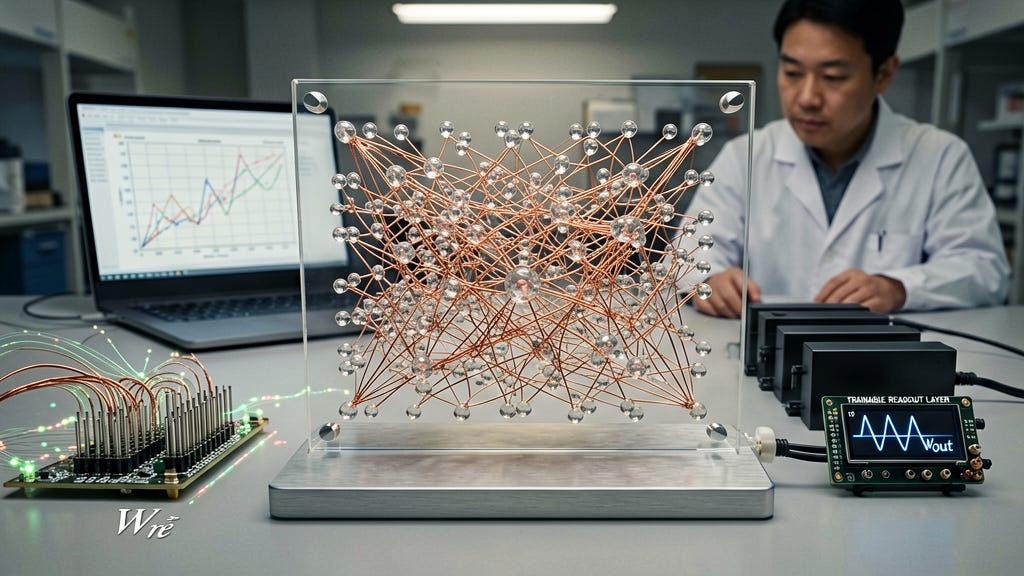
Researchers Work to Decode the "Black Box" of Reservoir Computing and Brain-Inspired AI
This article explores Reservoir Computing (RC), a specialized form of recurrent neural networks (RNNs) that mimics biological brain processe
 akmaier.substack.com·16d ago
Theoretical Analysis Reveals Why Linear RNNs Are More Parallelizable Than Nonlinear RNNs
This paper establishes a theoretical connection between types of RNNs and standard complexity classes to explain why linear RNNs (LRNNs) are
 arxiv.org·13d ago
New preprint:

Schema theory revisited: A spectrum of abstraction in AI and neuroscience
This article examines schema theory—a foundational concept in psychology, cognitive science, and neuroscience—and its relevance to both biol

New 1D Lattice Framework Enables Near-Optimal Quantum Simulation of Nonunitary Dynamics
Researchers have developed a new framework that converts nonunitary dynamics into unitary dynamics suitable for quantum computers, using a "
 quantumzeitgeist.com·11d ago