





















How to get a free *.city.state.us locality domain in the US
By
speckx

A baker's-dozen of insight crammed into one ring.
Summary
This article explains how US residents can obtain a free locality domain name (e.g., somename.city.state.us) for their town. It covers the history of locality domains dating back to 1992, the process of registering one by obtaining nameservers from Amazon Lightsail, submitting the Interim .US Domain Template to the locality's delegated manager, and configuring DNS entries. The article provides a step-by-step technical guide for setting up these geographic domain names.
Key quotes
· 3 pulledA locality domain is a domain name that's associated with a location in the United States, such as frederick.seattle.wa.us (which currently redirects to fredchan.org).
Locality domains were first created in 1992, and the infrastructure has been maintained under government contract.
If your town has its own domain, you can get nameservers from Amazon Lightsail, send the Interim .US Domain Template to the delegated manager for your locality to register one, then point DNS entries at your webhost.
You might also wanna read

BGP Lab Project Expanded to Include Full IPv6 Feed
The author extends their BGP lab project to support full IPv6 feeds, following requests from readers who previously received IPv4 BGP feeds.
lukasz.bromirski.net·2d ago
Whosthere: A Go-based LAN discovery tool with interactive TUI for unprivileged network scanning
Whosthere is a Go-based Local Area Network (LAN) discovery tool with an interactive Terminal User Interface (TUI). It performs unprivileged,
 Product Hunt·10d ago
Investigating Intermittent ECONNRESET Errors in Local TCP Connections (Part 1)
A technical blog post investigating mysterious ECONNRESET errors occurring between two services communicating over TCP on the same machine.
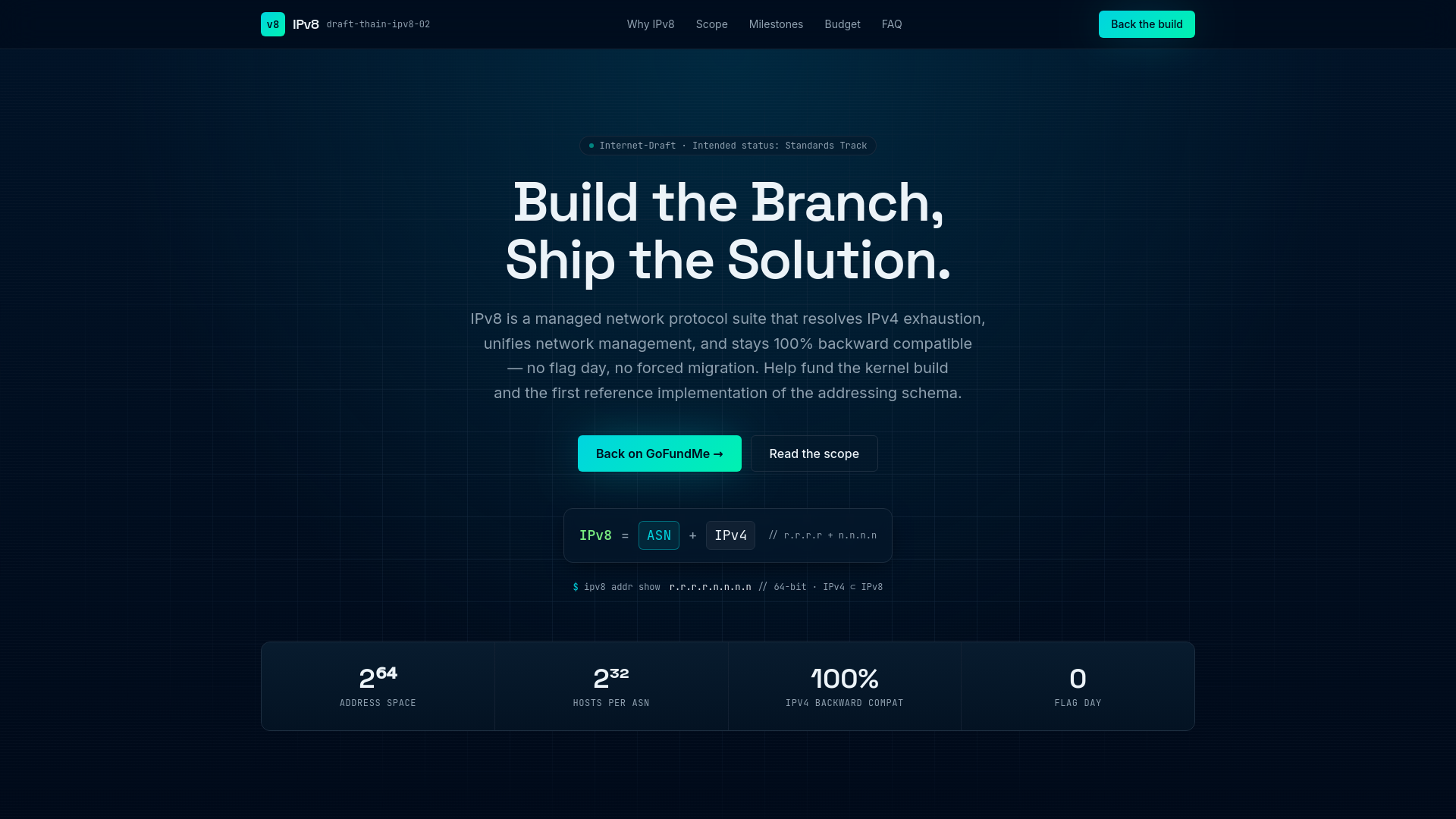
IPv8: An Alternative IPv4 Successor with Backward Compatibility and Integrated Network Management
This article introduces IPv8, an alternative successor to IPv4 that differs from IPv6 by focusing on integrated network management and singl
Cloudflare fixes CUBIC congestion control bug in QUIC implementation that permanently pinned performance at minimum
Cloudflare engineers discovered and fixed a bug in the CUBIC congestion control algorithm (RFC 9438) used in their QUIC implementation (quic
 blog.cloudflare.com·19d ago
PlanB-LPM: Portable C++ Implementation of IPv6 Longest-Prefix-Match Algorithm with AVX-512 SIMD
This article describes an independent reimplementation of the PlanB algorithm for IPv6 longest-prefix-match (LPM) routing. The implementatio
 github.com·1mo ago