





















Self-Improving Software: How AI Agents Can Create Continuous Improvement Cycles
By
normalocity

Toasted just enough. A reliable bake, gently seasoned.
Summary
The article discusses the concept of self-improving software in the context of AI-driven development. It highlights the problem of "documentation debt" where documentation lags behind code changes, creating challenges for both human developers and AI agents. The author proposes that as AI becomes more agentic, software can enter a cycle of self-improvement where AI agents can analyze code, update documentation, and even suggest improvements, creating a continuous improvement loop that reduces technical debt and enhances software quality.
Key quotes
· 5 pulledIn the traditional software development lifecycle, there is often a widening gap between the code we write and the documentation that describes it.
This 'documentation debt' becomes a significant hurdle for both human developers and the AI agents we collaborate with.
However, as AI becomes more agentic, we are entering a new era where software can, in a very real sense, become self-improving.
The cycle of improvement begins with AI agents that can read, understand, and analyze our codebases.
This creates a virtuous cycle where software quality improves over time, with less manual intervention required from human developers.
You might also wanna read


Building a Software Factory with Claude Code: From AI-Assisted Coding to Agentic Development
This article provides a comprehensive guide on building a software factory using Claude Code and other AI coding tools. It covers the evolut
 freecodecamp.org·4d ago
AI's Impact on Software Engineering: Evolution or Replacement?
The article explores the complex relationship between AI tools like ChatGPT and software engineering, examining whether AI represents the en
 The Verge·9mo ago
Agentic Technical Debt and the Stochastic Tax: Governance Challenges in AI Agent Systems
This article introduces the concept of "Agentic Technical Debt" in AI systems that act as production infrastructure—reasoning over multiple
 arxiv.org·2d ago
The Intensifying Competition in AI-Powered Coding Tools and Software Development
The article discusses the intensifying competition in AI-powered coding tools, focusing on how major tech companies like OpenAI, Google, and
The Verge·1mo ago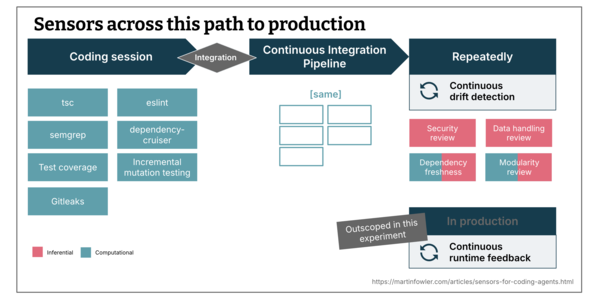
Using ESLint and static analysis as maintainability sensors for AI coding agents
A practical walkthrough of using computational sensors like ESLint and static analysis tools to monitor and improve codebase maintainability

AI Integration in Software Development: How Claude Code and Agentic Workflows Are Transforming the Terminal into a Conversational Interface
The article discusses how AI is transforming software development by integrating large language models (LLMs) into development workflows, pa
 Prototypr·4mo ago